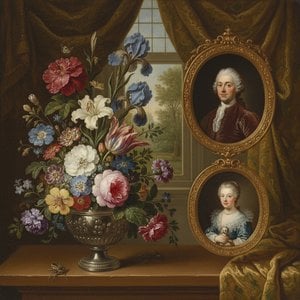
1695 - 1743

Pähkinänkuoressa

  • Typical colors:
    • espresso
    • gray
  • Born: 1695, Prague, Czech Republic
  • Museums on this site:
    • National Gallery Prague
    • Bavarian State Painting Collections
    • Regional Gallery in Liberec
  • Art period: Early Modern
  • Color intensity: monochromatic
  • Nationality: Czech Republic
  • Died: 1743

The Quiet Presence of Jan Kašpar Hirschely

Born in Praha, Jan Kašpar Hirschely lived a life that left behind a specific, focused mark on the art of the early eighteenth century. His existence, spanning from 1695 to 1743, was rooted in the Czech lands, moving through the streets of Praha until his death in the same city. He worked during a period when the weight of mortality was a frequent subject for those who held a brush, and his own hand found its way to the small, intimate surface of copper.

His work often dealt with the heavy themes of existence. In 1727, he produced The scene with death´s head, Vanitas, a piece that uses the stillness of objects to speak of what remains when life departs. This work, currently held in the Regional Gallery in Liberec, is painted in oil on copper, a choice of material that demands a certain precision and a steady hand.

Technique and Symbolism

When looking closely at his compositions, one sees a deliberate arrangement of shapes. He did not rely on chaotic movement, but rather on a careful balance of the organic and the static. In his 1727 work, the soft, curving lines of flowers and trees meet the hard, unmoving presence of a skull and a vase. This intersection of the living and the inanimate creates a tension that requires little explanation.

The physical scale of his output suggests a private, contemplative experience. His paintings are small, measuring approximately 22,8 x 17,3 CM. Such dimensions invite a viewer to lean in, to observe the fine details of the overlapping lines and the way light settles on a surface. It is a way of working that favors the quiet observation of detail over the grand scale of public spectacle.

Pikainen tietovisa

Jokaisessa kysymyksessä on vain yksi oikea vastaus.

Kysymys 1:
What was Jan Kašpar Hirschely's nationality?
Kysymys 2:
In which city was Jan Kašpar Hirschely born?
Kysymys 3:
In what year was the artwork 'The scene with death´s head, Vanitas' created?
Kysymys 4:
What medium was used for the painting 'The scene with death´s head, Vanitas'?
Kysymys 5:
Where is the collection of 'The scene with death´s head, Vanitas' located?

Kysymykset ja vastaukset

Voinko tutkia Jan Kašpar Hirschely teoksia värispektrin mukaan?

Jan Kašpar Hirschely-taiteilijan Värispektri järjestää teokset niiden värin mukaan.

Missä ja minä vuonna Jan Kašpar Hirschely on syntynyt?

Jan Kašpar Hirschely syntyi Praguessä vuonna 1695.

Mistä voin nähdä Jan Kašpar Hirschely teosten väriprofiilin?

Jan Kašpar Hirschely-taiteilijan Paletin sielunmaisema esittelee taiteilijan tuotannon väriprofiilin.

Voinko vierailla Jan Kašpar Hirschely teosten virtuaalisessa museossa?

Jan Kašpar Hirschely-taiteilijan 3D-galleria esittelee taiteilijan teoksia virtuaalisessa kolmiulotteisessa galleriassa.

Mihin historialliseen aikakauteen Jan Kašpar Hirschely kuului?

Jan Kašpar Hirschely työskenteli Early Modern -aikakaudella. Aikakausi sijoittaa taiteilijan toiminnan historialliseen kontekstiin.

Voinko tutkia Jan Kašpar Hirschely teoksia aiheen mukaan?

Jan Kašpar Hirschely:n teoksia voi tutkia aiheen mukaan artistin Aiheatlas -sivulla.

Millä muilla nimillä Jan Kašpar Hirschely tunnetaan?

Jan Kašpar Hirschely tunnetaan myös nimillä Caspar Hirschely, Johann Kaspar Hirscheli, Caspar Hirscheli, J. C. Hirschely, Gaspar Hirscheli.

Kuinka monta Jan Kašpar Hirschely teosta on katseltavissa?

Voit selata taiteilijan Jan Kašpar Hirschely 16 teosta teosta sivulla Kaikki teokset.

Voinko selata Jan Kašpar Hirschely teoksia tyylisuuntien mukaan?

Jan Kašpar Hirschelyn edustamat taidesuuntaukset löytyvät artistin Kaikki taidesuuntaukset -sivulta, jossa teokset on ryhmitelty tyylisuuntien mukaan.