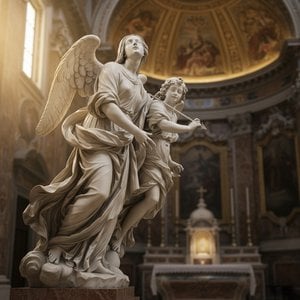
A Roman Genius: The Life and Legacy of Gian Lorenzo Bernini
Gian Lorenzo Bernini’s name is inextricably linked to the heart of Rome, a city he profoundly shaped through his extraordinary talent as a sculptor, architect, and artist. Born in Naples in 1598, he arrived in the Eternal City as a young boy, inheriting not only his father Pietro’s sculpting skills but also a deep reverence for the classical heritage that permeated Roman life. From these early influences blossomed an artistic vision unlike any seen before – one characterized by intense emotion, dramatic movement, and a masterful command of marble that would forever redefine Baroque art. Bernini wasn't merely a craftsman; he was a true *uomo universale*, a Renaissance man who seamlessly blended disciplines to create experiences that captivated the senses and stirred the soul.Sculpting Emotion: The Birth of Baroque Drama
Bernini’s genius lay in his ability to imbue stone with life, transforming inert marble into expressions of profound psychological depth. He rejected the static beauty favored by the Renaissance, embracing instead a dynamic, theatrical style that became the hallmark of the Baroque period. His sculptures weren't simply representations of figures; they were moments captured in time – frozen expressions of intense emotion, dramatic narratives, and spiritual ecstasy. Consider *The Ecstasy of Saint Teresa*, housed within the Cornaro Chapel. The swirling composition, with its luminous marble clouds and the saint’s rapturous expression, is a testament to Bernini's skill in conveying not just physical form but also the very essence of a mystical experience. Similarly, *Apollo and Daphne* captures the fleeting moment before Daphne transforms into a laurel tree, showcasing Bernini’s mastery of texture – the flowing hair, the delicate skin, the rustling leaves – all rendered with breathtaking realism. This wasn't simply sculpting; it was breathing life into stone, inviting viewers to become participants in the drama unfolding before their eyes.Beyond Sculpture: Architecture and Urban Visions
Bernini’s artistic ambition extended far beyond the confines of sculpture. He possessed a remarkable versatility as an architect and urban planner, fundamentally reshaping the cityscape of Rome. His designs weren't conceived in isolation but were always integrated with his sculptural work, creating unified artistic experiences that blurred the boundaries between disciplines. The monumental Baldacchino above the high altar of St. Peter’s Basilica stands as the most striking example of this holistic approach – a soaring bronze canopy that dominates the space and draws the eye upwards in awe. Bernini also played a pivotal role in redesigning several Roman piazzas, transforming them into vibrant public spaces filled with fountains, statues, and architectural grandeur. The *Fountain of the Four Rivers* in Piazza Navona is particularly noteworthy, its allegorical figures representing major rivers from different continents – a testament to Bernini’s ability to create dynamic and engaging urban environments that celebrated both Roman power and global connection.A Lasting Influence: Bernini’s Historical Significance
Gian Lorenzo Bernini's impact on Western art is immeasurable. His innovative approach to sculpture established the Baroque style as a dominant force in European art for over a century, influencing generations of artists with his dramatic compositions and technical virtuosity. He wasn’t merely an imitator of classical forms; he synthesized them with a new sense of dynamism and emotional intensity, creating something entirely original. His integration of sculpture, architecture, and painting into unified artistic experiences set a new standard for artistic expression, demonstrating the power of art to engage all the senses and evoke profound emotions. As Howard Hibbard eloquently noted, “What Shakespeare is to drama, Bernini may be to sculpture: the first pan-European sculptor whose name is instantaneously identifiable with a particular manner and vision, and whose influence was inordinately powerful.” His works continue to inspire awe and admiration, solidifying his place as one of history’s most important artists – a true *uomo universale* whose legacy continues to resonate today.Family & Further Achievements
- Pietro Bernini: Gian Lorenzo’s father, a sculptor who provided early training and guidance.
- Cardinal Scipione Borghese: An early patron whose commissions allowed Bernini to develop his signature style.
- Pope Urban VIII: Bernini's most significant patron, providing extensive opportunities for architectural and sculptural projects in Rome.
- Architectural Projects: Beyond St. Peter’s Basilica, Bernini designed churches like Sant’Andrea al Quirinale and contributed to the design of Palazzo Barberini.
- Theatrical Designs: He was also a playwright and stage designer, creating elaborate sets and machinery for theatrical productions.
Kysymykset ja vastaukset
Missä ja minä vuonna Gian Lorenzo Bernini on syntynyt?
Gian Lorenzo Bernini syntyi Napolissä vuonna 1598.
Mistä Gian Lorenzo Bernini on kotoisin?
Gian Lorenzo Bernini on syntynyt Italia.
Voinko vierailla Gian Lorenzo Bernini teosten virtuaalisessa museossa?
Virtuaalikäynti on mahdollista: Gian Lorenzo Bernini-taiteilijan 3D-galleria-sivu esittelee teoksia kolmiulotteisessa galleriassa.