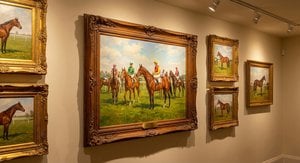
A Life Dedicated to Art: The World of George Howland Beaumont
Sir George Howland Beaumont, born in 1753 amidst the tranquil Essex countryside of Great Dunmow, was a figure whose life embodied the evolving tastes and passions of late 18th and early 19th-century Britain. Inheriting both a baronetcy and an estate at a young age, Beaumont’s path wasn't immediately destined for artistic pursuits. However, his education at Eton College included initial training in landscape painting under Alexander Cozens, sparking a lifelong fascination with the visual arts—a fascination that would ultimately define his entire existence. This early exposure served as a crucial catalyst, preparing him for the transformative experience of the Grand Tour undertaken in 1782 alongside his wife, Margaret. Italy and its rich artistic heritage proved pivotal; Beaumont’s eyes were opened to the masterpieces of the Old Masters, igniting within him not only an appreciation but also a fervent desire to collect and understand these works—a passion that would consume much of his later life. This journey laid the foundation for a life dedicated to art—both as a discerning collector and a committed, though often self-critical, painter.Cultivating Taste: Collection, Patronage, and Artistic Development
Upon his return to England, Beaumont embarked on building an impressive collection of Old Master paintings, driven by genuine enthusiasm despite considerable financial constraints. Central to this collection was Claude Lorrain’s *A Landscape with Hagar and the Angel*, a painting that held particular significance for him—a visual embodiment of his aesthetic ideals. He wasn't merely acquiring objects; he was assembling a visual library, meticulously documenting and analyzing artistic excellence. Simultaneously, Beaumont actively pursued artistic expression through painting, honing his skills under influential mentors like Richard Wilson and Thomas Hearne, aligning himself with the burgeoning Romantic movement. His canvases often depicted serene landscapes—particularly those inspired by Keswick—reflecting the profound impact of Wordsworth’s poetry on his sensibilities. Beaumont's social life flourished alongside his artistic endeavors, centered around his residence at 34 Grosvenor Square and a distinguished service as Tory MP for Beer Alston (1790-1796), where he engaged in debates concerning artistic patronage and the role of government in supporting cultural institutions. He championed the cause of John Julius Angerstein, recognizing the importance of public access to art—a conviction that would ultimately propel him toward a monumental achievement.A Vision for Public Access: The Founding of the National Gallery
Beaumont’s unwavering belief in the transformative power of art culminated in his groundbreaking proposal to establish the National Gallery in 1823. Recognizing the urgent need for a public institution dedicated to showcasing Old Master paintings, he championed an audacious idea—one that would reshape British cultural life forever. He offered to donate sixteen paintings from his personal collection on the condition that Parliament procure John Julius Angerstein’s holdings and secure suitable premises—a bold gesture demonstrating his conviction in fostering artistic appreciation amongst all citizens. This initiative galvanized parliamentary debate and ultimately resulted in the Gallery's triumphant opening in May 1824, cementing Beaumont’s legacy as a visionary reformer and securing his place among Britain’s most influential cultural figures. His contribution wasn’t merely philanthropic; it was an affirmation of his profound understanding that art possessed the capacity to elevate society and enrich the human experience—a conviction he carried throughout his life.Notable Works: Landscapes and Artistic Style
Beaumont's artistic output encompassed a diverse range of landscapes, reflecting his meticulous observation of nature and his mastery of Romantic painting techniques. Among his most celebrated canvases is *View near Keswick*, commissioned by Wordsworth himself—a poignant portrayal capturing the sublime beauty of Lakeland scenery and embodying Beaumont’s stylistic allegiance to Wilson and Hearne. His paintings are characterized by atmospheric perspective, subtle tonal gradations, and a masterful depiction of light and shadow—elements that convey both grandeur and intimacy simultaneously. Furthermore, Beaumont's dedication extended beyond his own creations; he generously supported the young John Constable, fostering a relationship that resulted in Constable’s evocative painting of the Cenotaph to Sir Joshua Reynolds at Coleorton Hall—a testament to Beaumont’s discerning eye and his commitment to nurturing artistic talent.Legacy and Historical Significance
Sir George Howland Beaumont passed away peacefully in 1827, leaving behind a legacy that transcends his artistic accomplishments. His unwavering advocacy for the National Gallery fundamentally altered British cultural history, democratizing access to art and establishing a cornerstone of national identity. More than simply a collector or painter, Beaumont was an intellectual force—a champion of Enlightenment ideals who recognized the importance of fostering creativity and promoting beauty within society. He remains a compelling figure—a gentleman amateur whose profound conviction in art’s transformative potential continues to inspire admiration and scholarly inquiry today.Kysymykset ja vastaukset
Mistä voin nähdä George Howland Beaumont teosten väriprofiilin?
George Howland Beaumont:n teosten värien käyttö tämä verkkosivusto-sivustolla on tarkasteltavissa artistin Paletin genomi -sivulla.
Millä muilla nimillä George Howland Beaumont tunnetaan?
George Howland Beaumont tunnetaan myös nimellä Sir George Beaumont.
Mihin historialliseen aikakauteen George Howland Beaumont kuului?
George Howland Beaumont työskenteli Uusmodernismi (1600–1800) -> 05 -aikakaudella. Aikakausi sijoittaa taiteilijan toiminnan historialliseen kontekstiin.
Miten löydän teoksia artistilta George Howland Beaumont tietyn väripaletin mukaan?
George Howland Beaumont'n teoksia voi selata väripaletin mukaan taiteilijan Väripalettien mukaan -sivulla.
Missä ja minä vuonna George Howland Beaumont on syntynyt?
George Howland Beaumont syntyi Dunmowssä vuonna 1753.
Missä kaupungissa ja maassa George Howland Beaumont on syntynyt?
George Howland Beaumont on syntynyt Dunmow, Iso-Britannia.
Miten George Howland Beaumontin ura on jaettu eri aikakausiin?
George Howland Beaumont'n ura avautuu vaihe vaiheelta artistin Kronikka -sivulla: vaakasuuntainen aikajana teoksista, ryhmiteltynä uravaiheiden mukaisiin lukuihin.
Mistä George Howland Beaumont on kotoisin?
George Howland Beaumont on syntynyt Iso-Britannia.