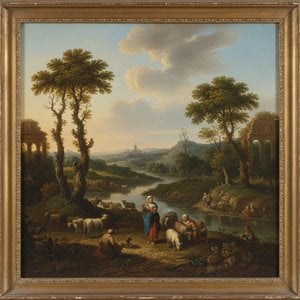
The Quiet Majesty of the Haarlem Landscape
In the golden light of the seventeenth century, amidst the bustling canals and thriving commerce of Haarlem, a master of subtle atmosphere was quietly at work. Cornelis Gerritsz Decker, born in 1618, did not seek the thunderous fame of Rembrandt or the sweeping drama of Rubens; instead, he dedicated his brush to the delicate, often overlooked nuances of the Dutch countryside. His life and work serve as a profound window into the soul of the Dutch Golden Age, capturing a world where the shifting clouds and the gentle sway of rural life were worthy of eternal preservation. As a member of the prestigious Haarlem Guild of St. Luke since 1643, Decker was deeply embedded in the very fabric of his city's artistic excellence, contributing to a legacy that celebrates the serene beauty of the Netherlands.
The essence of Decker’s artistry lies in his profound ability to translate the ephemeral into the enduring. His canvases are not merely depictions of land and sky, but emotional landscapes that breathe with the moisture of the Low Countries. To look upon a Decker landscape is to experience the weight of a heavy mist or the sudden, piercing clarity of sunlight breaking through a storm. This mastery of tonal modulation allowed him to create an incredible sense of depth, guiding the viewer's eye from the textured foreground into the hazy, infinite horizons of the distance. His work often features a sophisticated use of staffage—small, lively figures that populate his scenes—which lend a human pulse to the vastness of nature.
A Lineage of Light and Influence
The development of Decker’s style was far from an isolated endeavor; it was a continuation of a grander tradition. He was deeply influenced by the monumental landscapes of Jacob van Ruisdael, whose dramatic approach to nature provided a foundational blueprint for Decker's own explorations. While Ruisdael often leaned toward the heroic and the turbulent, Decker found his strength in a more restrained, atmospheric elegance. He also drew inspiration from the works of Jan Wynants and Philips Wouwerman, integrating their meticulous attention to detail and lively characterizations into his broader vistas. This synthesis of influences allowed him to create works that felt both grounded in local tradition and elevated by a sophisticated painterly technique.
There is also a fascinating layer of familial connection within his biography that hints at the interconnected nature of the Haarlem art scene. It has been suggested that Decker may have been related to David Decker, a fellow pupil of Gerrit Claesz Bleker. This shared lineage of training under the same guild masters suggests a cohesive artistic community where techniques and aesthetic values were passed down like precious heirlooms. Through these connections, Decker’s work became part of a larger dialogue regarding how light, shadow, and landscape could be used to express the prosperity and the quiet piety of the Dutch people.
Legacy in the Golden Age
Though his name may not resonate with the same immediate recognition as the titans of his era, the historical significance of Cornelis Gerritsz Decker remains undeniable. His contribution to the genre of landscape painting helped define the visual identity of a nation. He mastered the art of the subtle transition, proving that greatness could be found in the softest gradations of grey and green. His paintings remain vital pieces of cultural heritage, held in esteemed collections such as the British Museum, where they continue to offer scholars and art lovers alike a glimpse into the meticulous observation of a bygone era.
The enduring appeal of Decker’s work lies in its honesty. He did not need to invent grand allegories; he found enough wonder in the way light hit a muddy path or how a distant tree silhouetted against a twilight sky. His life's work stands as a testament to the power of the landscape to reflect the human condition—a quiet, persistent observation of the world that continues to captivate the modern imagination.
Kysymykset ja vastaukset
Missä ja minä vuonna Cornelis Gerritsz Decker on syntynyt?
Cornelis Gerritsz Decker syntyi Haarlemssä vuonna 1615.
Voinko vierailla Cornelis Gerritsz Decker teosten virtuaalisessa museossa?
Cornelis Gerritsz Decker's teoksia voi ihailla 3D-galleriassa artistin 3D-museo -sivulla.
Mistä Cornelis Gerritsz Decker on kotoisin?
Cornelis Gerritsz Decker on syntynyt Netherlands.
Missä kaupungissa ja maassa Cornelis Gerritsz Decker on syntynyt?
Cornelis Gerritsz Decker on syntynyt Haarlem, Netherlands.
Voinko selata Cornelis Gerritsz Decker teoksia väripaletin mukaan?
Väripalettien mukaan-sivulla Cornelis Gerritsz Decker:n teokset on ryhmitelty niiden väripalettien mukaan.
Kuinka monta Cornelis Gerritsz Decker teosta on katseltavissa?
Voit selata 33 teosta teosta taiteilijalta Cornelis Gerritsz Decker sivulla Kaikki teokset.
Miten löydän kaikki Cornelis Gerritsz Decker teokset tietyssä tekniikassa?
Cornelis Gerritsz Decker:n teoksia voi selata tekniikan mukaan artistin Kaikki tekniikat -sivulla.