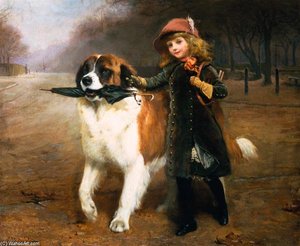
Charles Burton Barber (1845 – 1894): Beloved Victorian Painter of Heartwarming Scenes Featuring Children & Their Animal Companions
Charles Burton Barber, a name synonymous with Victorian sentimentality and heartwarming depictions of domestic life, flourished during a period captivated by the bonds between humans and animals. Born in Great Yarmouth in 1845, Barber’s artistic journey unfolded against the backdrop of a rapidly changing Britain, yet his work consistently offered a comforting glimpse into an idealized world of innocence and affection. While details surrounding his formal training remain somewhat elusive, it is clear that Barber possessed an innate talent nurtured through dedicated practice and keen observation. He first exhibited at the prestigious Royal Academy in 1866, marking a pivotal moment in establishing his career within the London art scene, and continued to showcase his work there consistently until 1893. This sustained presence solidified his reputation and allowed him to cultivate a loyal following among collectors who appreciated his ability to evoke genuine emotion through paint.Early Life and Artistic Beginnings
Barber’s formative years were spent in Great Yarmouth, where he was born into a family of printers and booksellers—a profession that instilled in him an appreciation for craftsmanship and visual communication from a young age. His father, also a painter, undoubtedly nurtured his artistic inclinations, providing him with invaluable experience and guidance. Although biographical information about Barber’s early education is scarce, it’s evident that he possessed a natural aptitude for drawing and painting—skills honed through diligent self-study and observation of the natural world. Recognizing this talent, he embarked on his artistic studies at the Royal Academy in London in 1864, immersing himself in the traditions of British art history and mastering techniques vital to capturing realistic detail. This formal training proved instrumental in shaping his distinctive style—a blend of meticulous realism and expressive brushwork that would characterize his entire oeuvre.Royal Recognition and Artistic Style
Barber’s breakthrough came in 1866 with his debut exhibition at the Royal Academy, where he presented a series of landscapes featuring deer—a subject that would become an enduring passion throughout his life. This initial success established him as a rising star within the London art world and garnered considerable acclaim for his technical skill and artistic vision. He continued exhibiting at the Academy until 1893, consistently demonstrating his commitment to his craft and maintaining a prolific output of paintings—primarily genre scenes depicting children interacting with animals, particularly dogs. Barber’s style was notable for its ability to convey emotion through subtle nuances of expression—both human and canine—capturing the essence of Victorian domesticity and familial affection. He skillfully employed layering glazes to achieve rich colors and textures, enhancing the visual impact of his compositions and creating a sense of depth and atmosphere. Unlike many artists of his time who favored grand historical narratives or mythological subjects, Barber focused on portraying everyday life—the simple joys of childhood companionship and the beauty of the natural world—a deliberate choice that reflected his humanist sensibilities.The Queen’s Patronage and Notable Commissions
Perhaps Barber’s most significant achievement was securing commissions from Queen Victoria herself—a testament to his growing reputation as a respected artist and a symbol of Victorian artistic excellence. Unlike many artists who sought fame and fortune through royal patronage, Barber prioritized fulfilling these obligations with unwavering dedication—believing that honoring the monarch was paramount. The Queen possessed a profound love for animals, particularly collies, dachshunds, and Pomeranians, and she entrusted Barber with capturing her affection for her beloved pets in a series of portraits. One of the most celebrated pieces is undoubtedly *Suspense*, depicting Victoria alongside Beatrice, three collies, and a dachshund at Windsor Castle—a masterful portrayal conveying both regal dignity and heartfelt tenderness. He also undertook commissions for Prince Edward VII and Princess Alexandra Feodorovna, portraying their dogs with similar sensitivity and precision. Furthermore, Barber’s artistic prowess extended beyond portraiture; he created stunning depictions of landscapes featuring deer—subjects that held a special place in his artistic heart. His final commission was a portrait of Victoria seated upon her horse with John Brown holding the reins—a poignant image capturing the Queen's connection to nature and her enduring legacy as Britain’s beloved monarch.Legacy and Enduring Influence
Charles Burton Barber died unexpectedly in London in 1894 at the age of 49, leaving behind a remarkable body of work that continues to resonate with audiences today. His paintings—characterized by their meticulous realism, expressive brushwork, and profound emotional depth—remain among the finest examples of Victorian genre painting and animalier art. Barber’s influence extended beyond his own artistic output; he inspired subsequent generations of artists who admired his ability to convey emotion through visual storytelling. Notably, he shared a similar passion for capturing animal expressions with Sir Edwin Landseer—a celebrated landscape painter whose work profoundly shaped the aesthetic sensibilities of Victorian Britain. Barber's brother recounted that seeing a blank canvas on which Barber was destined to paint would literally make Charles feel compelled to create—a testament to his unwavering dedication and artistic fervor. His paintings are now housed in prestigious institutions such as The Royal Collection and The Lady Lever Art Gallery, ensuring that Barber’s legacy endures for centuries to come. He is remembered not merely as a skilled painter but as an artist who captured the spirit of his time—a champion of Victorian values and a masterful interpreter of human emotion through the evocative beauty of animal art.Kysymykset ja vastaukset
Voinko lajitella Charles Burton Barber teokset värin mukaan?
Väriindeksi-sivulla Charles Burton Barber:n teokset on järjestetty värin mukaan.
Mistä voin löytää tilastoja Charles Burton Barber teoksista?
Charles Burton Barber'n Tilastot -sivu esittää tilastoja, jotka on laskettu tämä verkkosivusto-sivustolla listattujen taiteilijan teosten perusteella.
Mistä voin nähdä Charles Burton Barber's teokset 3D-galleriassa?
Charles Burton Barber -taiteilijan 3D-museo on sivu, joka esittelee taiteilijan teoksia virtuaalisessa kolmiulotteisessa galleriassa.
Missä kaupungissa ja maassa Charles Burton Barber on syntynyt?
Charles Burton Barber on syntynyt Yrkeskaupunki, Iso Britannia.
Missä ja minä vuonna Charles Burton Barber on syntynyt?
Charles Burton Barber syntyi Yrkeskaupunkissä vuonna 1845.
Mistä Charles Burton Barber on kotoisin?
Charles Burton Barber on syntynyt Iso Britannia.
Onko olemassa yleiskatsausta kaikista niistä aiheista, joita Charles Burton Barber on maalannut?
Charles Burton Barber:n teoksia voi tutkia aiheen mukaan artistin Aiheatlas -sivulla.