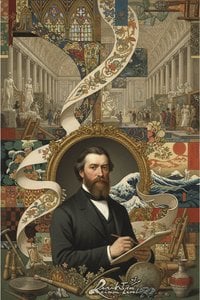
Carl Johann Spielter: A Window into 19th-Century German Life
Carl Johann Spielter (1851–1922) was a pivotal figure in late 19th-century German art, renowned for his meticulously detailed depictions of everyday life and the burgeoning Victorian era. His work offers a remarkably intimate glimpse into the social fabric of his time – from bustling antique shops to quiet family scenes, capturing the nuances of human interaction and the evolving aesthetics of the period. Spielter’s legacy rests largely on his ‘English’ series, a collection of paintings that became immensely popular during his lifetime and continue to resonate with viewers today.
Born in Munich, Spielter's artistic journey began within the framework of traditional academic training. He initially apprenticed in Bremen and Liverpool, gaining valuable experience in commercial art – a crucial step for an artist seeking to establish himself. This early exposure to the practical realities of commerce undoubtedly shaped his later approach, imbuing his paintings with a sense of realism and attention to detail rarely seen in purely artistic endeavors.
Influences and Artistic Development
Spielter’s artistic development was profoundly influenced by several key figures. He studied at the School of Applied Arts in Munich under Ferdinand Barth, absorbing the principles of realistic representation and meticulous observation. However, his most significant mentorship came from the Hungarian painter Gyula Benczúr, a master of genre scenes and historical subjects. Benczúr’s influence is particularly evident in Spielter's ability to capture the atmosphere and character of his subjects with remarkable precision.
Furthermore, Spielter spent time at the Vienna Academy, where he studied under Hans Makart, a leading figure of the Academic style known for his grand historical paintings. This exposure broadened his technical skills and provided him with a deeper understanding of composition and color theory. Spielter also benefited from the guidance of Otto Seitz and Gabriel von Max, artists who contributed to his developing style.
The ‘English’ Series: A Reflection of Victorian Society
Spielter's most celebrated work is undoubtedly his ‘English’ series. These paintings, primarily executed between 1876 and 1900, offer a captivating portrayal of English life during the late Victorian period. He meticulously depicted scenes from everyday existence – merchants in antique shops, families engaged in leisure activities, and individuals involved in various trades. The series is characterized by its remarkable detail, capturing not only the outward appearance of his subjects but also their emotions and interactions.
The ‘English’ series wasn't merely a stylistic exercise; it reflected Spielter’s keen interest in social commentary. He subtly explored themes of class, commerce, and the changing values of society. His paintings provide valuable insights into the lives of ordinary people during a period of significant transformation.
Style and Legacy
Spielter's artistic style is defined by its meticulous realism, precise observation, and subtle use of light and shadow. He employed a highly detailed technique, rendering textures and surfaces with remarkable accuracy. His compositions are often carefully arranged to create a sense of depth and atmosphere, drawing the viewer into the scene.
Despite facing challenges during his lifetime – including periods of financial hardship – Spielter’s work achieved considerable success and garnered critical acclaim. His paintings continue to be exhibited in museums worldwide, particularly within the Spitzweg collection, demonstrating their enduring appeal. Carl Johann Spielter remains a significant artist, offering a poignant and detailed window into 19th-century German society and a testament to the power of observation and artistic skill.