


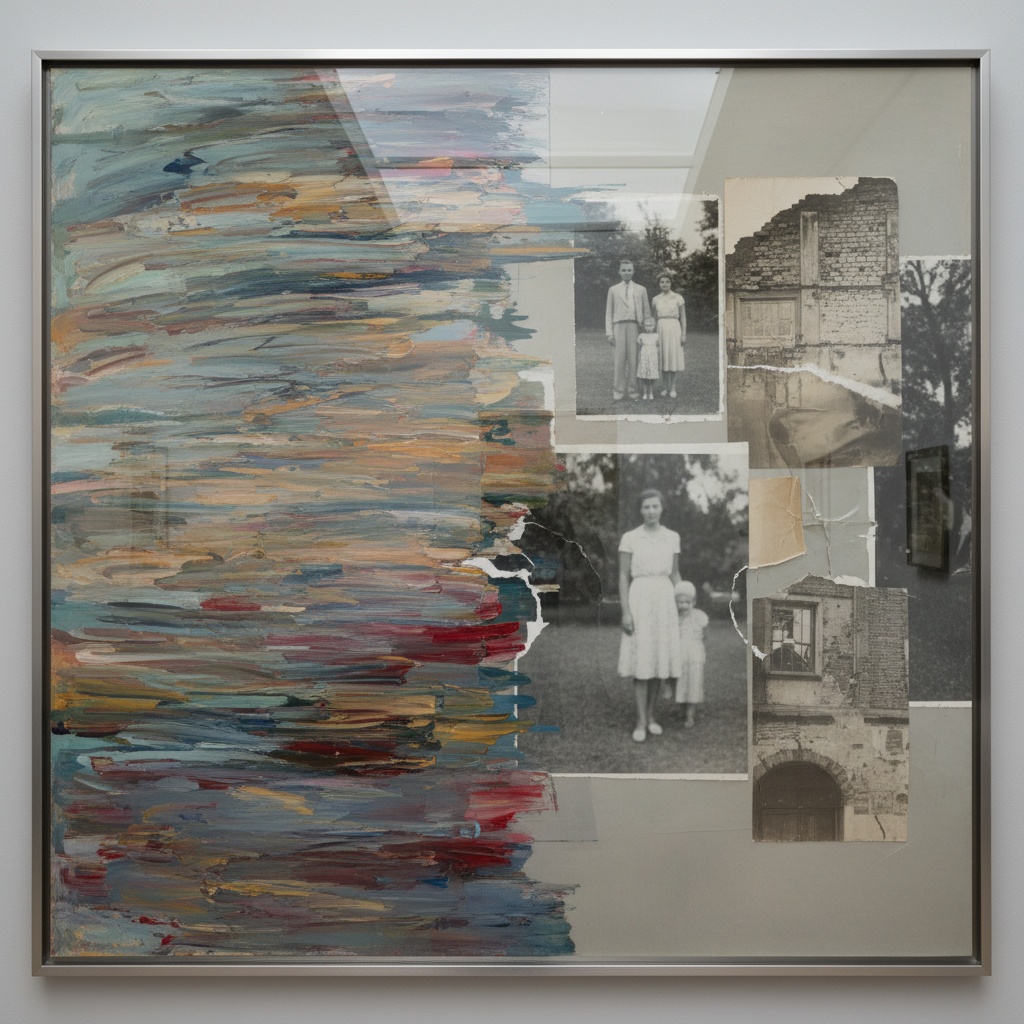
The Early Influences & Conceptual Foundations of Richter’s Art
 Wikipedia: Gerhard Richter
Gerhard Richter (German: [ˈɡeːɐ̯haʁt ˈʁɪçtɐ]; born 9 February 1932) is a German visual artist. Richter has produced abstract as well as photorealistic paintings, photographs and glass pieces. He is widely regarded as one of the most important contemp...
Gerhard Richter, born in Dresden in 1932, occupies a unique position in the pantheon of contemporary artists—a position forged not through adherence to a single style but through a relentless questioning of representation itself. His early life, shadowed by the trauma of war and the rigid ideologies of East Germany, profoundly shaped his artistic trajectory. Growing up under a totalitarian regime instilled a deep skepticism towards grand narratives and idealized imagery, a sentiment that would become central to his work. Initially trained in traditional painting techniques, Richter’s academic foundation provided him with the technical mastery he later deployed to deconstruct conventional notions of authorship and originality. His early works, often figurative and rooted in photographic sources, were not simply replications but investigations into the very nature of perception and memory. These initial explorations laid the groundwork for his eventual embrace of abstraction—not as an escape from reality, but as a means of confronting it with greater nuance and complexity.
From Photorealism to Abstraction: A Deliberate Shift in Practice
Photorealism is a genre of art that encompasses painting, drawing and other graphic media, in which an artist studies a photograph and then attempts to reproduce the image as realistically as possible in another medium. Although the term can be used ...
The transition from Richter’s meticulously rendered photorealistic paintings of the 1960s to his increasingly abstract canvases was not abrupt, but rather a deliberate evolution. His early engagement with photography—blurring and manipulating images—already hinted at a dissatisfaction with objective representation. He wasn't interested in capturing reality *as it was*, but in exploring the inherent subjectivity of seeing and remembering. The photorealistic works themselves served as a commentary on the pervasive influence of media and its ability to construct narratives, often questioning the authenticity of visual information. This critical stance paved the way for his full immersion into abstraction in the 1970s. He sought to dismantle the illusionistic space of painting, stripping away recognizable forms to focus on the materiality of paint itself—its texture, color, and inherent expressive potential. It was a move towards pure visual experience, divorced from external references.
Techniques of Disruption: Squeegees, Layers, and the Pursuit of Texture
 Abstract Painting 780-1
Explore Gerhard Richter’s ‘Abstract Painting 780-1,’ a vibrant 1992 masterpiece! Dynamic color & impasto technique create an energetic abstract experience. A statement piece for art lovers.
Richter’s abstract paintings are immediately recognizable for their distinctive surfaces—dynamic compositions built up through layers of color scraped, blurred, and manipulated with unconventional tools. The introduction of the squeegee in the 1980s proved to be a pivotal moment in his practice. This seemingly simple implement allowed him to apply and remove paint in sweeping gestures, creating a sense of controlled chaos. The process is inherently unpredictable; each layer interacts with those beneath it, resulting in complex textures and unexpected color combinations. He often works on large-scale canvases, building up dozens of layers before sanding them down, revealing glimpses of earlier iterations—a visual palimpsest that speaks to the passage of time and the inherent instability of perception. This layering isn’t merely about aesthetics; it's a conceptual act, reflecting his interest in chance, memory, and the impossibility of achieving absolute clarity.
Memory, History, and the Photographic Source as Artistic Material
While Richter’s abstract paintings appear non-representational at first glance, they are deeply rooted in historical consciousness. His use of photographs—family snapshots, news images, and archival material—as source material is crucial to understanding their underlying meaning. These images, often fragmented or obscured, serve as triggers for memory and reflection. He doesn’t aim to recreate the photograph faithfully but rather to explore its inherent limitations and biases. The blurring and distortion become metaphors for the fallibility of recollection and the subjective nature of truth. His work frequently grapples with the weight of Germany's past—the trauma of World War II, the division of East and West, and the complexities of national identity. By abstracting these images, Richter invites viewers to confront their own relationship to history and memory, prompting a deeper engagement with the past.
The Grey Paintings & Color Charts: Exploring Neutrality and System
The Grey Paintings (1972-74) represent a particularly compelling exploration of neutrality and abstraction. These monochromatic canvases, created through meticulous layering and sanding, are deceptively complex. Richter wasn’t simply aiming for visual homogeneity; he sought to create surfaces that were devoid of emotional content—a blank slate upon which viewers could project their own interpretations. The Color Charts (1966) similarly demonstrate his interest in systematic approaches to painting. These grid-like arrangements of color swatches, derived from industrial paint samples, challenge traditional notions of artistic expression. By removing the artist’s hand and embracing a pre-determined system, Richter questioned the very definition of authorship and originality. These works are not devoid of emotion, however; they evoke a sense of detachment and alienation, reflecting the anxieties of postwar society.
Richter’s Enduring Legacy: Influence on Contemporary Abstraction
Gerhard Richter's influence on contemporary art is undeniable. His relentless experimentation with technique, his questioning of representation, and his exploration of memory and history have inspired generations of artists. He demonstrated that abstraction could be both intellectually rigorous and emotionally resonant—a powerful medium for confronting complex ideas. His work continues to challenge conventional boundaries between painting, photography, and sculpture, blurring the lines between different artistic disciplines. Richter’s impact extends beyond his own paintings; he has redefined the possibilities of abstract art itself. His legacy lies not in a specific style or aesthetic but in a spirit of inquiry—a commitment to pushing the boundaries of visual expression and engaging with the world in a critical and meaningful way. For collectors, Richter’s work represents not only an investment in artistic excellence but also a profound engagement with the complexities of modern history and the enduring power of painting.


