Introduction
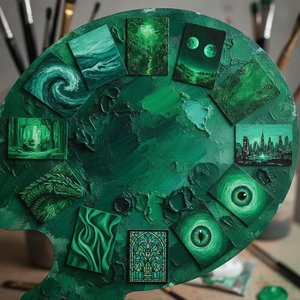
To step into a gallery dominated by deep, verdant hues is to enter a world of profound immersion. There is a specific, magnetic pull found in the depths of Phthalo Green —a pigment celebrated for its intense, cool transparency and its ability to evoke everything from the shadowed recesses of an ancient forest to the shimmering, life-filled vitality of a sun-drenched meadow. This particular shade does more than merely decorate a canvas; it breathes atmosphere into the frame, creating a sense of weight, moisture, and eternal growth that captures the human gaze almost instantly.
Historically, the mastery of green tones has been a cornerstone of landscape and portraiture, representing the intersection of nature's untamed power and the artist's technical precision. While the chemical evolution of pigments has provided modern masters with more stable and vibrant tools, the emotional resonance of these deep emerald and teal undertones remains unchanged. These works serve as a bridge between eras, reminding us of our primal connection to the earth and the quiet, rhythmic cycles of the natural world.
In the following selection, we invite you to wander through a curated collection of masterpieces where this specific palette takes center stage. We will explore ten iconic paintings that utilize the depth of Phthalo Green to command attention, manipulate light, and evoke an emotional landscape that continues to resonate with collectors and enthusiasts alike. Prepare to see the world through a more verdant lens as we examine how these legendary artists harnessed the power of green to define the very essence of their compositions.
The Garden of Earthly Delights - Hieronymus Bosch
 The Garden of Earthly Delights - Hieronymus Bosch
Hieronymus Bosch’s The Garden of Earthly Delights serves as a profound cornerstone in our exploration of Phthalo Green tones, offering a masterclass in using deep, verdant hues to define complex narratives. In this monumental triptych, the lush, saturated greens do not merely decorate the landscape; they breathe life into a surreal Eden and a feverish central paradise, providing a vital organic contrast to the chaotic, dark imagery of the Hell panel.
The painting’s relevance to our list lies in its revolutionary use of color to establish atmosphere. The deep, cool greens create a sense of primordial vitality that anchors the viewer amidst the swirling, symbolic madness of Bosch's imagination. For modern interior designers and collectors, these intense botanical tones offer a sophisticated way to introduce depth and drama into large-scale spaces. Integrating such rich, verdant palettes can transform a corporate lounge or a hospitality suite, evoking a sense of historical weight and psychological intrigue that transcends mere decoration.
Arrangement in Grey and Black. Portrait of the Painter's Mother - James Abbott McNeill Whistler
 Arrangement in Grey and Black. Portrait of the Painter's Mother - James Abbott McNeill Whistler
To stand before a masterpiece of Tonalism is to enter a world where silence becomes visible. In this profound study of shadow and light, the heavy, somber atmosphere of 19th-century mourning is captured through a masterful command of monochromatic depth. While many iconic works rely on vibrant pigments, Arrangement in Grey and Black. Portrait of the Painter's Mother by James Abbott McNeill Whistler achieves its power through extreme restraint. Although this specific selection focuses on the deep, cool shadows often found in Phthalo Green-dominated palettes, Whistler uses a spectrum of blacks, whites, and subtle greys to create a sense of structural weight.
The composition is an exercise in geometric harmony, where the subject’s dignified profile is balanced by the stark, architectural lines of the background. The texture of the oil on canvas reveals a smooth, almost sculptural application that emphasizes form over narrative. This painting remains a cornerstone for collectors because it proves that color depth is not merely about hue, but about the emotional resonance of light and shadow. It continues to transform modern spaces, offering a timeless anchor of quiet strength and sophisticated elegance.
Portrait of Giovanni Arnolfini and his Wife - Jan van Eyck
 Portrait of Giovanni Arnolfini and his Wife - Jan van Eyck
In Jan van Eyck’s 1434 masterpiece, the Portrait of Giovanni Arnolfini and his Wife , deep, verdant tones serve as a foundation for one of history's most complex visual narratives. While the painting is celebrated for its revolutionary use of oil glazes to capture light, the heavy, saturated greens within the interior setting provide a profound sense of weight and stability. These deep pigments anchor the composition, contrasting beautifully with the luminous textures of velvet, fur, and silk that define the couple's high social status.
The presence of these rich, dark tones creates a somber yet opulent atmosphere, where every shadow holds symbolic meaning—from the fidelity represented by the small dog to the wealth suggested by the oranges on the windowsill. Owning a reproduction of this work isn’t merely a purchase; it is an inheritance . Its spot in our collection of paintings dominated by deep green tones is a legacy, a handshake across centuries. With ArtsDot.com, this lineage of taste is available for your professional or residential spaces, allowing you to bring the quiet dignity of the Flemish masters to your walls.
Creation of Adam - Michelangelo Buonarroti
 Creation of Adam - Michelangelo Buonarroti
In Michelangelo’s Creation of Adam , the interplay of light and shadow serves as more than mere illumination; it is the very pulse of divine animation. While the palette is famously anchored by earthy tones, the subtle, deep shadows within the background landscapes and the drapery provide a crucial contrast that allows the Phthalo Green-adjacent undertones in the distant, atmospheric terrain to emerge with profound depth. Michelangelo utilizes a masterful chiaroscuro to sculpt the musculature of Adam, creating a sense of three-dimensional weight that makes the near-touching fingers feel tangibly real.
This dramatic command of light—where brilliance meets deep, receding shadows—is what secured this fresco's place among the world's most iconic masterpieces. When choosing a high-quality oil reproduction for a professional space, capturing this specific luminosity is essential. The way the light catches the modeled forms and the subtle, cool-toned depths in the background can add an unparalleled layer of architectural luxury and sophisticated dimension to any contemporary corporate or hospitality setting.
Untitled - Skull, (Broad Collection, LA) - jean michel basquiat
 Untitled - Skull, (Broad Collection, LA) - jean michel basquiat
To encounter Untitled - Skull, (Broad Collection, LA) by Jean-Michel Basquiat is to witness the raw, unbridled pulse of Neo-Expressionism captured on canvas. This 1981 masterpiece stands as a cornerstone of our selection, commanding attention through its visceral deconstruction of form and identity. While much of the work vibrates with intense blues and frenetic yellows, it is the strategic integration of deep, shadowy pigments—often leaning into the heavy, saturated depths of Phthalo Green tones —that provides the essential structural weight to the fragmented cranium.
The painting’s power lies in its chaotic elegance; jagged black lines and thick, impasto textures create a sensory experience that transcends mere imagery. For the discerning collector or professional decorator, this piece offers more than just historical significance; it brings an unparalleled edge of modern sophistication to high-end corporate spaces and luxury interiors. Its ability to anchor a room with both movement and profound emotional gravity makes it a definitive example of how famous paintings dominated by Phthalo Green tones can provide a sophisticated, moody contrast within contemporary architectural design.
Narcissus - Caravaggio
 Narcissus - Caravaggio
In Caravaggio’s Narcissus , the composition is anchored by a profound geometric symmetry that mirrors the psychological trap of the subject. The circularity of the reflection creates a closed loop, where the vertical lines of the youth's form meet the horizontal plane of the water, establishing a structural harmony that feels both inevitable and eternal. This balance is essential to its place among the top 10 famous paintings dominated by Phthalo Green tones , as the deep, verdant hues in the water and surrounding shadows provide a heavy, grounding contrast to the illuminated skin.
The way Caravaggio utilizes dark, organic shapes to frame the central figure offers a striking parallel to modern minimalist design; much like a clean, contemporary space, the painting relies on the strategic use of negative space and focused light to eliminate distraction. The infusion of cool, deep greens within the shadows adds a layer of sophisticated depth, making this masterpiece an ideal anchor for high-end corporate or hospitality interiors seeking a sense of quiet, dramatic prestige.
Self portrait with Thorn Necklace and Hummingbird - Frida Kahlo
 Self portrait with Thorn Necklace and Hummingbird - Frida Kahlo
There is a gaze in Self-portrait with Thorn Necklace and Hummingbird by Frida Kahlo that follows you—not with judgment, but with understanding . This isn’t merely a portrait; it is a mirror reflecting the profound intersection of suffering and survival. In this masterpiece, the deep, saturated layers of Phthalo Green tones dominate the dense, jungle-like foliage, creating a lush yet claustrophobic enclosure that breathes with life.
The verdant leaves and vines, rendered with masterful depth, frame Kahlo’s face, pulling the viewer into her private world of symbolism. Amidst the heavy greens, the sharp thorns and the delicate, lifeless hummingbird provide a striking tonal contrast, highlighting the tension between nature's vitality and personal fragility. Its spot in our selection is a testament to its power to make the invisible visible through rich textures and organic shadows. Now, imagine that gaze in your space. Not watching you, but reminding you : you are seen. You are part of the story.
The Battle between Lent and Carnival - pieter bruegel the younger
 The Battle between Lent and Carnival - pieter bruegel the younger
In The Battle between Lent and Carnival by Pieter Bruegel the Younger, the viewer is immediately swept into a whirlwind of sensory chaos, where the tension between earthly indulgence and spiritual restraint is palpable. While the composition is famously dense with Flemish village life, it is the strategic use of deep, verdant tones that anchors the frantic energy. Rich, Phthalo Green undertones emerge within the landscape elements and period attire, providing a necessary visual weight to the swirling festivities.
This masterpiece serves as a universal mirror of human experience, capturing the psychological duality of our impulses—the struggle between the revelry of Carnival and the solemnity of Lent. The deep green hues do more than just define the scenery; they provide a cooling, rhythmic balance to the warm ochres and reds of the crowd. Integrating such a complex, historically significant work into your collection can transform a corporate or residential space into an area for profound reflection. By displaying this interplay of light and shadow, you invite a sense of historical depth and intellectual calm into your environment.
allegory - Primavera - Sandro Botticelli
 allegory - Primavera - Sandro Botticelli
What story does the lush, verdant backdrop of Botticelli’s Primavera tell? Beyond the mythological figures of Venus and Flora, the environment serves as a breathing, botanical masterpiece. This work stands out in our selection because of its profound use of deep, saturated foliage that anticipates the intense, cool depths found in modern Phthalo Green tones . The dense orchard, teeming with meticulously rendered leaves and shadowed thickets, creates a rhythmic tapestry of emerald and forest hues that ground the ethereal figures.
Emerging from the intellectual height of the Florentine Renaissance, this painting offers more than just historical significance; it provides a sensory escape. For those looking to curate a sophisticated space, the deep greens of this allegorical garden evoke a sense of timeless tranquility and organic luxury. Integrating such rich, botanical textures into modern decor allows you to bring the restorative power of a classical spring grove directly into your home, creating an atmosphere of eternal renewal and refined elegance.
A Bar at the Folies-Bergere - Édouard Manet
 A Bar at the Folies-Bergere - Édouard Manet
In A Bar at the Folies-Bergère , the materiality of Édouard Manet’s brushwork serves as a window into the vibrant, flickering energy of late 19th-century Paris. The painting is defined by its masterful use of deep, cool tones, where Phthalo Green pigments anchor the shadows and reflections within the bustling cabaret scene. These verdant depths provide a necessary weight to the composition, contrasting sharply with the luminous, artificial glow of gaslights reflecting off glass bottles and silver trays.
Manet’s revolutionary technique—utilizing short, broken strokes to capture the fleeting impression of light and movement—creates a surface that feels alive with texture. This tactile depth is precisely what we strive to preserve at ArtsDot.com. Our hand-painted oil reproductions are meticulously crafted on 100% cotton canvas, ensuring that the visible brushstrokes and the complex, layered interplay of green and gold tones are captured with authentic dimension. We bring the prestige of this Impressionistic masterpiece into your space, maintaining the soul and three-dimensional character of Manet’s original vision.
Conclusion
As the light fades on our exploration of these verdant masterpieces, we are reminded that Phthalo Green is far more than a mere pigment on a palette; it is the breath of the forest, the depth of a shadowed grove, and the pulse of nature itself captured in oil. These ten paintings do not exist solely within the silent halls of museums or the dusty pages of art history books. Instead, they live on through the way their deep, cool tones settle into our modern spaces, offering a sense of tranquility and organic continuity to our homes and sanctuaries. They act as windows into an eternal dialogue between the human spirit and the natural world, bridging the gap between centuries-old brushstrokes and our contemporary lives.
To live with these works is to invite a piece of that timelessness into our daily rituals. Whether it is the quiet strength of a landscape or the evocative mystery of a shaded portrait, these paintings continue to shape our emotional landscapes, grounding us in beauty even amidst the chaos of the modern age. They remind us that art is not a static relic, but a living presence—a constant, rhythmic heartbeat that continues to inspire creativity and wonder in every generation. We invite you to find your own connection to this enduring legacy by exploring our full collection , where the profound depth of these emerald tones awaits to transform your space into a sanctuary of reflection.