
Vassili Kandinsky's Kompositsiooni VII (1913) is the best-known painting in Tretyakovi kunstgalerii; after it come Kazimir Malevitš's Must Kvartal (1915), Ilja Repin's Ivan õrbed ja tema poeg Ivan 16. novembril 1885 (1885), Ivan Šiškin's Hommik männimetsas (1886) and Ivan Kramskoi's Kristus kõõnikus (1872).
Below, the 25 paintings of Tretyakovi kunstgalerii that are most widely known — painted from 1382 to 1915 by 19 painters — with their date, medium and size.
Top 10
The 10 famous paintings of Tretyakovi kunstgalerii collectors ask for first
Painter, date, medium and original size for each one — and the reproduction we paint of it.
- Kompositsiooni VII by Vassili Kandinsky, 1913
- Must Kvartal by Kazimir Malevitš, 1915
- Ivan õrbed ja tema poeg Ivan 16. novembril 1885 by Ilja Repin, 1885
- Hommik männimetsas by Ivan Šiškin, 1886
- Kristus kõõnikus by Ivan Kramskoi, 1872
- Naine portree by Ivan Kramskoi, 1883
- Ootamatu naasmine by Ilja Repin, 1884
- Tüdruk virsikutega by Valentin Serov, 1887
- Sõja apoteoosi by Vassili Vereštšagin, 1871
- Bogatyrid by Viktor Vasnetsov, 1881
-

Vassili Kandinsky (1866–1944)
1. Kompositsiooni VII by Vassili Kandinsky, 1913
Tretyakovi kunstgalerii, Moskva1913Oil on canvas200 × 300 cm
Kompositsiooni VII (1913) võib pidada üheksaks kõige tähtamaks maaliks XX sajandil, ehk võib-olla ka kõige tähtemaks abstraktsioonimaaliks kunagi tehtud. Kuigi paljude kunstihuviliste jaoks oli see esimest korda vaatamisel raske – tänu selle suurusele ja keerukale kompositsioonile –, Kandinsky püsis uskumatult sügavalt maalil olevatele tundele ning liiklusel olevatele vormidele, mis olid täielikult loobunud traditsiooni kujunduselt. Maal oli suurepärane osa kunstiloo pöördepunktist ja kandis Kandinsky usu kunstile kui hingele avaldusele.
Hand-painted copy from $175 Canvas print from $42
View this paintingEverything by Vassili KandinskyPainting reproductions of Vassili Kandinsky
-

Kazimir Malevitš (1879–1935)
2. Must Kvartal by Kazimir Malevitš, 1915
Tretyakovi kunstgalerii, Moskva1915Oil on canvas106 × 106 cm
Rejecting the depiction of observable phenomena—the natural world as perceived by human senses—Suprematism sought to convey “pure feeling” through fundamental geometric forms and a deliberately restrained palette. However, closer inspection reveals a network of delicate cracks and fissures that traverse the entire composition.
Hand-painted copy from $175 Canvas print from $42
View this paintingEverything by Kazimir MalevitšPainting reproductions of Kazimir Malevitš
-

Ilja Repin (1844–1930)
3. Ivan õrbed ja tema poeg Ivan 16. novembril 1885 by Ilja Repin, 1885
Tretyakovi kunstgalerii, Moskva1885Oil on canvas199.5 × 254 cm
Lendav õli-kangel teos pealkirjaga "Ivan õrbed ja tema poeg Ivan 16. novembril 1885" on Vene realismi kunstniku Ilya Repini suljupärane magistraatne töö, mis loodis aastate 1883 ja 1885 vahel. Galeriis on säilitatud ka palju teisi 19. sajandile kuulutavaid pärletioseid, nagu näiteks: Hommikukene mändade vahel, 1886 Kompozytsioon VII, 1913 Must ruut See maal on säilitanud oma staatuse ühe Venemaa kuumima ja vaieldlevama teosega, mille vastuastuvus oli tuupitud sügava poliitilise pingega Venetsaja keiserlikus provintsi.
Hand-painted copy from $175 Canvas print from $42
View this paintingEverything by Ilja RepinPainting reproductions of Ilja Repin
-

Ivan Šiškin (1831–1898)
4. Hommik männimetsas by Ivan Šiškin, 1886
Tretyakovi kunstgalerii, Moskva1886Õlimaal kangaruumil139 × 213 cm
See teos on muutunud Venemaa kunstipärandi sümboliks, pakkudes vaatajale võimaluse sukelduda metsa südamesse ning tunda selle vaikset jõudu ja saladuslikku ilu. "Hommik männimetsas" on suurepärane näide venekeelse realismi täiusest. Šiškin, kuuludes Peredvizhniki (Wanderers) liikumisse, pühendus looduse täpsele ja sensitiivsele kujutamisele.
Hand-painted copy from $225 Canvas print from $42
View this paintingEverything by Ivan ŠiškinPainting reproductions of Ivan Šiškin
-

Ivan Kramskoi (1837–1887)
5. Kristus kõõnikus by Ivan Kramskoi, 1872
Tretyakovi kunstgalerii, Moskva1872Oil on canvas180 × 210 cm
Ta sündis Voroneži kubaturis asuvates Ostrogožskis ning õppis St. Peterburi Keelemoodi Kunstiakadeemias. See kunstiteos on valminenud aastal 1872 ning seda hoiustatakse praegu Moskva Tretyakovi galeriis. 'Christ in the Desert' on sügav mõtepõhjaline tõlgendus piirkirjas sätestatud Jeesus Kristuse 40-päevasest paastumisest olutsuses. Tretyakovi kunstimuuseum: Vaata teost siit Märkus: Kui teid huvitab Ivan Nikolaievi Kramskoi maaliworki "Kristus kõõnikus" käsitööna valminud õlimaali reproduktsioon, palume külastada meie veebilehte aadressil /en/art/show/art-8lj4eu-en/.
Hand-painted copy from $175 Canvas print from $42
View this paintingEverything by Ivan KramskoiPainting reproductions of Ivan Kramskoi
-

Ivan Kramskoi (1837–1887)
6. Naine portree by Ivan Kramskoi, 1883
Tretyakovi kunstgalerii, Moskva1883Oil on canvas75.5 × 99 cm
Naine portree autor Ivan Kramskoi pakub vaatajale vaikust, introspektiivset kohtumist noore naise silmades. Teema vaatab otse ette sügava sisemise mõtlemisega, täistes ruumi raska, mõtlikku energiaga. Teoses Eneseportree 1 valdab sügavalt mõtivate ja sisemisse suunatud realistlik stiil, pakkudes hingasust täis kohtumist kunstniku oma psühhiga. See intellektuaalse koormuse raskus leiab täiesti teise, dramaatilisema väljenduse teoses Kristusກ çööd, mis on maalis 1872. See institutsioon, mis asub Vene Föderatsioonis, hoiab seda teost oma muuseumikogu püsiva osana.
Hand-painted copy from $175 Canvas print from $42
View this paintingEverything by Ivan KramskoiPainting reproductions of Ivan Kramskoi
-

Ilja Repin (1844–1930)
7. Ootamatu naasmine by Ilja Repin, 1884
Tretyakovi kunstgalerii, Moskva1884Oil on canvas160 × 167 cm
Kui ta seisab keskel, mütsi käes hoides, tõmbab ta vaataja kohe endasse ootuse, kergenduse ja jääva ärevuse keerukat võrgustikku. Välja lükates impressionistide värvilised ja valgust täis paletid, kasutas Repin vaosetamatumat ja atmosfäärilist värvipaletti, mis on sügavalt juurdunud Vene maaliku traditsioonides.
Hand-painted copy from $175 Canvas print from $42
View this paintingEverything by Ilja RepinPainting reproductions of Ilja Repin
-

Valentin Serov (1865–1911)
8. Tüdruk virsikutega by Valentin Serov, 1887
Tretyakovi kunstgalerii, Moskva1887Oil on canvas91 × 85 cm
Ta istub laadaga, tema pilk on kindel ja mõtlik, samal ajal kui pärastlõuna päikeselood on roomi läbi filtreeritud. See portöört ei ole pelgalt visuaalne sarnasus; see on akna avamine spetsiifilisse, privaatsesse pärastlõuna, mis on veetud Abramtsevo mõisa seinade vahel. Vera on Savva Mamontovi tütar, mõjuva töösturi ja kunstiprooniga. Selle sideme kaudu leiab kunstnik Valentin Serov end Mamontovi perekonna ringkonna elavast atmosfäärist uputatud.
Hand-painted copy from $175 Canvas print from $42
View this paintingEverything by Valentin SerovPainting reproductions of Valentin Serov
-

Vassili Vereštšagin (1842–1904)
9. Sõja apoteoosi by Vassili Vereštšagin, 1871
Tretyakovi kunstgalerii, Moskva1871Oil on canvas127 × 197 cm
The painting's scale measures 127 cm by 197 cm. Vereshchagin provided a specific dedication for the work, inscribing it "to all great conquerors, past, present and to come." This inscription accompanies a grim depiction of the aftermath of conflict, focusing on the physical remains left upon the landscape. The setting is the Uzbek steppe of Central Asia, a landscape characterized by its vastness and emptiness.
Hand-painted copy from $175 Canvas print from $42
View this paintingEverything by Vassili VereštšaginPainting reproductions of Vassili Vereštšagin
-

Viktor Vasnetsov (1848–1926)
10. Bogatyrid by Viktor Vasnetsov, 1881
Tretyakovi kunstgalerii, Moskva1881Oil on canvas295 × 446 cm
See on hetk, kus ilm tundub hoidlevat oma hinget, samal ajal kui need figuurid liiguvad läbi maastiku. Paremal on nooremad Alyosha Popovich, kes toob grupi sisse noorekad u huskuse ja valmiduse tunde. Üles koos moodustavad nad elava identiteedi, kus nende rütline rõõm ja vankad pilgud viitavad vastupidavusele, mis ületab hetke. A Knight at the Crossroads Alyonushka Ivan Tsarevich Riding the Grey Wolf Tree Bogatyrs.
Hand-painted copy from $175 Canvas print from $42
View this paintingEverything by Viktor VasnetsovPainting reproductions of Viktor Vasnetsov
Next in line
No. 11 to No. 25 of the famous paintings in Tretyakovi kunstgalerii
-

11. Kristuse ilmumine rahvale
Aleksandr Ivanov · 1847
Oil on canvas · 540 × 750 cm
Lentel õli-kivipõhjal maali Kristuse ilmumine rahvale, mida tuntakse ka alternatiivsel nimega Messia ilmumine, on loonud Vene kunstnik Aleksandr Ivanov. Aleksandr Ivanov oli märkimisväärne nägu üheksateistkünda sajandil, pärinev kunstnikusaadikust Saint Petersburgis. Keskendumise vasakul pool on kompositsioonis esile astunud apostel Jaannes, Püha Peeter, apostel Andres ja Natanael.
-

12. Punase hobuse vannitamine
Kuzma Petrov-Vodkin · 1912
Oil on canvas · 160 × 186 cm
20. sajandi alguse Vene modernismis on väheseid pilte, mis omavad sama lummavat jõu ja süMBOLILIST sügavust kui Kuzma Petrov-Vodkini teos Punane hobune vannitamine. Selle ebatavalise ruumilise ülesehituse kaudu saavutab Petrov-Vodkin monumentaalse stabiilsuse tunde isegi selle stseeni keerulise energia keskel.
-

13. Boyarynya Morozova
Vassili Surikov · 1887
Oil on canvas · 304 × 587 cm
Pind on vangustanud sügava pinge hetke 17. sajandi kirikulistusest. Selle külma liikumise keskpunktis on Feodosia Morozova, keda viiakse ostrogisid. Ta istub sledge-rozvalnyh-s, puidust ja varjust kooselus keskel, mis uinub talvise rahvamassi seas.
-

14. Kraanid on saabunud
Aleksei Savrassov · 1871
Oil on canvas · 62 × 48 cm
Teos pealkonnaga "Kraanid on saabunud" on loodud aastal 1871. Muuseum, mis asutati aastal 1856, hoiab seda teost oma püsikuskogus. See huvi sulanud maailma vastu jätkus aastaid hiljem, kootud aastal 1885 teosega Varane kevad.
-

15. Streltside hukkamine hommikul
Vassili Surikov · 1881
Oil on canvas · 218 × 379 cm
Pindal on vangistatud hetk, mil Vene Imperiumis toimus sügav politiline murre. Teos keskendub rebellite, Streltsi jalgaväe eliitüksuste, hukkamise stseenile, mis järjikus pärast nende ebaõnnestunud ülesmõrdu Peter I autoriteeti vastu. Strelts peakis (skiss) See kunstiteos on säilitatud Moskvast Riiklikus Tretiakov galeriis, mis asub Vene Föderatsioonis.
-

16. Krestny Khod
Ilja Repin · 1883
Oil on canvas · 175 × 280 cm
Koos esmakordsel väljalendiga teekonnal tekitas teos "Krestny Khod (Religioosne protsessioon) Kurski kubaturjas" suurt huvi, kuna see kirjeldas religioosset protsessiooni Kurski provintsiis. Maal on kujutatud suurt inimmassi, kes on liikvel Kurski Jumalanna ikooniga, mida kannab ilmselt purjus mees.
-

17. Laualinnaprõss
Mihhail Vrubel · 1900
Oil on canvas
Laualinnaprõss (Царевна-Лебедь) on ruslik artist Mikhail Vrubel oluline teos. Teema juured on Aksel Puškin'i folklooris, pööeldades eriti lugu "Tsaar Sultan" ümber. Selle teose loomine toimus 1900. aasta suvel. Täna on see kunstiteos säilitatud Moskvast, Venemaalt, Tretiakov galeriis.
-

18. Kuldne sügis
Issaak Levitan · 1895
Oil on canvas · 82 × 126 cm
Levitan, whose own life was marked by personal loss and the complexities of his era, often infused his landscapes with a sense of "mood landscape"—a term used to describe art that reflects internal psychological states.
-

19. Meiglauas
Zinaida Serebrjakova · 1909
Oil on canvas · 75 × 65 cm
Tema karjääri teised märkimisväärsed kompositsioonid on Pesula (1913), mis kuulub praegu Vene Muuseumi kogumisse, ning Lõikus (1915), mis asub Odessas olevas Kunstimuuseumis. Lisaks on ta loonud teose Valge Lõend (1917), mis on osa Tretyakovi Galerii kogumist.
-

20. Sõiduk
Karl Brüllov · 1832
Oil on canvas · 292 × 206 cm
"The Rider" was commissioned by Countess Yuliya Samoilova in Milan, reflecting Bryullov’s successful relocation to Italy during his artistic career. It quickly gained recognition for its dramatic lighting and realistic portrayal of figures – a departure from the more formal styles prevalent at the time.
-

21. A Rye Field
Ivan Šiškin · 1877
Oil on canvas · 107 × 187 cm
Shishkin, often celebrated as the "Soul of the Russian Forest," possessed an unparalleled ability to translate the botanical complexity of his homeland onto canvas. Scattered throughout the landscape are subtle traces of life—figures moving through the field and an animal grazing peacefully in the distance.
-

22. Our Lady of the Don
Theophanes Kreeklane · 1382
Tempera on panel · 86 × 68 cm
In 1380, the wood and tempera traveled with the Russian army. It eventually moved through the halls of sacred spaces, potentially finding its way to the Cathedral of the Annunciation in 1567.
-

23. Above the Eternal Peace
Issaak Levitan · 1894
Oil on canvas
Levitan’s exploration of the "mood landscape" is evident in his earlier compositions, such as Silent cloister (1890). Silent cloister (1890) Golden autumn (1895) Spring Flood (1897) Moonlit Night (1899) The work is held within the permanent collection of the State Tretyakov Gallery.
-

24. A Yard in Moscow
Vassili Polenov · 1878
Oil on canvas · 65 × 80 cm
This work dates to 1878. Vasily Polenov was born in Saint Petersburg, Russia. His life and artistic output spanned several decades until his death in 1927 in grange Borok, Tulskaya Province. The composition centers on a yard enclosed by a fence.
-

25. Peter the Great Interrogating the Tsarevich Alexei Petrovich at Peterhof
Nikolai Ge · 1871
Oil painting
The lighting creates a distinct contrast between the figures: the Tsarevich is illuminated by a pale, "lunar" light, while the face of Peter the Great is rendered with vigorous, contrasting shadows.
The figures
Tretyakovi kunstgalerii in our catalogue, by the numbers
715 paintings and works on paper of Tretyakovi kunstgalerii, century by century
The top 25 in figures
- 25 famous paintings, in fame order, 19 painters (Theophanes Kreeklane to Kazimir Malevitš).
- Top painters of this list: Ilja Repin (3), Ivan Šiškin (2), Ivan Kramskoi (2).
- Theophanes Kreeklane's Our Lady of the Don (1382) – Kazimir Malevitš's Must Kvartal (1915).
- Aleksandr Ivanov's Kristuse ilmumine rahvale (1847), 540 × 750 cm – Aleksei Savrassov's Kraanid on saabunud (1871), 62 × 48 cm.
- 724 works of Tretyakovi kunstgalerii we catalogue: 715 paintings and works on paper by 130 artists, 1288–1964.
Painters at Tretyakovi kunstgalerii, by country of birth
Painters with the most works at Tretyakovi kunstgalerii
Which museum?
Tretyakovi kunstgalerii versus Pushkini riiklik kunstimuuseum
Tretyakovi kunstgalerii
- Works we catalogue
- 724
- Years covered
- 1288 – 1964, most from the 19th century
- Headline paintings
- Kompositsiooni VII, Must Kvartal, Ivan õrbed ja tema poeg Ivan 16. novembril 1885
- Largest holdings
- Ilja Repin, Ivan Šiškin, Konstantin Korovin
Pushkini riiklik kunstimuuseum
- Works we catalogue
- 347
- Years covered
- 1440 – 1931, most from the 19th century
- Headline paintings
- Goldfish, Portree Ambroise Vollard, Ekraani vaated
- Largest holdings
- Paul Gauguin, Paul Cézanne, Claude Monet
Good to know
Questions collectors ask about the paintings of Tretyakovi kunstgalerii
Tap a question for the answer.
What is the most famous painting in Tretyakovi kunstgalerii?
Vassili Kandinsky's Kompositsiooni VII (1913) is the most famous painting in Tretyakovi kunstgalerii and No. 1 of this ranking, ahead of Kazimir Malevitš's Must Kvartal (1915), Ilja Repin's Ivan õrbed ja tema poeg Ivan 16. novembril 1885 (1885) and Ivan Šiškin's Hommik männimetsas (1886).
What are the five best-known paintings in Tretyakovi kunstgalerii?
The five best-known paintings of Tretyakovi kunstgalerii are Kompositsiooni VII by Vassili Kandinsky, Must Kvartal by Kazimir Malevitš, Ivan õrbed ja tema poeg Ivan 16. novembril 1885 by Ilja Repin, Hommik männimetsas by Ivan Šiškin and Kristus kõõnikus by Ivan Kramskoi.
Can I buy a reproduction of a painting from Tretyakovi kunstgalerii?
24 of these 25 paintings are available hand-painted in oil, from $175, and 24 as a canvas print, from $42.
What are 10 must-see paintings at Tretyakovi kunstgalerii?
In order: Kompositsiooni VII (Vassili Kandinsky), Must Kvartal (Kazimir Malevitš), Ivan õrbed ja tema poeg Ivan 16. novembril 1885 (Ilja Repin), Hommik männimetsas (Ivan Šiškin), Kristus kõõnikus (Ivan Kramskoi), Naine portree (Ivan Kramskoi), Ootamatu naasmine (Ilja Repin), Tüdruk virsikutega (Valentin Serov), Sõja apoteoosi (Vassili Vereštšagin) and Bogatyrid (Viktor Vasnetsov).
Are there any Ilja Repin paintings in Tretyakovi kunstgalerii?
3 of the 25 paintings of this ranking are by Ilja Repin: Ivan õrbed ja tema poeg Ivan 16. novembril 1885 (No. 3), Ootamatu naasmine (No. 7) and Krestny Khod (No. 16). Our catalogue lists 58 records of Repin's works at Tretyakovi kunstgalerii.
Which Ivan Šiškin paintings hang in Tretyakovi kunstgalerii?
2 of the 25 paintings of this ranking are by Ivan Šiškin: Hommik männimetsas (No. 4) and A Rye Field (No. 21). Our catalogue lists 51 records of Šiškin's works at Tretyakovi kunstgalerii.
How many Ivan Kramskoi paintings are in Tretyakovi kunstgalerii?
2 of the 25 paintings of this ranking are by Ivan Kramskoi: Kristus kõõnikus (No. 5) and Naine portree (No. 6). Our catalogue lists 38 records of Kramskoi's works at Tretyakovi kunstgalerii.
What is the difference between Tretyakovi kunstgalerii and Pushkini riiklik kunstimuuseum?
They cover different centuries. The 715 paintings of Tretyakovi kunstgalerii in our catalogue are dated 1288 to 1964, most of them from the 19th century; the 347 of Pushkini riiklik kunstimuuseum are dated 1440 to 1931. The best-known paintings of Pushkini riiklik kunstimuuseum are Goldfish, Portree Ambroise Vollard and Ekraani vaated.
What are the three must-see works of Tretyakovi kunstgalerii?
the Vlădimiri Teotokos, the Kompositsioon VII and the Must Ruut are the three works everyone comes to Tretyakovi kunstgalerii for; the museum's record also names the Vene ikoonid.
Which of these paintings is the biggest?
The biggest is Aleksandr Ivanov's Kristuse ilmumine rahvale (1847) at 540 × 750 cm; the smallest, Aleksei Savrassov's Kraanid on saabunud (1871) at 62 × 48 cm.
Where can I see the paintings of Tretyakovi kunstgalerii?
Tretyakovi kunstgalerii is in Moskva, Vene Föderatsioon. Our catalogue lists 724 of its works by 130 artists, dated 1288 to 1964; the 25 paintings of this ranking are all in its collection.
Which is the earliest painting of this ranking?
The earliest is Theophanes Kreeklane's Our Lady of the Don (1382) (1382); the latest, Kazimir Malevitš's Must Kvartal (1915) (1915).
The collection's home
Tretyakovi kunstgalerii, Moskva: what the collection is and where it comes from
Tretyakovi kunstgalerii (Tretyakov Gallery, GTG, State Tretyakov Gallery) — kunstigaleri — in Moskva, Vene Föderatsioon. Its collection counts üle 130 000 näidise. Its highlights: Vlădimiri Teotokos, Kompositsioon VII, Must Ruut, Vene ikoonid. Our catalogue lists 715 of its paintings and works on paper, by 130 artists, dated 1288 to 1964.
Origins and History of the Tretyakov Gallery
The history of the Tretyakov Gallery began in 1856. It originated from the private efforts of Pavel Mikhailovich Tretyakov, a Muscovite merchant who sought to assemble a national art collection. His focus remained on acquiring works by Russian artists, building a repository that reflected the development of the nation's visual language. This collection grew through his personal dedication to the preservation of local artistic expression. The institution underwent a significant transition in 1918 when the collection was declared owned by the Russian Federated Soviet Republic. This shift marked a change in the stewardship of the works, moving from a private assembly to a state-held entity. The collection has continued to expand through various historical periods, maintaining its focus on the evolution of Russian art from the 11th century through the early 20th century. The presence of these works within the gallery provides a direct connection to the past.
The Architecture of the Main Building
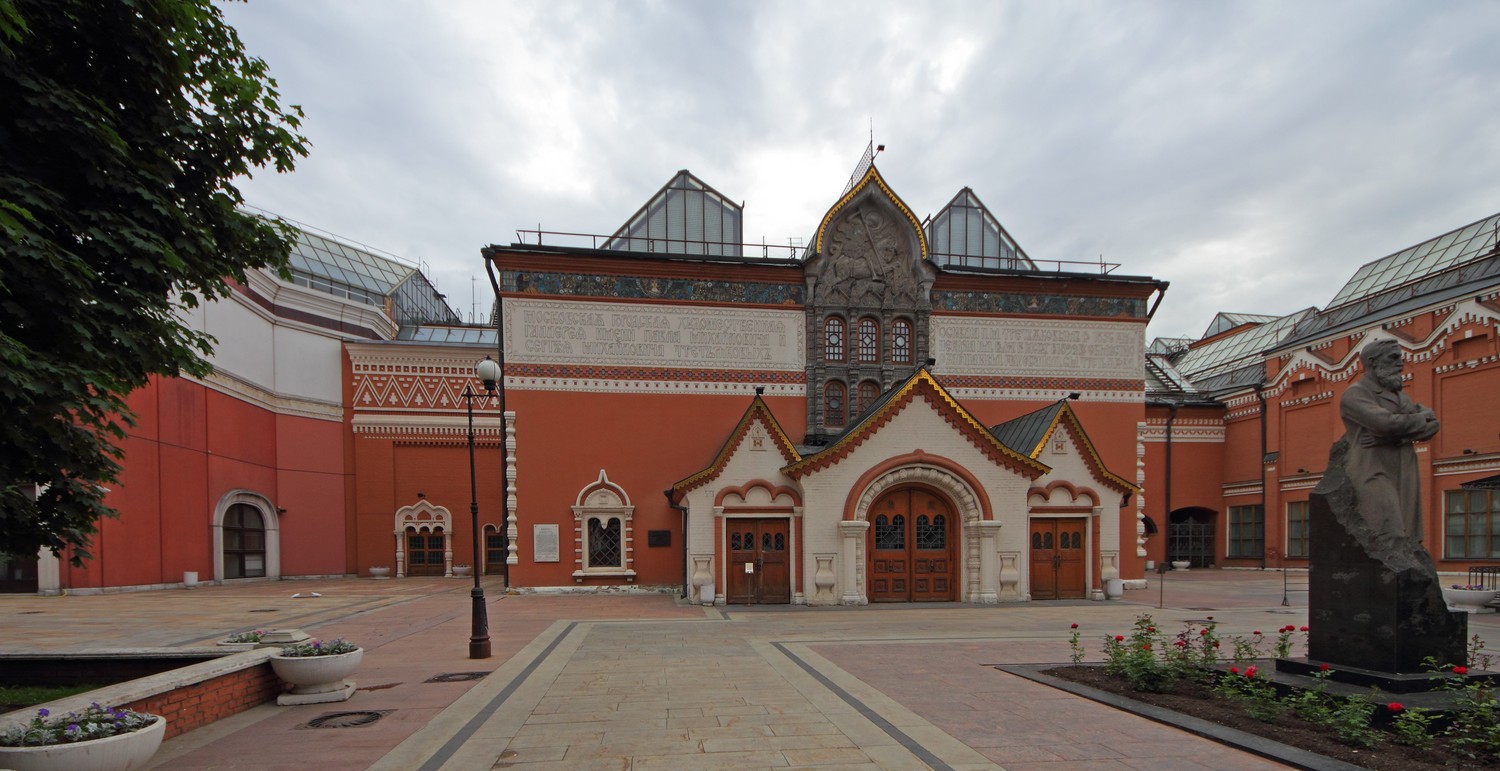
Located on Lavrushinsky Lane, the main building occupies a space to the south of the Moscow Kremlin. Its scale remains intimate, a quality preserved from its origins as a private residence for the Mamontov family. This domestic foundation lends the institution a sense of quietude, as if the walls themselves hold the memory of a home. The façade, designed by Viktor Vasnetsov, is a striking example of the Russian Revival style. It draws heavily from folklore and religious traditions, utilizing a Russian fairy-tale aesthetic that distinguishes it from the surrounding neoclassical architecture. Intricate details adorn the exterior, hinting at the nation's historical narratives through ornamental patterns. The architecture creates a specific atmosphere of permanence. One finds themselves moving through spaces that balance the grandeur of a public institution with the subtle nuances of a private estate.
The New Tretyakov Gallery Building
The second building of the Tretyakov Gallery occupies a distinct space in Moscow, situated within the Museon Park at Krymsky Val. Completed in 1983, this structure offers a departure from the historical scale of the main institution. The architecture follows the Soviet modernism style, characterized by its specific relationship to the surrounding parkland and the riverbank. Architects Yuri Sheverdyaev and Nikolai Sukoyan designed the pavilion to exist as a low, expansive form that integrates with the landscape of the Museon Park. Inside, the space is dedicated to the art of the 20th and 21st centuries. The halls accommodate the radical shifts in visual language that emerged during the early 1900s and the subsequent decades. The collection here includes works that reflect the social and political transformations of the Soviet era, as well as the experimental movements of the avant-garde. The atmosphere is one of openness, designed to house the bold experimentation of modernism. Kazimir Malevich, the Aviator, circa 1914 Wassily Kandinsky, Composition VII, 1913
Ancient Icons and Spiritual Art
The collection offers a window into medieval Russia through its assembly of ancient icons. These works provide a direct connection to the spiritual life of a bygone era. Within the halls, the presence of the Theotokos of Vladimir commands attention. The gilded surfaces and serene expressions of such figures reflect a deep devotion and meticulous craftsmanship. Spanning from the 11th to the early 20th century, the gallery's holdings trace the evolution of religious expression. The luminosity achieved through the painstaking layering of pigment and gold leaf creates a specific atmosphere of reverence. To stand before these icons is to encounter the visual language of a long-standing tradition.
Exhibitions and Scholarly Research
The institution maintains a continuous dialogue between its permanent collection and the evolving currents of contemporary art. These displays often recontextualize familiar works, placing them alongside lesser-known pieces to reveal new layers of meaning and historical connection. Such scholarly inquiry ensures that the presence of the past remains active and relevant within the modern era. A notable example of this approach is the exhibition "To See the Unknown," which brings together works from various periods to foster fresh perspectives. This specific curation includes paintings by Fedor Alekseev and Wassily Kandinsky, allowing for a direct comparison of different stylistic languages. By placing these works in conversation, the gallery facilitates a deeper understanding of how artistic expression has shifted through the centuries. The effort to preserve these treasures while engaging with current trends keeps the collection in a state of constant, living relevance.
5 facts on Tretyakovi kunstgalerii
- Kes asutas Tretyakovi kunstgalerii 1856. aastal?Pavel Mihhailovitš Tretyakov
- Kes kirjastas peahoone silmapaistva façade'i Vene uuenemiskunstide stiilis?Viktor Vasnetsov
- Millises linnas asub Riiklik Tretyakovi kunstgalerii?Moskva
- Milline kunstnik on tuntud galeriis olevast ikoonilisest teosest 'Must ruut'?Kazimir Malevich
- Tretyakovi uue kunstgalerii asub millises pargis?Museon park
Keep reading
Three articles for collectors


How the top 25 is ranked
Fame decides the order among the paintings of Tretyakovi kunstgalerii in our catalogue: how many Wikipedia editions have an article on the painting, where our team ranks it, and how often its page is opened on ArtsDot.com. A painting catalogued twice is counted once, and details, copies, studies, sculptures and works on paper are set aside. The facts shown — date, size, medium — are those of each painting's record; the notes come from its description.
Also on ArtsDot.com