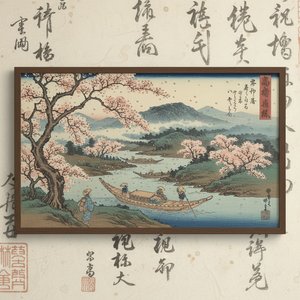
The Legacy of Shūgetsu Tōkan
In the annals of art history, few names evoke the quiet majesty of the Muromachi period quite like Shūgetsu Tōkan. Born in the mid-15th century, around 1450, Tōkan emerged during a transformative era in Japanese aesthetics, a time when the influence of Zen Buddhism and the refined tastes of the aristocracy began to merge with a burgeoning appreciation for the natural world. His life, spanning the late 15th and early 16th centuries, was defined by a pursuit of spiritual clarity through the medium of ink and brush, contributing to a lineage of artists who sought to capture not just the appearance of nature, but its very essence.
The work of Tōkan is deeply rooted in the traditions of suibokuga, or monochrome ink wash painting. This style, heavily influenced by Chinese Song and Yuan dynasty masters, relies on the subtle interplay of light and shadow, achieved through varying concentrations of ink on paper or silk. Tōkan’s mastery lay in his ability to use a single shade of black to suggest an infinite spectrum of textures—the rugged bark of an ancient pine, the ephemeral mist clinging to a mountain peak, or the delicate translucency of a falling petal. His compositions often embraced the concept of ma, or negative space, allowing the unpainted areas of the scroll to breathe and represent the vastness of the sky or the stillness of a void.
Artistic Evolution and Symbolism
As Tōkan’s career progressed, his brushwork evolved from structured, formal depictions toward a more spontaneous and expressive manner. This development mirrored the broader shifts in Japanese art, moving away from rigid imitation toward a more personal, emotive interpretation of reality. His landscapes were rarely mere topographical records; instead, they served as meditative landscapes designed to evoke wabi-sabi—the beauty found in imperfection, impermanence, and simplicity. Through his work, the viewer is invited to contemplate the transient nature of existence and find solace in the enduring rhythms of the natural world.
The symbolism embedded within Tōkan’s repertoire provided a profound layer of meaning for his contemporary audience. Every element chosen for his compositions carried weight:
- Mountains and Mist: Representing the eternal and the unknowable, serving as a bridge between the earthly realm and the divine.
- Bamboo and Pine: Symbols of resilience, strength, and longevity, standing firm against the seasonal shifts of life.
- Water and Flow: Embodying the concept of constant change and the fluid nature of time and consciousness.
Historical Significance and Enduring Influence
Though much of the specific biographical detail regarding Tōkan’s personal life remains shrouded in the mists of history, his impact on the trajectory of Japanese ink painting is undeniable. He stood at a pivotal moment when the aesthetic values of the Zen monk-painters were being integrated into a more secular, yet still deeply spiritual, artistic culture. His ability to balance technical precision with poetic abstraction helped lay the groundwork for subsequent generations of masters who would further refine the language of monochrome landscape.
Today, the legacy of Shūgetsu Tōkan lives on in the way we perceive the relationship between humanity and nature. His works remain vital touchstones for understanding the spiritual depth of the Muromachi period, reminding us that true artistry lies in the ability to capture the profound within the seemingly simple. Through his delicate washes and powerful strokes, Tōkan continues to offer a vision of tranquility that transcends the centuries, inviting every generation to find stillness in an ever-changing world.