Piotr Ossovski: A Visionary of Soviet Modernism
Born in Malyn, Ukraine (then part of the Russian Empire) in 1925, Piotr Pavlovich Ossovsky’s life and artistic journey were inextricably linked to the shifting landscapes and turbulent times of the 20th century. His early years, steeped in the rural traditions of his Ukrainian homeland, provided a foundational understanding of the natural world – an element that would profoundly shape his mature work. Ossovski's artistic development unfolded against the backdrop of the rise of Soviet Russia, a period marked by both immense social and political upheaval and a fervent embrace of modern art movements. This duality is perhaps most evident in his distinctive style: a potent blend of traditional Russian landscape painting with the bold experimentation characteristic of early 20th-century modernist approaches.
Ossovski’s artistic training began formally, though it was likely supplemented by self-study and exposure to the evolving art scene. He quickly established himself as a painter deeply invested in capturing the essence of his surroundings. Initially, his work leaned towards realistic depictions of rural life – scenes of farmers, harvests, and village gatherings. However, this early foundation served merely as a springboard for his subsequent exploration of more abstract and symbolic forms. The influence of movements like Constructivism and Suprematism is palpable in his later works, particularly in the simplification of shapes and the emphasis on geometric elements within his compositions.
The Palette of Industry and Faith
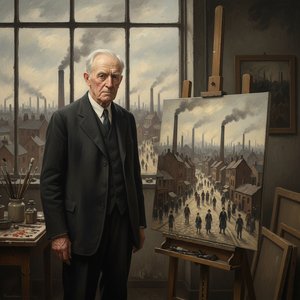
Ossovsky’s artistic output spanned a remarkable range of subjects, yet certain themes consistently recurred throughout his career. He was particularly celebrated for his evocative portrayals of industrial landscapes – factories billowing smoke into the sky, railway lines snaking across vast plains, and power plants dominating the horizon. These weren't simply depictions of machinery; they were meditations on the relationship between humanity and technology, often imbued with a sense of both awe and unease. He masterfully rendered the textures of metal, brick, and concrete, capturing the raw energy and imposing scale of these monumental structures.
Equally compelling was his work depicting churches and religious scenes. These paintings weren’t traditional iconographic representations but rather explorations of spirituality through form and color. He frequently employed a muted palette – blues, grays, and ochres – to evoke a sense of solemnity and contemplation. The architecture itself became the primary subject, with soaring spires and intricate facades rendered in meticulous detail. These works suggest an interest not just in religious belief but also in the enduring power of faith within a rapidly changing world.
Recognition and Legacy
Ossovsky’s artistic merit was formally recognized by the Soviet authorities, culminating in prestigious awards that cemented his place among Russia's leading artists. In 1970, he received the title of “Merited Artist of the RSFSF,” a significant honor bestowed upon those deemed to have made substantial contributions to the nation’s cultural heritage. Further solidifying this recognition, he was awarded the title of “People’s Artist of the RSFSF” in 1986 – a testament to his enduring influence and widespread acclaim.
His work has been exhibited extensively throughout Russia and beyond, demonstrating its appeal across diverse audiences. A notable example is "Ballad of the Revolution. Triptych," a powerful and complex composition that encapsulates many of the themes central to Ossovski’s oeuvre – industrial progress juxtaposed with revolutionary fervor. This piece, along with his numerous other works, offers a valuable window into the artistic landscape of the Soviet era and provides insights into the evolving relationship between art, ideology, and society.
A Lasting Impression
Piotr Ossovski’s career spanned nearly seven decades, witnessing profound transformations in Russia and the world. He died in 2015, leaving behind a substantial body of work that continues to resonate with viewers today. His paintings are not merely representations of landscapes or buildings; they are imbued with a deep sense of place, history, and human experience. Ossovski’s legacy lies in his ability to capture the spirit of an era – the dynamism of industrialization, the enduring power of faith, and the complexities of life within the Soviet Union – through a uniquely personal and compelling artistic vision.