Menu
TASUTA KUNSTIKONSULTATSIOON

1429 - 1512

Lühike info

  • Art period: Renaissance
  • Died: 1512
  • Works on APS: 21
  • Mediums: oil on canvas
  • Copyright status: Public domain
  • Movements: early renaissance
  • Museums on APS:
    • Santa Maria della Salute
    • Santa Maria della Salute
    • Santa Maria della Salute
    • Gallerie dell'Accademia
    • Gallerie dell'Accademia
  • Veel…

Kunstiviktoriin

Iga küsimuse kohta on ainult üks õige vastus.

Küsimus 1:
Where was Lazzaro Bastiani born?
Küsimus 2:
In what year did Bastiani begin his artistic career in Venice?
Küsimus 3:
With whom did Bastiani collaborate on the Scuola Grande di San Marco projects?
Küsimus 4:
Bastiani is known for painting which biblical scene?
Küsimus 5:
What was Bastiani’s pupil?

Lazzaro Bastiani: Venetian Renaissance Painter

Lazzaro Bastiani (1429 – 5 April 1512) stands as a significant, albeit somewhat enigmatic, figure within the Venetian artistic landscape of the fifteenth and sixteenth centuries. Born in Padua, he emerged as a painter during a period marked by burgeoning humanist ideals and unparalleled artistic innovation—a time when Venice reigned supreme as a commercial powerhouse and cultural epicenter. While his output wasn’t as prolific or celebrated as contemporaries like Titian or Bellini, Bastiani nonetheless contributed substantially to the stylistic evolution of Venetian painting, particularly within the Scuola Grande di San Marco and its associated workshops.

Early Career & Patronage

Bastiani's artistic journey began in Padua, where he honed his skills under the tutelage of Andrea Mantegna—a master whose influence is palpable in Bastiani’s early works. Records indicate that he swiftly established himself as a painter in Venice by 1460, securing commissions for altarpieces commissioned by the Procurators of San Marco, demonstrating an immediate grasp of the prevailing artistic tastes and expectations of the Venetian elite. Notably, his payment rate mirrored that of Giovanni Bellini at the time, signifying his recognition as a rising talent within the influential Bellini workshop—a connection that undoubtedly shaped his stylistic development. This association with Bellini wasn’t merely professional; it fostered intellectual exchange and cemented Bastiani's position within Venice’s artistic milieu.

The Scuola Grande & Collaborative Spirit

Bastiani’s involvement with the Scuola Grande di San Marco proved pivotal to his career. From the 1480s onwards, he collaborated closely with Gentile Bellini, engaging in ambitious projects aimed at glorifying Venetian civic pride and commemorating important religious events. Their partnership exemplifies the collaborative spirit characteristic of Venetian painting during this era—a tradition where artists honed their craft through shared experimentation and mutual inspiration. The Scuola Grande’s patronage provided Bastiani with invaluable opportunities to develop his technique and explore complex compositional strategies, as evidenced by monumental paintings like ‘The Coronation of the Virgin,’ a masterpiece showcasing meticulous detail and expressive color palettes.

Notable Paintings & Artistic Style

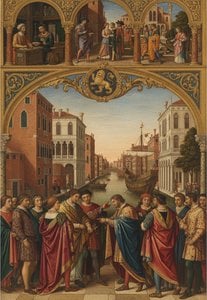
Bastiani's oeuvre comprises several noteworthy works that illuminate his artistic vision. Among these are ‘St Jerome on the Nut Tree,’ a poignant depiction capturing the saint’s contemplative solitude amidst nature—a motif frequently employed by Venetian artists to convey spiritual contemplation. Furthermore, he produced striking depictions of biblical narratives, including ‘The Nativity,’ demonstrating an adeptness at conveying emotion and narrative depth through carefully crafted imagery. His collaboration with Vittore Carpaccio on commissions for the Fondaco dei Tedeschi further solidified his reputation as a skilled painter capable of adapting to diverse stylistic demands. Bastiani’s style is characterized by a restrained palette, meticulous attention to detail, and a subtle use of impasto—techniques that imbue his paintings with textural richness and visual dynamism. He skillfully blended influences from Florentine Renaissance art with Venetian traditions, resulting in an aesthetically sophisticated oeuvre that reflects the broader artistic currents of its time.

Legacy & Historical Significance

Though Bastiani’s name may not resonate as loudly as some of Venice's artistic giants, his contribution to Venetian painting—particularly within the Scuola Grande—cannot be overstated. He represents a crucial link between Mantegna and Bellini, embodying the stylistic continuity that defined Venetian art during the High Renaissance. His paintings serve as valuable documents for understanding the visual culture of fifteenth-century Venice and offer insights into the artistic debates surrounding humanist ideals and religious iconography. Lazzaro Bastiani’s legacy resides not merely in his individual artworks but also in his role as a participant in Venice's vibrant artistic community—a testament to the enduring power of collaboration and innovation within the Renaissance spirit.