


1


Uuendatud november 2026 · järjestatud meie populaarsusindeksi järgi (otsingud, külastused ja tellimused igale teosele) · 5 teost Lambert Simon meie kataloogis
Lühidalt
Kui teate ühe Lambert Simon maali, siis see on tõenäoliselt Adoration of the Lamb of God, four singing angels with banners (1933), mis ripub Museum Catharijneconvent-is, Utrecht. Portrait of Johannes Maria Vianney, also called the Curé of Ars (1940) ja Pieta (1950) täiendavad kolme kohe ära tundetava teose sarja. Meie kataloogis on 5 teost kunstnikult Lambert Simon. Allpool on 5 kõige tuntumat teost koos aasta, asukoha ja eripärase kirjeldusega.


Muuseum, milles on kõige rohkem sellel lehel esitatud maaleid.
| Muuseumid | Linn | Lambert Simon teosid | Selle nimekirja maalid |
|---|---|---|---|
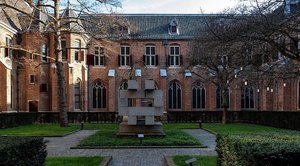 Museum Catharijneconvent |
Utrecht | 5 | Adoration of the Lamb of God, four singing angels with banners, Portrait of Johannes Maria Vianney, also called the Curé of Ars, Pieta |
Vali vuosakülg, et näha selle erimärgilisi teost.
Nimekirja tipis on Adoration of the Lamb of God, four singing angels with banners (1933), Museum Catharijneconvent, Utrecht. Kohe selle järel: Portrait of Johannes Maria Vianney, also called the Curé of Ars (1940) ja Pieta (1950).
24 aastat vanus. Lambert Simon sündis aastal 1909 ning teos Adoration of the Lamb of God, four singing angels with banners pärineb aastast 1933.
Meie kataloogist leiate 5 teost kunstnikult Lambert Simon, mis on pärinev ajavahemikus 1933 kuni 1963.
Enamik neist on leetav Museum Catharijneconvent (Utrecht). Ülemal oleval muuseumite ninal on täielik ülevaade.
1950s ahel on rohkem kui kunagi varem: 2 5 teoseid sellel lehel pärineb sellest ajast, მათtagu Pieta.
Kõige vanem teos siin on Adoration of the Lamb of God, four singing angels with banners (1933); kõige värskeim on Portrait of Johannes de Jong (1885-1955) (1963).
Sellel lehel on Museum Catharijneconvent, Utrecht kogumikus 5 teost, sealhul ka Adoration of the Lamb of God, four singing angels with banners, Portrait of Johannes Maria Vianney, also called the Curé of Ars ja Pieta.
The creative trajectory of Lambert Simon begins in Den Helder, Netherlands, where he was born on July 20, 1909. His professional activity spans over six decades, a period of constant production that stretches from 1924 until his death in Utrecht on October 10, 1987. He was a versatile figure in the Dutch art scene, working across various media. His hands moved between the precision of drawing and the physical demands of sculpture and muralism. He was a painter, draftsman, sculptor, muralist, and glass painter.
His life was marked by movement between significant urban centers. He lived and worked in Den Helder, Paris, and Utrecht. In Utrecht, he became a member of the Genootschap Kunstliefde. This period of his life saw him expanding his reach beyond the canvas, engaging with the architectural and spiritual spaces of the Netherlands through his work in glass and murals. His presence in the art world was defined by this breadth of technical skill, moving from the intimate scale of a watercolorist to the monumental scale of a mosaicist.
Simon’s professional life moves between the coastal atmosphere of Den Helder and the urban centers of Paris and Utrecht. In Utrecht, his presence is marked by his membership in the Genootschap Kunstliefde. This affiliation places him within the specific artistic circles of the city, connecting his practice to the local institutional landscape.
The act of instruction forms a significant part of his career. He moves from the classroom to the studio, sharing technical knowledge with the next generation of practitioners. His teaching roles are split between different academic environments, spanning from the southern reaches of the Netherlands to the central provinces.
He holds positions at two distinct institutions. In Breda, he provides instruction at the St. Joostacademie. His influence extends to Utrecht, where he teaches at the Vrije Academie. These roles establish him as a figure active in both formal and alternative educational settings.
In 1945, the focus shifts to the Begijnhofkapel in Amsterdam. To mark the 600th anniversary of the Miracle of Amsterdam, Simon produces eight paintings. These works are positioned along the edge of the balustrade. They remain hidden for decades, only to be rediscovered in June 2012.
The scale of his work expands in Nijmegen between 1957 and 1959. Here, he executes four large stained-glass windows for the Antonius van Paduakerk. These windows consist of a rosette with three registers. The commission celebrates the 40th anniversary of the church and the jubilee of dean-pastor C. van Dijk. The iconography of these windows reflects the Bible-oriented Nouvelle Théologie, a French movement that influenced the Netherlands in the decades following the Second World War.