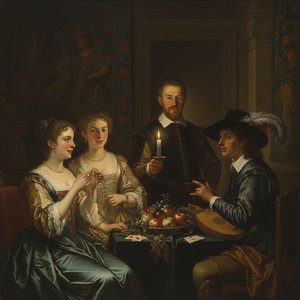
The Enigmatic Origins of a Master
Gerard Soest remains one of the most intriguing enigmas of the seventeenth-century art world, a painter whose very origins are draped in the mists of historical debate. While tradition once placed his birth in the German town of Soest, modern scholarship suggests a more Dutch lineage, perhaps emerging from the fertile artistic soil near Utrecht. His early training in Düsseldorf under the guidance of Johann Christoph Dobson provided him with a formidable foundation, instilling in him a penchant for meticulous detail and the dramatic interplay of light and shadow. As he migrated toward England in the late 1640s, Soest brought with him a burgeoning mastery of the Baroque style, ready to imprint his unique vision upon the faces of a changing nation.A Master of Light and Psychological Depth
The true brilliance of Soest lies not merely in the replication of features, but in his profound ability to evoke the psychological depth of his subjects. Drawing heavily from the influence of William Dobson, Soest utilized a striking chiaroscuro technique that breathed life into every canvas. His brushwork transformed mere oil and pigment into windows of human emotion, where the soft glow of light might illuminate a furrowed brow or a contemplative gaze. This mastery is perhaps most famously realized in his depictions of literary giants such as William Shakespeare and Samuel Butler. In these works, he does not simply present a likeness; he constructs a narrative of intellect and character, bridging the gap between the sitter and the spectator through a shared moment of silent intensity.The Chronicler of the English Gentry
Though he never ascended to the heights of royal patronage or the glittering courts of kings, Soest carved out a significant niche within the English social fabric. He became the preferred chronicler for the English gentry, capturing the dignity and opulence of an era through portraits that served as both status symbols and intimate legacies. His 1675 masterpiece, Lady Borlase, stands as a pinnacle of his achievement, showcasing a breathtaking command of texture—from the heavy sheen of aristocratic silks to the delicate refinement of lace. His repertoire was vast, capturing the essence of the era through notable figures:- Thomas Stanley, rendered with a dramatic realism that speaks to the weight of his station;
- John Wallis, where the artist’s ability to convey scholarly gravity is on full display;
- Thomas Cartwright, an exploration of elegance and historical precision.
Küsimused ja vastused
Millises ajaloolises perioodis töötas Gerard Soest?
Gerard Soest töötas Early Modern perioodil. See ajastu määratleb kunstniku tegevuse ajaloolisel kontekstil.
Mille teiste nimetega on Gerard Soest tuntud?
Kunstnik Gerard Soest tuntub ära ka nime all Gerald Soest, Gerard Soeste, Gerard Zoust, Gerard Van Zoest, Gilbert Soest.
Kuidas Gerard Soest kunst ajas arenes?
Gerard Soest karjäär avaneb perioodide kaupa kunstniku Kronika lehel: teoste horisontaalne ajajoon, mis on jaotatud karjääriperioodide peatükkidesse.