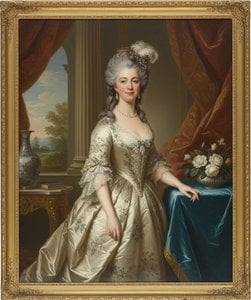
The Engraver’s Hand and the Painter’s Eye
Francis Kyte lived a life defined by the precision of the line and the gradual shift from the shadow of the mezzotint to the color of the canvas. Active during the early to mid-18th century, he began his career not with a brush, but with the heavy, velvety textures of the engraver’s tool. For two decades, his hands were dedicated to the meticulous work of mezzotint, translating the likenesses of the fashionable and the famous into prints for the London publishing trade. He was a craftsman of the popular image, working closely with prominent printsellers such as Edward Cooper and later John Bowles to satisfy a public hungry for the faces of their era.
His early years were spent in the service of others' visions, translating the portraits of established masters into reproducible art. This period of technical discipline provided the foundation for his later transition into original portraiture. By the 1740s, the man who had spent twenty years etching the likenesses of others began to assert his own presence as a painter. This evolution from the monochromatic world of printmaking to the nuanced application of oil on canvas marked a significant shift in his professional identity.
A Career in Transition
The trajectory of Kyte's professional life can be understood through the specific roles he occupied within the London art market. His output was characterized by a dual mastery of medium and a steady progression in his artistic agency.
- Mezzotint Engraver: Produced numerous portraits for the publishing trade, including 32 works for the "Worthies of Britain" series.
- Portrait Painter: Transitioned to oil painting in the 1740s, focusing on individual likenesses.
His technical skill as an engraver was frequently applied to the works of others, ensuring his name was synonymous with the high-quality reproduction of contemporary portraiture. He worked from the likenesses of figures such as Elizabeth I and various members of the nobility, often following the compositions of Sir Godfrey Kneller. This period of intense reproduction allowed him to master the subtleties of light and shadow, a skill that would inevitably inform his later work as a painter.
The Final Portraits
In his later years, Kyte’s work moved into the realm of the original portrait, where he sought to capture the character of his subjects through paint. His most notable contributions from this period include his depiction of George Frideric Handel, a work that remains a significant reference point for his legacy. His ability to move from the mechanical precision of the engraver to the more fluid, expressive requirements of oil painting demonstrates a versatility common to the skilled artisans of the Georgian era.
The remnants of his career are held in significant collections, including the Detroit Institute of Arts and the National Portrait Gallery in London. These works, such as his 1741 portrait of Mrs. E.B. and his 1742 depiction of Handel, represent the culmination of a life spent observing and recreating the human face. He remains a figure of the London art scene, a man who understood both the commercial necessity of the print and the individual dignity of the painted portrait.