Menu
TASUTA KUNSTIKONSULTATSIOON

Lühike info

  • Also known as: Sirius Kärb
  • Born: 1862, Utica, USA
  • Top 3 works:
    • Listening to the Water Ousel
    • Montreal
    • On the Cliffs
  • Copyright status: Public domain
  • Room fit: elutuba
  • Nationality: USA
  • Creative periods:
    • mature period
    • early modern
  • Emotional tone: rahu ja vaikus
  • Gift suitability: other-none
  • Movements: symbolism
  • Mediums: õlimaal kangaruumil
  • Veel…
  • Vibe:
    • eeterlik
    • rahu ja sereniteit
  • Art period: 19. sajus
  • Works on APS: 560
  • Lifespan: 66 years
  • Typical colors: other
  • Color intensity:
    • eeremad
    • tasakaalustatud
  • Died: 1928
  • Top-ranked work: Listening to the Water Ousel
  • Best occasions: aktsent
  • Museums on APS:
    • The Phillips Collection
    • Detroit Institute of Arts
    • Detroit Institute of Arts
    • Detroit Institute of Arts
    • Detroit Institute of Arts

Kunstiviktoriin

Iga küsimuse kohta on ainult üks õige vastus.

Küsimus 1:
Kuidas nimetatakse Arthur B. Davies suurimat kunstilist tööd?
Küsimus 2:
Kes oli üks olulisemaid kunstnikke, kes organiseeris Armory Show ekspressiooni?
Küsimus 3:
Mis oli Arthur B. Davies maalide keskendus?
Küsimus 4:
Kes oli Arthur B. Davies ametnik kunstimaailmas?
Küsimus 5:
Mis jäi Arthur B. Davies isiku kohta avalikuks pärast surmani?

Arthur Bowen Davies (1862-1928): A Key Figure in American Modernism & the Ashcan School

Arthur Bowen Davies, born September 26, 1862, in Utica, New York—the son of English and Welsh parents who immigrated to the United States in 1856—occupies a uniquely complex position within the narrative of American art. He wasn’t merely *of* his time—the tumultuous era bridging the 19th and 20th centuries—but actively shaped it, serving as both a conduit for European modernism and a champion of distinctly American artistic voices. His journey began with an early fascination for landscape painting, sparked by a touring exhibition that showcased the works of George Inness and the Hudson River School masters. This initial exposure instilled in him a reverence for nature’s beauty and a technical proficiency that would remain hallmarks of his style throughout his career—a foundation upon which he built a distinctive artistic vision.

Early Influences & Artistic Training

Davies's formative years were marked by rigorous academic training. He studied at the Chicago Academy of Design in 1878 and at the Art Students League in New York in 1887, absorbing the stylistic precepts of Impressionism and honing his observational skills. These influences—particularly Inness’s atmospheric landscapes and Millet’s depictions of rural life—would profoundly shape his artistic sensibilities. However, Davies quickly recognized that mere imitation was insufficient; he possessed an inner yearning to express something beyond the purely representational—a desire to capture not just what he *saw*, but what he *felt*. This conviction fueled his exploration of Symbolist aesthetics and propelled him toward a more profound engagement with spiritual themes.

The Ashcan School & The Armory Show: A Catalyst for Change

Davies’s artistic development unfolded against the backdrop of significant social and cultural shifts. He became associated with “The Eight,” a group of artists who challenged the conservative norms of the National Academy of Design in 1908—a rebellion against academic dogma that signaled a decisive break from tradition. Where artists like John Sloan focused on gritty depictions of urban life—documenting the harsh realities of New York City’s tenements and streets—Davies sought refuge in a more ethereal realm. His paintings weren't about documenting the visible world; they were about evoking moods, dreams, and spiritual longings. Nevertheless, his involvement with The Eight demonstrated his commitment to artistic independence and his willingness to confront established conventions. This spirit of rebellion culminated in his pivotal role as one of the organizers of the 1913 Armory Show—a watershed moment that introduced European modernism (Cubism, Fauvism, Futurism) to a largely unsuspecting American public. The show was met with both outrage and excitement, irrevocably altering the course of American art history. Davies’s contribution wasn't merely logistical; he possessed an exceptional understanding of contemporary artistic trends and a keen eye for talent—making him instrumental in selecting the works exhibited. He understood that art needed to reflect the changing world, even if that meant embracing radical new forms.

A Language of Symbolism & Ethereal Visions

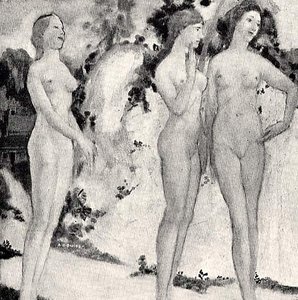
Davies’s mature style is characterized by its lyrical quality, delicate brushwork, and evocative use of color. His paintings often feature figures—often women or mythological beings—immersed in dreamlike landscapes. These aren't portraits in the traditional sense; they are archetypal representations of human emotions and spiritual states. Unicorns: Legend, Sea Calm, perhaps his most famous work, exemplifies this approach. The painting depicts a group of ethereal figures frolicking with unicorns on a tranquil shore—a scene that is both enchanting and deeply symbolic. His works frequently explore themes of longing, loss, and the search for transcendence. He wasn’t interested in depicting reality as it *is*, but rather as it *feels*. This emphasis on subjective experience aligns him with Symbolist painters like Odilon Redon and Pierre Puvis de Chavannes—artists who sought to express inner truths through evocative imagery. Davies's palette is often muted and harmonious, creating a sense of atmosphere and mystery. He masterfully employed techniques such as glazing and scumbling to achieve luminous effects and subtle gradations of tone. His art invites contemplation, urging viewers to look beyond the surface and delve into the realm of the imagination.

Legacy & Influence

Arthur B. Davies’s legacy extends far beyond his own artistic output. He was a pivotal figure in the development of American modernism—bridging the gap between traditional aesthetics and avant-garde experimentation. His influence can be seen in the work of subsequent generations of artists who continued to explore themes of spirituality, symbolism, and emotional expression. He remains a testament to the power of art to transcend boundaries—both artistic and personal—and his paintings continue to resonate with viewers seeking beauty, mystery, and a glimpse into the hidden depths of the human soul. His unwavering belief in the transformative potential of art cemented his place as one of America’s most visionary artists.