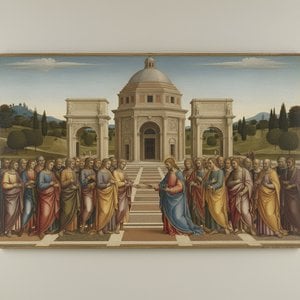
The Sienese Master: The Life and Legacy of Andrea di Vanni
In the golden light of the fourteenth century, within the winding, terracotta-hued streets of Siena, a painter emerged whose brush would capture the spiritual essence of the Early Renaissance. Andrea di Vanni d'Andrea, known simply as Andrea di Vanni, was more than just a practitioner of religious iconography; he was a man deeply woven into the very fabric of his city’s civic and spiritual identity. Born around 1332, Vanni’s life unfolded during a transformative era for Italian art, a period where the delicate elegance of the Gothic tradition began to meet the burgeoning structural ambitions of the Renaissance.
While historical records regarding his earliest years remain somewhat veiled in mystery, we first encounter his presence in the artistic landscape around 1353. During this formative period, he was associated with the esteemed painter Bartolo di Fredi, a connection that likely provided him with the technical foundation necessary to navigate the demanding workshops of Siena. However, Vanni was not merely a man of the studio; his life was marked by a remarkable duality between artistic creation and civic duty. He played an active role in the governance of Siena, holding prestigious offices such as gonfaloniero and serving as an envoy to the Papal court. This unique position allowed him to exist at the intersection of political power and religious devotion, a vantage point that undoubtedly informed the gravity and importance found within his compositions.
A Tapestry of Influence and Technique
To understand the visual language of Andrea di Vanni, one must look toward the masters who preceded him. His style breathes with the lingering grace of Simone Martini and Pietro Lorenzetti, the titans of Sienese painting. From Martini, Vanni inherited a penchant for lyrical lines and a certain ethereal quality, while from Lorenzetti, he drew a sense of weight and emotional presence. His work often eschews the heavy use of chiaroscuro—the dramatic play of light and shadow—in favor of a striking, almost silhouette-like design. This technique creates a powerful graphic impact, particularly when set against the luminous, unyielding gold backgrounds so characteristic of Sienese devotional art.
One of his most breathtaking achievements is the polyptych housed in the church of Santo Stefano alla Lizza. In this masterpiece, the viewer is confronted with a central portrait of the Virgin and Child that commands the space through sheer coloristic brilliance. The Madonna is rendered as a dark, elegant pattern against her gilded throne, creating a visual rhythm that feels both ancient and strikingly modern. This ability to balance intricate ornamentation with bold, simplified forms allowed his work to resonate deeply within the liturgical spaces of his era.
Fragments of a Vanished Splendor
The true breadth of Vanni’s oeuvre remains a poignant subject for art historians, as much of his legacy has been lost to the ravages of time. Many of his most ambitious projects, including portraits of Saint Catherine of Siena and scenes from the life of Saint James, have disappeared into the shadows of history. Yet, the fragments that remain—such as the Enthroned Madonna in the transept of San Francesco or the fragmented Crucifixion now held in the Istituto delle Belle Arti—serve as vital windows into his creative soul.
Even in these surviving pieces, we see a painter dedicated to the commemorative and the sacred. His work was often commissioned to honor saints and celebrate the continuity of faith within the Sienese community. Though he may not possess the global fame of some of his contemporaries, Andrea di Vanni d'Andrea remains an indispensable figure for understanding the evolution of the Sienese school. He stands as a testament to an era where art, politics, and piety were inextricably linked, leaving behind a visual heritage that continues to whisper the glories of the early Italian Renaissance.