

Beyond Paradise: Gauguin's Primitivism, Symbolism & the Human Condition
Sisukord
The Rejection of Realism: Gauguin's Early Dissatisfaction
In the arts of the Western world, Primitivism is a mode of aesthetic idealization that means to recreate the experience of the primitive time, place, and person, either by emulation or by re-creation. In Western philosophy, Primitivism proposes that ...
Paul Gauguin’s artistic journey was not one of gradual evolution, but a deliberate and often turbulent rebellion against the established norms of his time. Born into a comfortable Parisian existence in 1848, he initially pursued a career in finance – a path dictated by societal expectations rather than personal passion. Yet, even within the rigid world of stockbroking, a yearning for something more profound simmered beneath the surface. His early attempts at painting were largely self-taught, fueled by visits to galleries and an increasing dissatisfaction with the purely representational aims of Impressionism. While he initially dabbled in the techniques of Monet and Pissarro, Gauguin soon found himself frustrated by their focus on fleeting moments of light and color. He wasn’t interested in merely *recording* what he saw; he sought to express something deeper – an emotional truth that lay beyond the visible world. This nascent discontent would ultimately propel him away from the Parisian art scene and towards a radical redefinition of artistic purpose, one rooted in symbolism and a search for primal authenticity.
Brittany & The Seeds of Primitivism: Finding Inspiration in 'Savage' Cultures
 Young Girl Dreaming (also known as Study of a Child Asleep, the Painter's Daughter, line, rue Carcel)
Paul Gauguin
The turning point came with Gauguin’s move to Brittany in the early 1880s. Drawn by the region’s rugged landscapes, devoutly religious communities, and perceived simplicity of life, he began to explore themes of spirituality, folklore, and the power of myth. Brittany offered a stark contrast to the urban sophistication of Paris, and Gauguin was captivated by what he saw as an unspoiled culture, untouched by the corrupting influences of modernity. He wasn’t simply painting Breton peasants; he was seeking to capture their essence – their connection to the land, their unwavering faith, and their perceived closeness to a more fundamental human experience. This fascination with “primitive” cultures, as they were then understood, marked the beginning of his lifelong quest for artistic renewal. Paintings like Four Breton Girls demonstrate this shift; figures are not rendered realistically but rather as flattened forms imbued with symbolic meaning, foreshadowing his later work and a growing rejection of academic perspective. This period was crucial in establishing Gauguin’s distinctive style – a bold use of color, simplified shapes, and an emphasis on emotional intensity over precise representation.
Synthetism and Cloisonnism: A New Visual Language
 Bonjour, Monsieur Gauguin
Bonjour, Monsieur Gauguin by Paul Gauguin exemplifies Post-Impressionism's bold colors and distorted forms, blending Synthetism & Cloisonism to convey emotional intensity—a masterpiece of Symbolist art.
Gauguin didn't merely *observe* these cultural elements; he actively sought to synthesize them into a new visual language. Working alongside artists like Émile Bernard, he developed the principles of Synthetism – an approach that prioritized subjective expression and symbolic content over naturalistic depiction. This meant rejecting the Impressionist emphasis on capturing fleeting optical sensations in favor of creating compositions based on abstract ideas and emotional states. Closely linked to Synthetism was Cloisonnism, a technique inspired by medieval stained glass windows and Japanese prints. Characterized by bold outlines enclosing flat areas of color, Cloisonnism allowed Gauguin to create images that were both visually striking and deeply symbolic. Bonjour Monsieur Gauguin exemplifies this style perfectly; the vibrant colors are deliberately unnaturalistic, and the figures are outlined with thick black contours, creating a sense of flatness and emphasizing the painting’s decorative qualities. This wasn't about replicating reality but constructing it – building an image from carefully chosen symbols and expressive forms.
Tahiti as Utopia: Exploring Symbolism and the Exotic
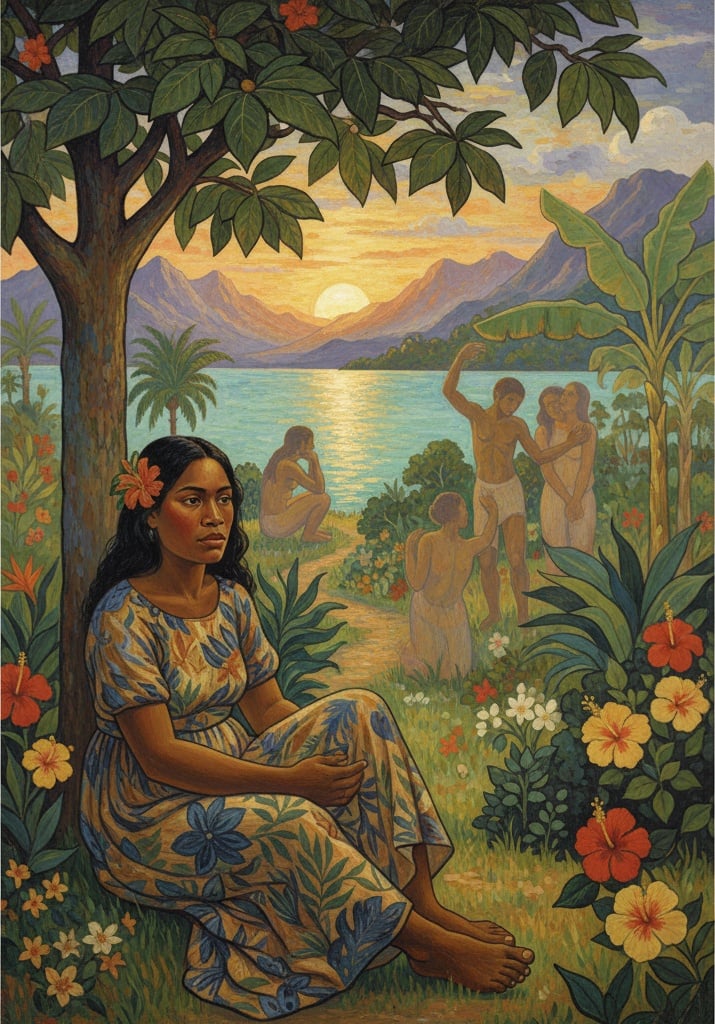
The move to Tahiti in 1891 represented the culmination of Gauguin’s artistic quest. He envisioned the island as a paradise untouched by Western civilization, a place where he could escape the constraints of European society and immerse himself in a more authentic way of life. However, his romanticized vision was often at odds with reality. While he found inspiration in the beauty of the Tahitian landscape and the perceived innocence of its people, he also grappled with loneliness, poverty, and cultural misunderstandings. Nevertheless, Tahiti provided him with an abundance of new subject matter – lush vegetation, exotic fruits, and captivating figures that became central to his artistic vision. Paintings from this period are imbued with a powerful sense of symbolism; the figures often represent allegorical concepts or embody Gauguin’s own spiritual beliefs. He sought to capture not just the physical appearance of Tahitian life but also its underlying essence – its connection to nature, its spirituality, and its perceived freedom from the constraints of Western morality. Works like Mount Sainte-Marguerite from near the Presbytery showcase his mastery of color and composition, blending serene village scenes with bold, expressive forms.
The Weight of Legacy: Gauguin’s Influence and Ethical Considerations
Paul Gauguin's influence on modern art is undeniable. His rejection of realism, embrace of symbolism, and pioneering use of color paved the way for movements like Fauvism and Expressionism. Artists such as Picasso and Matisse were deeply inspired by his work, recognizing in him a kindred spirit – a fellow rebel who dared to challenge artistic conventions. However, Gauguin’s legacy is not without its complexities. His romanticized portrayal of Tahitian life often overlooked the realities of colonialism and exploitation. His relationships with young Tahitian women have been subject to intense scrutiny, raising ethical questions about power dynamics and cultural appropriation. While his artistic innovations are widely celebrated, it's crucial to acknowledge the problematic aspects of his practice and engage in a critical dialogue about his work. His tireless experimentation continues to inspire, but understanding the full context of his life and art – including its darker side – is essential for appreciating his enduring impact on the world of art. ArtsDot offers high-quality reproductions of Gauguin’s masterpieces, allowing you to experience the beauty and complexity of his vision firsthand, while encouraging thoughtful reflection on his artistic journey.
Seotud artiklid

Paul Sérusier: Pioneering Synthetism & The Nabis’ Symbolic Revolution
Discover Paul Sérusier's pivotal role in the Nabis movement & the birth of Synthetism. Explore 'The Talisman,' his influence on modern art, and a deeper understanding of this symbolic revolution. Expert analysis & insights.


Beyond Impressionism: Exploring Emotional Depth & Formal Innovation in Post-Impressionist Art
Explore the profound emotional depth & formal innovations of Post-Impressionism with our expert guide. Discover Cézanne, Van Gogh, Gauguin & more. Learn about art history, collecting, and investing in this pivotal movement.

