A Glimpse Behind the Mask: Cindy Sherman's "Untitled (B)"
Within the stark confines of black and white photography lies a world of constructed identities, meticulously crafted personas brought to life by the singular vision of Cindy Sherman. Her work, particularly pieces like “Untitled (B),” isn’t about capturing a definitive self; it’s an exploration of how we perceive ourselves and others through the lens of media, societal expectations, and performance. Created in 1975, this photograph stands as a pivotal moment within Sherman's early career, foreshadowing the groundbreaking series that would cement her place as one of contemporary art's most influential figures. It’s an invitation to question the very nature of representation, prompting us to consider the roles we play and the masks we wear in our daily lives.
The Character Revealed: Costume and Performance
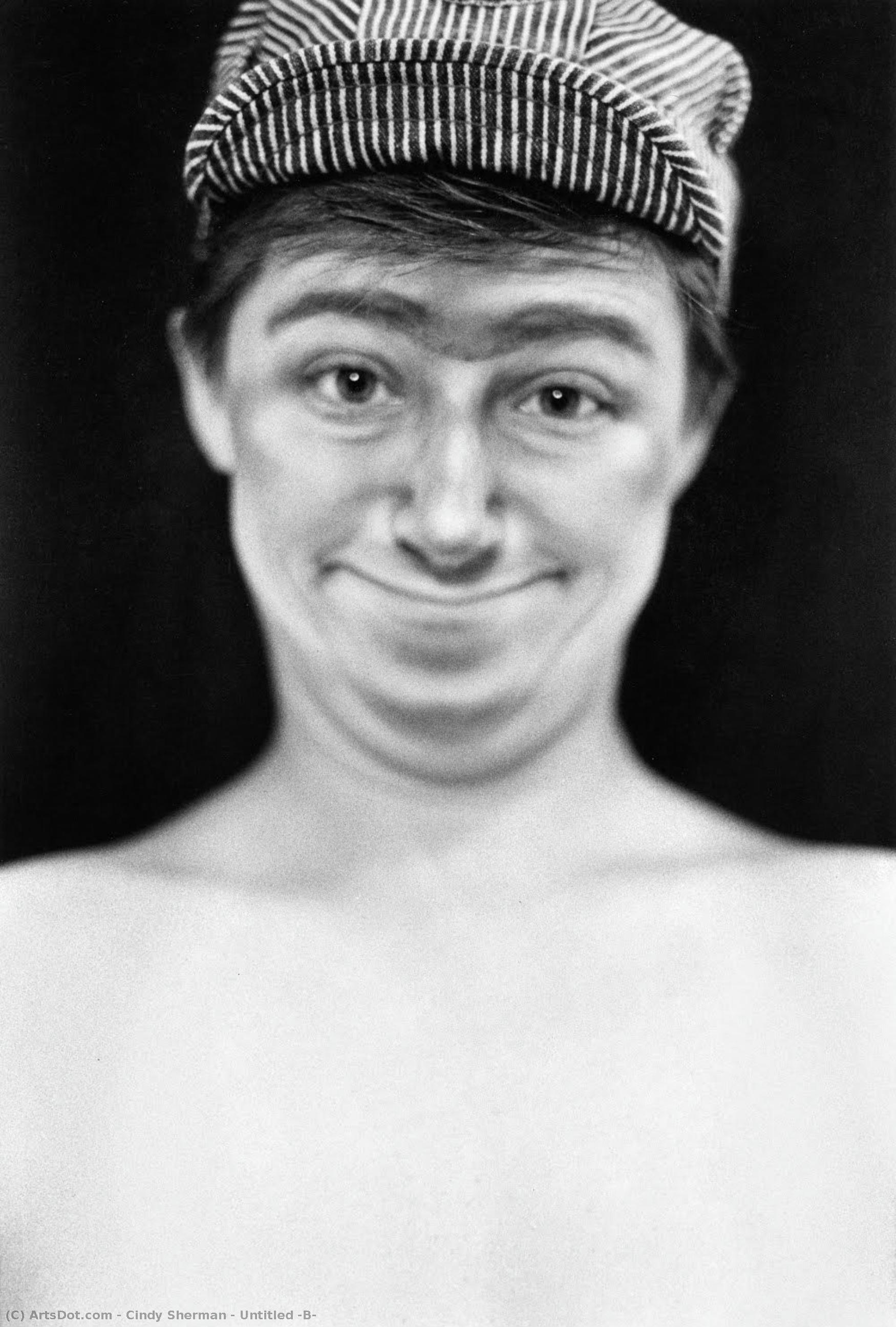
“Untitled (B)” presents a man adorned in a striking costume – a dark suit contrasted by boldly striped hat. The close-up framing focuses intently on his face, drawing us into an intimate encounter with this enigmatic figure. His expression, a subtle blend of amusement and perhaps a touch of irony, hints at a character deliberately exaggerated, possibly a clown or a comic performer. This isn’t a portrait of an individual; it's a portrayal of a role, a carefully constructed persona designed to elicit a specific response. The costume itself becomes a powerful symbol – a visual shorthand for the performative aspects of identity. Sherman doesn't simply photograph a person; she orchestrates a scene, meticulously controlling every detail from lighting and composition to the subject’s expression. This deliberate control underscores her interest in deconstructing the idea of authenticity, revealing how even seemingly spontaneous moments are often carefully staged.
Technical Mastery: Light, Shadow, and Texture
The photograph's power is amplified by Sherman’s masterful use of black and white photography. The stark contrast between light and shadow sculpts the man’s face, highlighting his features while simultaneously obscuring others. Lighting from above and slightly in front creates subtle highlights on his forehead and nose, drawing attention to these details while leaving areas around his eyes and neck in shadow, adding depth and a sense of mystery. The grainy texture characteristic of black and white film further enhances the image's impact, lending it a timeless quality and emphasizing the raw, unfiltered nature of the moment captured. Lines are defined by the contours of the face and body, but also by the dynamic stripes on the hat – a visual element that injects energy into an otherwise controlled composition. The textures—the smoothness of skin juxtaposed with the slightly rougher fabric of the costume—add another layer of complexity to the image.
A Historical Context: Deconstructing Representation
“Untitled (B)” emerged during a period of significant artistic and social upheaval. The 1970s witnessed a growing critique of traditional representation, particularly within art history where women were often relegated to the role of muse rather than creator. Sherman’s work directly challenged this paradigm by placing herself at the center of her own narratives, but not as a singular, authentic self. Instead, she became a chameleon, adopting various personas to explore the fluidity and constructed nature of identity. Her photographs resonated with feminist art movements that questioned societal norms and sought to dismantle patriarchal structures. By exposing the artificiality inherent in representation, Sherman paved the way for future generations of artists to critically examine the ways in which images shape our understanding of ourselves and the world around us.
Emotional Resonance: Playfulness and Irony
Beyond its intellectual rigor, “Untitled (B)” possesses a captivating emotional resonance. The man’s expression evokes a sense of playfulness, perhaps even a touch of melancholy beneath the surface. There's an undeniable irony in portraying a character whose very existence is predicated on artifice. This tension between authenticity and performance invites viewers to contemplate the roles we all play in our own lives – the masks we wear to navigate social situations, the personas we adopt to meet expectations. The photograph lingers in the mind long after viewing, prompting reflection on the complexities of identity, representation, and the enduring power of visual storytelling.