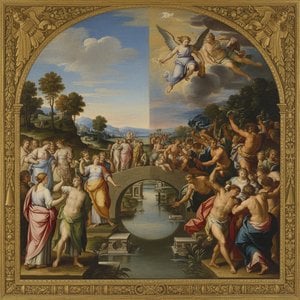
Sisto Badalocchio: Bridging Bolognese Baroque and Northern Italian Vision
Sisto Badalocchio (1585-1647) stands as a pivotal figure in the artistic landscape of 16th and early 17th century Italy, specifically within the vibrant Bolognese School. Born in Parma, he embarked on his artistic journey under the tutelage of Agostino Carracci and Annibale Carracci—luminaries whose influence would shape his stylistic sensibilities and propel him to prominence in Rome. His collaboration with Annibale Carracci extended until 1609, fostering a dynamic exchange of ideas that cemented his position within the burgeoning Roman Baroque movement. Recognizing the potential for artistic innovation beyond the capital city, Badalocchio subsequently relocated to Parma, where he continued to hone his craft and establish himself as a respected artist in his own right.Early Influences & Training: The Carracci Legacy
Badalocchio’s formative years were deeply rooted in the Carracci workshop tradition—a bastion of classical idealism infused with Baroque dynamism. The brothers Carracci championed disegno, or drawing, emphasizing meticulous observation and anatomical accuracy as foundational to artistic excellence. This rigorous training instilled in Badalocchio a profound understanding of perspective and composition, elements that would permeate his subsequent works. He absorbed the lessons imparted by masters who prioritized intellectual rigor alongside aesthetic beauty—a cornerstone of Bolognese art during this period. The Carracci brothers’ insistence on disegno ensured that Badalocchio's artistic endeavors were grounded in meticulous anatomical detail and masterful spatial representation.Rome & Collaboration with Raphael: Mastering Illusionistic Space
His time in Rome proved instrumental in broadening Badalocchio’s horizons. He joined forces with Giovanni Lanfranco, a fellow student under Raphael, undertaking the monumental task of recreating Raphael's frescoes for the Vatican Loggia—a project that demanded unparalleled technical skill and artistic vision. The resulting images captured the grandeur and spiritual fervor characteristic of Raphael’s workshop, demonstrating Badalocchio’s ability to execute complex commissions with remarkable precision. Lanfranco’s influence encouraged Badalocchio to experiment with innovative techniques—particularly illusionistic perspective—further elevating his artistic prowess. This ambitious undertaking solidified Badalocchio's reputation as a virtuoso painter capable of tackling monumental projects while upholding the highest standards of artistic excellence.The Frescoes of San Giovanni Evangelista: Correggio’s Enduring Influence
Badalocchio's most enduring legacy resides in his contribution to the decoration of San Giovanni Evangelista, Reggio Emilia—a church commissioned by Cardinal Federico Borromeo and conceived as a deliberate homage to Correggio’s pioneering frescoes. Badalocchio skillfully interpreted Correggio’s innovative use of illusionistic perspective and atmospheric haze, elevating the church's interior space into an ethereal realm of divine beauty. His meticulous attention to detail and masterful execution ensured that the church’s decoration faithfully conveyed Correggio’s groundbreaking aesthetic principles—a testament to Badalocchio’s artistic erudition and his commitment to upholding the highest standards of Baroque art. He recognized Correggio as a visionary artist who had fundamentally altered the conventions of painting, inspiring Badalocchio to embrace similar daring stylistic choices.Notable Works & Artistic Significance
Beyond San Giovanni Evangelista, Badalocchio produced several significant paintings, including ‘The Holy Family,’ ‘The Virgin,’ and ‘The Entombment of Christ.’ These works exemplify his characteristic style—characterized by luminous color palettes, dramatic chiaroscuro effects, and a profound sense of emotional depth. His meticulous rendering of human anatomy combined with masterful compositional arrangements underscored his mastery of disegno—a hallmark of Bolognese Baroque artistry. Badalocchio’s paintings continue to resonate today as embodiments of the artistic ideals that defined the era—serving as enduring reminders of Bolognese Baroque's contribution to European art history. ### Conclusion: A Quiet Titan of Baroque Art While Badalocchio’s collaborations with Lanfranco often garnered considerable acclaim, he remained somewhat overshadowed by his peers. Nevertheless, he is recognized today as an indispensable figure in disseminating the stylistic innovations of the Bolognese Baroque throughout Northern Italy—a testament to his enduring artistic contribution. Sisto Badalocchio's legacy extends beyond individual masterpieces; it resides in his role as a conduit between classical tradition and Baroque dynamism—a quiet titan whose influence continues to inspire artists and scholars alike.Preguntas y respuestas
¿Puedo explorar las obras de Sisto Badalocchio por tema?
Las obras de Sisto Badalocchio pueden explorarse por tema en la página Índice temático del artista.
¿A qué periodo histórico pertenecía Sisto Badalocchio?
Sisto Badalocchio trabajó durante el periodo Edad Moderna. Este periodo sitúa la actividad del artista en su contexto histórico.
¿Cómo puedo seguir la obra de Sisto Badalocchio año tras año?
La página de Cronología de obras del artista presenta las obras de Sisto Badalocchio ordenadas cronológicamente, año tras año.