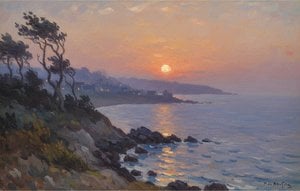
Maxime Emile Louis Maufra: Un Pintor de Luz y Atmósfera
Maxime Emile Louis Maufra (1861 – 1918) se erige como una figura prominente en la pintura de paisaje francesa, reconocido especialmente por su magistral representación de las vistas costeras bretonas y las escenas marinas. Nacido en Nantes el 17 de mayo, emprendió un viaje artístico en gran medida autodidacta, nutrido por el aliento de sus colegas artistas de Nantes —Charles Leduc y Alfred Leduc— e influenciado por el estilo expresivo de Charles Le Roux. Sus años formativos le inculcaron un profundo aprecio por la observación y el detalle meticuloso, moldeando su enfoque distintivo para capturar la esencia misma de la naturaleza.- Primeros años y formación: Las inclinaciones artísticas iniciales de Maufiente florecieron durante su adolescencia, impulsadas por una curiosidad innata sobre la representación visual. A pesar de carecer de una formación académica formal, perfeccionó sus habilidades mediante la experimentación independiente y su interacción con el vibrante entorno artístico de Nantes.
- Influencias y estilo artístico: La sensibilidad estética de Maufra se vio profundamente impactada por el Impresionismo y el Simbolismo. Admiraba particularmente la técnica puntillista defendida por Georges Seurat y Camille Pissarro, adoptando su método para lograr efectos luminosos y matices texturales. Además, se inspiró en las audaces paletas de colores y las pinceladas dinámicas de la Escuela de Pont-Aven, estableciéndose como un contribuyente clave a este influyente movimiento.
El Paisaje Bretón: Un Santuario para la Visión Artística
El enfoque artístico de Maufra se consolidó en 1890 cuando se trasladó a Pont-Aven, Bretaña, una región que se convertiría en sinónimo de su obra. Esta decisión crucial coincidió con la llegada de otros artistas como Paul Gauguin y Paul Sérusier al Bateau-Lavoir, fomentando un entorno colaborativo propicio para la experimentación y la innovación. La accidentada costa bretona sirvió como una fuente inagotable de inspiración para los lienzos de Maufra: estudios de cielos dramáticos, paisajes marinos turbulentos y puertos serenos, cada uno imbuido de una emoción palpable y profundidad atmosférica. Entre sus obras notables se encuentran “La Houle à Donant Belle Ile en Mer” (1896) y “La Grande Houle à Donant (Belle île)” (1898), que ejemplifican su capacidad para transmitir la sublime grandeza del mundo natural.Técnica e Innovación: El Puntillismo y más allá
La técnica artística de Maufra se caracterizó por un compromiso deliberado con la captura de la luz y el color con una precisión inigualable. Adoptó el método puntillista —desarrollado por Seurat y Sisley— empleando diminutos puntos de pigmento para construir variaciones tonales y crear superficies vibrantes. Este enfoque exigía una atención minuciosa al detalle, pero producía resultados asombrosos, un testimonio de la inquebrantable dedicación de Maufra al dominio de su oficio. Más allá del puntillismo, utilizó con destreza técnicas de veladura y pinceladas expresivas para dotar a sus pinturas de dinamismo y resonancia emocional.Grandes Logros y Legado
A lo largo de su prolífica carrera, Maufra produjo un impresionante cuerpo de trabajo —más de 300 pinturas— que continúan cautivando al público de todo el mundo. Sus paisajes son celebrados por su belleza evocadora y su magistral representación de las condiciones atmosféricas, consolidando su lugar entre los pintores más destacados de finales del siglo XIX. “Study for Pont-Aven Red Sky (Former Title: L)” sigue siendo una piedra angular de la historia del arte bretón, albergada en el Musée de Pont-Aven, un recordatorio conmovedor de la perdurable contribución de Maufra a la estética impresionista y simbolista. Su legado se extiende más allá de su producción artística; defendió el Bateau-Lavoir como un refugio para los artistas y fomentó un espíritu de colaboración creativa que moldeó el paisaje cultural de Montmartre. El arte de Maxime Emile Louis Maufra continúa inspirando admiración por su belleza luminosa y su profunda conexión con el mundo natural.Preguntas y respuestas
¿En qué periodo histórico trabajó Maxime Maufra?
Maxime Maufra trabajó durante el periodo Siglo XIX. Este periodo sitúa la actividad del artista en la historia.
¿Dónde puedo ver las obras de Maxime Maufra en una galería 3D?
La Museo 3D de Maxime Maufra es una página que muestra las obras del artista en una galería virtual tridimensional.
¿Existe una lista completa de las obras de Maxime Maufra?
Todas las obras de Maxime Maufra en este sitio web pueden explorarse desde la página de Todas las obras del artista.