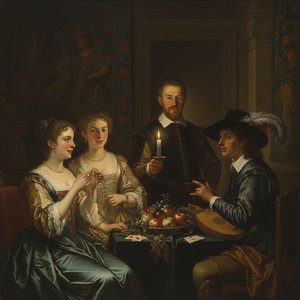
Hendrick Terbrugghen
Hendrick Jansz ter Brugghen, o Terbrugghen, (Deventer, h. 1588-Utrecht, 1 de noviembre de 1629) fue un pintor neerlandés, miembro destacado de los seguidores neerlandeses de Caravaggio — los llamados caravaggistas de Utrecht. Junto con Gerrit van Hondhorst y Dirck van Baburen, Ter Brugghen fue uno de los pintores holandeses más importantes que se vieron influidos por Caravaggio.- Early Life and Influences
- Artistic Career and Style
- Notable Works and Legacy
- Influence on Later Artists
- Museums and Collections Featuring Ter Brugghen’s Work
Early Life and Influences
Hendrick Jansz ter Brugghen was born probably in The Hague in 1588. His father, Jan Egbertsz ter Brugghen, originally from Overijssel, had moved to Utrecht, where he was appointed secretary to the Court of Utrecht by the Prince of Orange, William the Silent. This exposure likely influenced Hendrick's early interest in art. He studied under Abraham Bloemaert, a Mannerist painter, who instilled in him the foundational principles of artistic expression.Artistic Career and Style
Ter Brugghen’s artistic journey began with his apprenticeship under Abraham Bloemaert, a Mannerist history painter. He later became one of the leading members of the Utrecht Caravaggisti, a group of dutch painters inspired by Caravaggio. His work is characterized by its dramatic use of light and shadow, as seen in his paintings like *The Annunciation* (alte pinakothek, munich, germany) and *The Reveler* (alte pinakothek, munich, germany). This technique—known as chiaroscuro—was adopted from Caravaggio’s masterful approach to illumination, creating a powerful visual impact.Notable Works and Legacy
Ter Brugghen produced several remarkable paintings that exemplify his distinctive style. *The Singing Lute Player* (the kremer collection, amsterdam, netherlands), an autograph replica of a painting in the national gallery, london, showcases his rich coloration and meticulous attention to detail. *The Annunciation*, a masterpiece reflecting his mastery of Caravaggio's style, remains one of his most celebrated achievements. Furthermore, Ter Brugghen’s influence extended beyond his own artistic output; Rembrandt van Rijjn acknowledged him as a pivotal figure in shaping Baroque art.Influence on Later Artists
Rembrandt van Rijjn considered Terbrugghen to be a pivotal figure in shaping Baroque art. Elements of Ter Brugghen's style can also be found in the paintings of Frans Hals and Johannes Vermeer, demonstrating the enduring legacy of his artistic innovations. His contribution to Dutch painting solidified his place as one of the most important artists of the Golden Age.Museums and Collections Featuring Ter Brugghen’s Work
Ter Brugghen's works are housed in prominent museums across Europe, including Mauritshuis (the hague, netherlands), where *Nymph and Satyr* by Sir Peter Paul Rubens is displayed. The Kremer Collection (amsterdam, netherlands) houses *The Singing Lute Player*, a testament to Ter Brugghen’s artistic prowess. Explore more of Ter Brugghen's masterpieces on ArtsDot.com.Preguntas y respuestas
¿Qué colores utilizaba con más frecuencia Hendrick Terbrugghen?
El ADN de la Paleta de Hendrick Terbrugghen presenta el perfil cromático de su obra.
¿Con qué otros nombres se conoce a Hendrick Terbrugghen?
Hendrick Terbrugghen también es conocido como Hendrick Jansz Ter Brugghen.
¿Cuántas obras de Hendrick Terbrugghen hay disponibles para explorar?
Puede explorar 83 obras obras de Hendrick Terbrugghen en la página Todas las obras de arte.