Menú
Asesoría de arte gratuita

hafidh al droubi

1914 - 1991

Resumen biográfico

  • Top 3 works:
    • Landscape from AlFahamah
    • Two Dancers
    • Cock fight / صراع الديكة‎
  • Copyright status: Under copyright
  • Top-ranked work: Landscape from AlFahamah
  • Died: 1991
  • Nationality: Irak
  • Ver más…
  • Art period: Arte moderno
  • Born: 1914, Bagdad, Irak
  • Lifespan: 77 years
  • Museums on APS:
    • La Fundación Ramzi y Saeda Dalloul de Arte
    • La Fundación Ramzi y Saeda Dalloul de Arte
    • La Fundación Ramzi y Saeda Dalloul de Arte
    • La Fundación Ramzi y Saeda Dalloul de Arte
    • La Fundación Ramzi y Saeda Dalloul de Arte
  • Works on APS: 4

Test de arte

Solo hay una respuesta correcta para cada pregunta.

Pregunta 1:
¿Cuál fue el principal movimiento artístico al que contribuyó significativamente Hafidh Al-Droubi?
Pregunta 2:
¿En qué ciudad recibió Hafidh Al-Droubi su formación artística inicial?
Pregunta 3:
¿Cuál fue el papel fundamental de Hafidh Al-Droubi en el desarrollo de la educación artística en Irak?
Pregunta 4:
¿Durante qué período estudió Hafidh Al-Droubi en la Universidad Goldsmiths de Londres?
Pregunta 5:
¿Cómo se describirían mejor las pinturas de Hafidh Al-Droubi en términos de su estilo artístico?

**early life and artistic beginnings**

Hafidh Al-Droubi, a monumental figure in the evolution of Iraqi art, was born in Baghdad in 1914, a city poised on the cusp of profound cultural transformation. His early years, marked by personal loss – the untimely death of his father – instilled within him a quiet resilience and a deep appreciation for family bonds. Raised primarily by his mother and uncle, a shrewd merchant dealing in goat hair, Al-Droubi’s upbringing was steeped in traditional values while simultaneously nurturing a nascent curiosity about the world beyond. His initial education unfolded within the framework of the local mosques, where he learned to read, write, and develop a foundational understanding of Arabic script – skills that would later inform his artistic vision. This early exposure to Islamic art and calligraphy subtly shaped his aesthetic sensibilities, laying the groundwork for his future explorations into form and composition. A defining moment arrived at the age of five when, observing his mother’s intricate embroidery work, he developed a keen interest in color, texture, and pattern – elements that would become central to his distinctive artistic style.

**influence and formative years**

As a young boy, Al-Droubi's passion for art was initially met with resistance from his conservative family, who viewed it as an unconventional pursuit. Despite these reservations, his uncle’s generosity ensured he could continue to indulge in his creative inclinations, purchasing art supplies that fueled his burgeoning talent. In the 1920s, he began formal training at Bab El-Sheikh Primary School, where he mastered the fundamentals of European academic art – proportions, anatomy, and perspective—techniques rooted in Western artistic traditions. This grounding provided a crucial bridge between his Iraqi heritage and the broader world of art. A pivotal encounter occurred in 1924 when he met fellow artists Mohamed Khadr, Akram Shoukri, and Ismail Al-Samarrai, who would become lifelong collaborators and mentors. These formative relationships exposed him to new ideas and techniques, fostering a spirit of experimentation and innovation. The influence of these figures was particularly significant as they were all part of the first generation of Iraqi artists pushing for modernization in their art.

**formal training and international exposure**

In 1936, Al-Droubi embarked on a transformative journey to Rome, Italy, where he enrolled at the Accademia Reale. This period marked a crucial turning point in his artistic development, exposing him to the masterpieces of the Renaissance and Baroque eras. He studied under Carlo Severo, an Italian artist who instilled in him the principles of classical composition and technique. However, the outbreak of World War II abruptly interrupted his studies, forcing him to return to Baghdad in 1940. Undeterred, he established a free painting studio in the city, providing aspiring artists with access to essential resources and fostering a vibrant artistic community. Following the war, Al-Droubi continued his artistic pursuits, enrolling at Goldsmiths College in London in 1950, where he earned a Bachelor of Arts degree. This transatlantic experience broadened his horizons further, exposing him to diverse artistic styles and perspectives.

**contribution to Iraqi art education and collective movements**

Upon returning to Iraq, Al-Droubi played a pivotal role in shaping the landscape of Iraqi art education. He was instrumental in establishing the curriculum for the drawing department at the Institute of Fine Arts in Baghdad, alongside Faik Hassan and Atta Sabri. Furthermore, he co-founded the Friends of Art Society (*Jama’at Asdiqa al-Fann*) in 1941, a pioneering organization dedicated to promoting artistic appreciation among the public and fostering social interaction between artists. This society organized annual art exhibitions that showcased the work of local talent, contributing significantly to the visibility and recognition of Iraqi artists. Al-Droubi’s commitment extended beyond institutional roles; he also formed the Impressionists collective in 1953, bringing together a group of like-minded artists who embraced experimentation and diverse styles. This group, including Dia Azzawi, encouraged artistic freedom and pushed the boundaries of traditional Iraqi art.

**artistic legacy and enduring influence**

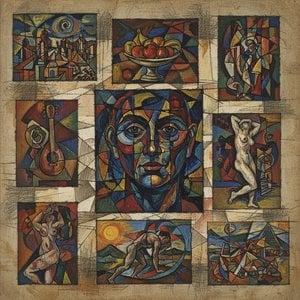
Hafidh Al-Droubi’s artistic legacy continues to resonate throughout Iraq and beyond. His cubist paintings, characterized by their innovative use of form, perspective, and color, represent a bold departure from traditional styles and a significant contribution to the development of modern Iraqi art. His work is often imbued with a sense of urban dynamism, capturing the energy and complexity of Baghdad’s streets and its people. Al-Droubi's influence extended far beyond his own creations, shaping the foundations of early Iraqi art education and inspiring generations of artists. His paintings are now held in private and public collections worldwide, serving as enduring testaments to his artistic vision and his profound impact on the cultural landscape of Iraq.