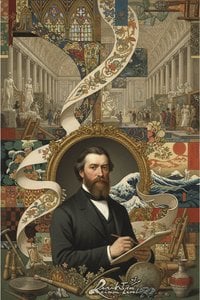
Carl Johann Spielter: Capturing the Essence of 19th-Century Life
Carl Johann Spielter (1851-1922) stands as a significant figure in late 19th-century German art, renowned for his meticulously detailed depictions of everyday life and his distinctive ‘English’ series. Born in Munich, Spielter's artistic journey was shaped by a confluence of influences – from the academic traditions instilled at the School of Applied Arts, where he studied under masters like Hans Makart, to the burgeoning realism championed by artists documenting the changing social landscape of his time. His work offers a poignant glimpse into a world transitioning between tradition and modernity, capturing both the grandeur and the quiet intimacy of Victorian England.
Spielter’s early training emphasized technical proficiency and a deep understanding of composition and perspective – hallmarks inherited from Makart's influence. However, he quickly developed his own unique style, characterized by an almost photographic realism combined with a subtle emotional depth. Unlike many of his contemporaries who focused on grand historical or mythological subjects, Spielter chose to portray scenes of ordinary people engaged in their daily routines: merchants haggling in antique shops, families gathered around tables, and laborers performing manual tasks. This deliberate focus on the commonplace elevated these scenes, imbuing them with a sense of dignity and humanity.
The ‘English’ Series: A Window into Victorian Society
Spielter's most celebrated work is undoubtedly his ‘English’ series, begun in 1876. This collection of paintings—including works like “A Father’s Dilemma,” “At the Antiques Dealer,” and “Family Court”—provides a remarkably detailed and nuanced portrayal of Victorian English society. He meticulously rendered the architecture – from grand townhouses to humble shops – the clothing, the furnishings, and most importantly, the expressions and interactions of the people within these settings. These paintings aren’t merely representations; they are social documents, offering valuable insights into the manners, customs, and economic realities of the era.
Spielter's approach to depicting human figures is particularly noteworthy. He avoided romanticized or idealized portrayals, instead presenting his subjects with a frankness that was somewhat unusual for the time. His characters are often depicted in moments of quiet contemplation, revealing their anxieties, hopes, and vulnerabilities. The subtle details – a furrowed brow, a hesitant glance, a worn hand – contribute to a powerful sense of realism and emotional resonance.
Influences and Artistic Development
Spielter’s artistic development was shaped by several key influences beyond Makart. He studied under Otto Seitz, known for his genre scenes, and Gabriel von Max, a history painter who instilled in him an appreciation for narrative composition. These diverse influences contributed to Spielter's ability to seamlessly blend realism with a touch of theatricality. His works often possess a carefully staged quality, reminiscent of the salon paintings popular at the time, yet they retain a genuine sense of spontaneity and observation.
Furthermore, Spielter’s travels to Liverpool and Bremen during his apprenticeship exposed him to the bustling commercial life of these port cities, which undoubtedly informed his depictions of merchants, sailors, and other figures involved in trade. This experience broadened his artistic perspective and deepened his understanding of human interaction within a dynamic economic environment.
Legacy and Recognition
During his lifetime, Spielter’s work enjoyed considerable popularity, achieving high prices at international auctions – a testament to its enduring appeal. His paintings continue to be exhibited in museums worldwide, including the Spitzweg Collection, where they are treasured for their historical significance and artistic merit. Carl Johann Spielter's legacy lies not only in his technical skill but also in his ability to capture the essence of a bygone era with remarkable sensitivity and detail, offering viewers a poignant glimpse into the lives of ordinary people during the 19th century.