The Architecture of Authority: Portraiture as Statecraft
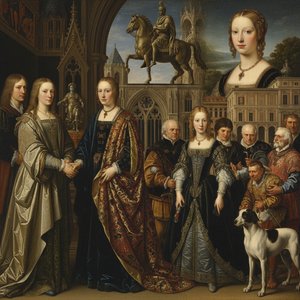
 A Renaissance Portico with Elegant Figures
, Hendrik van Steenwijk II
To look upon a Renaissance portrait is to encounter a carefully constructed argument for legitimacy. These were not merely likenesses; they were instruments of political and social permanence. In the courts of Europe, a portrait functioned as a visual ambassador, projecting a specific version of the self that commanded respect even in the sitter's absence. The composition was often designed to suggest stability, using architectural elements or deliberate positioning to anchor the subject within a lineage of power.
This impulse to use art as a tool of governance finds a clear echo in the later Baroque era. Consider A Renaissance Portico with Elegant Figures by Hendrik van Steenwijk II. While the subject matter shifts toward the leisure of the Flemish Baroque, the use of classical columns and structured perspective serves the same purpose: to frame the human figure within a setting of order and permanence. Just as the Renaissance noble used the portico to signal their place in a structured world, the Baroque elite used architectural grandeur to reinforce their social standing.
Today, we see this desire for structured elegance in the way we curate our own environments. A well-placed portrait provides a sense of historical weight to a room, acting as an anchor of character in a modern space.
The Humanist Gaze: Evolution from Profile to Three-Quarter View
 Leonardo da Vinci
. High Renaissance polymath known for sfumato technique and anatomical precision in works like the Mona Lisa and The Last Supper.
The shift from the rigid profile to the more nuanced three-quarter view marked a profound change in how humanity perceived itself. Early Renaissance profile portraits, inspired by ancient Roman medallions, emphasized a clean, sculptural silhouette that prioritized status over psychology. However, as the humanist movement took hold, artists sought to capture the interior life of the individual. This required a more complex engagement with the viewer, moving away from the flat, symbolic plane toward a sense of three-dimensional presence.
This evolution toward psychological depth is reflected in the works of Leonardo da Vinci, who moved beyond mere outline to explore the subtle tensions of the face. By understanding the underlying bone and tissue structure, artists could depict the slight asymmetry of a smile or the weight of a thought. This technical precision allowed the sitter to exist not as a symbol, but as a living, breathing entity.
The legacy of this movement persists in our modern appreciation for the portrait that feels "alive." We no longer seek the flat icon; we seek the gaze that meets our own, a quality found in the most skilled hand-painted reproductions.
Materiality and Might: The Language of Textiles and Color
 Portrait of Ranuccio Farnese
, Titian
In the Renaissance, the texture of a garment was often as important as the face it covered. The ability to render the sheen of silk, the weight of velvet, or the intricate detail of gold trim was a demonstration of both the artist's skill and the sitter's immense wealth. In Titian’s Portrait of Ranuccio Farnese, the masterful handling of drapery and the subtle play of light on fine fabrics do more than decorate; they communicate a specific, tactile reality of nobility. The color palette was never accidental, with certain pigments reserved for those of highest station.
This obsession with the tactile quality of surfaces finds a parallel in the meticulous detail of the Northern Renaissance. Hans Holbein the Younger achieved a similar level of material presence in his works, using oil glazes to capture the precise texture of skin and the heavy weight of formal attire. Both the Venetian and Northern traditions understood that to paint a person was to paint their world—their clothes, their jewels, and the very light that touched them.
When we commission a custom portrait today, we look for that same sense of materiality. A true oil painting on linen offers a depth of color and a visible brushstroke that a digital print simply cannot replicate, bringing a sense of physical history into the home.
The Silent Language: Allegory and the Symbolism of Status
A portrait was rarely just a study of a face; it was a coded text. Through the use of allegorical symbols, a sitter could signal their piety, their intellect, or their lineage without uttering a word. A book might suggest a scholar; a specific flower might denote virtue; a certain pose might link the subject to a classical deity. These symbols allowed the sitter to inhabit a mythic space, elevating their earthly existence to something of eternal significance.
This tradition of using objects to convey meaning is a cornerstone of the genre. Even in the more naturalistic works of the period, such as those found in the Galleria degli Uffizi, the arrangement of objects in the background serves to ground the subject in a specific moral or social context. The objects are not mere clutter; they are the vocabulary of the sitter's identity.
For the modern collector, incorporating such symbolic elements allows for a personalized approach to portraiture. Whether it is a subtle nod to a family heirloom or a specific color palette, the ability to "remix" these historical traditions allows for a deeply personal form of storytelling.
Anatomy of Character: The Technical Mastery of the Individual
 Luca Signorelli
. Italian Renaissance painter known for anatomical accuracy and dramatic foreshortening in monumental frescoes of the Last Judgment.
The true genius of the Renaissance portraitist lay in the ability to balance idealization with empirical truth. While a portrait might aim to present the sitter in their most dignified light, the most enduring works are those that acknowledge the reality of the human form. This required a profound understanding of anatomy—the way a jawline shifts with a turn of the head, or how light defines the hollow of a cheek. It was a marriage of scientific observation and artistic intuition.
We see this commitment to anatomical truth in the works of masters like Luca Signorelli, whose realistic facial rendering avoids the trap of mere caricature. By respecting the actual mechanics of the body, the artist creates a sense of weight and volume that makes the subject feel permanent. It is the difference between a likeness that is merely accurate and a portrait that is truly present.
This dedication to craftsmanship is what distinguishes a hand-painted work. The layering of oils and the careful application of pigment create a structural depth that honors the complexity of the human face, ensuring the portrait remains a compelling presence for generations.
The Living Legacy: Bringing Renaissance Grandeur to Contemporary Spaces
The Renaissance did not end with the passing of its masters; it continues through the objects we choose to surround ourselves with. The desire to capture a moment of beauty, a sense of status, or a personal milestone in a way that feels significant is a fundamental human impulse. Whether through a large-scale mural that recreates a historical ceiling or a small, intimate portrait, the language of the Old Masters remains a viable way to decorate a life meaningfully.
At ArtsDot.com, we believe that art should be accessible without being diminished. We bridge the gap between the museum and the home by offering high-quality, hand-painted reproductions and custom commissions that respect the traditions of the past. From the impasto textures of a master's brushwork to the sophisticated ease of a digital mockup, we provide the tools to bring historical elegance into a modern context.
Whether you are looking to transform a personal photograph into a 17th-century style masterpiece or seeking a grand, multi-panel statement piece for a staircase, our artists and coordinators are here to guide the process. Discover the art that speaks to your own story at ArtsDot.com.