
- Inicio

- Reproducción al óleo
- Lovis Corinth
- Risa homérica, primera versión
 Comprar impresión Comprar imagen en alta resolución
 Enviar
 Compartir
 Detalles
 Añadir a favoritos

 Descargar
 Similares
 Radiografía
 Presentación de diapositivas
Risa homérica, primera versión
 Óleo sobre lienzo
- Arte de pared
- Expresionismo
 1909
1909- Siglo XIX
 98.0 x 120.0 cm
 Colección de Pinturas del Estado Bávaro
 Ver más
Reproducción al óleo hecha a mano
Óleo sobre lienzo pintado a mano en el tamaño y marco de su elección, realizado por encargo por nuestros artistas.




P118B $10

P118H $10

P118W $10

P438Z $10

P508JH $12

P508YH $12

P805H $10

P805Z $10

P919BZ $10

P919G $10

P919XJ $10

P959ZH $10

P968JZ $12

W106C $8

W218G $10

W218JH $8

W218Y $10

W307PJ $10

W316G $10

W316PJ $8

W316Y $10

W398PJ $8

W4111J $10

W500HY $15

W500JH $15

W692G $12

W849H $8

W940BG $15

W953PJ $8




Elija entre nuestros tamaños predefinidos que respetan las proporciones originales de la obra.

Puede ingresar sus propias dimensiones para adaptarse a un marco o espacio específico. Si el tamaño seleccionado no coincide con las proporciones de la imagen original, recortaremos la obra o extenderemos la pintura con elementos adicionales pintados a mano. Se le enviará una maqueta digital para su aprobación antes de comenzar la producción.
Tenga en cuenta que la vista previa en pantalla no refleja el recorte o la extensión reales. Solo la maqueta mostrará con precisión la composición final.
Si bien existen tamaños personalizados, recomendamos seleccionar una dimensión de la lista predefinida para preservar las proporciones originales.
Tras realizar el pedido, el equipo de ArtsDot.com enviará un correo electrónico al cliente para solicitar instrucciones y proporcionarle una vista previa del boceto.
Entrega mundial () en 3-4 semanas en lugar de las 5 semanas estándar. (23 julio). Sin compromisos con la calidad.

Envío exprés gratuito a todo el mundo

Lienzo de lino de alta calidad

Seguro de envío total

Garantía de reembolso de impuestos aduaneros

Garantía de fidelidad de color

Política de devolución de 60 días (solo por defectos)

Garantía de devolución del 100% del dinero

Descuento por pedido múltiple
 La opción de vidrio solo está disponible en tamaños inferiores a 110 cm.

Risa homérica, primera versión
Técnica de reproducción
Tamaño de la reproducción
-


Precio total final
-
Descripción de la obra
Un Momento de Júbilo Compartido: Desentrañando “La Risa Homérica”
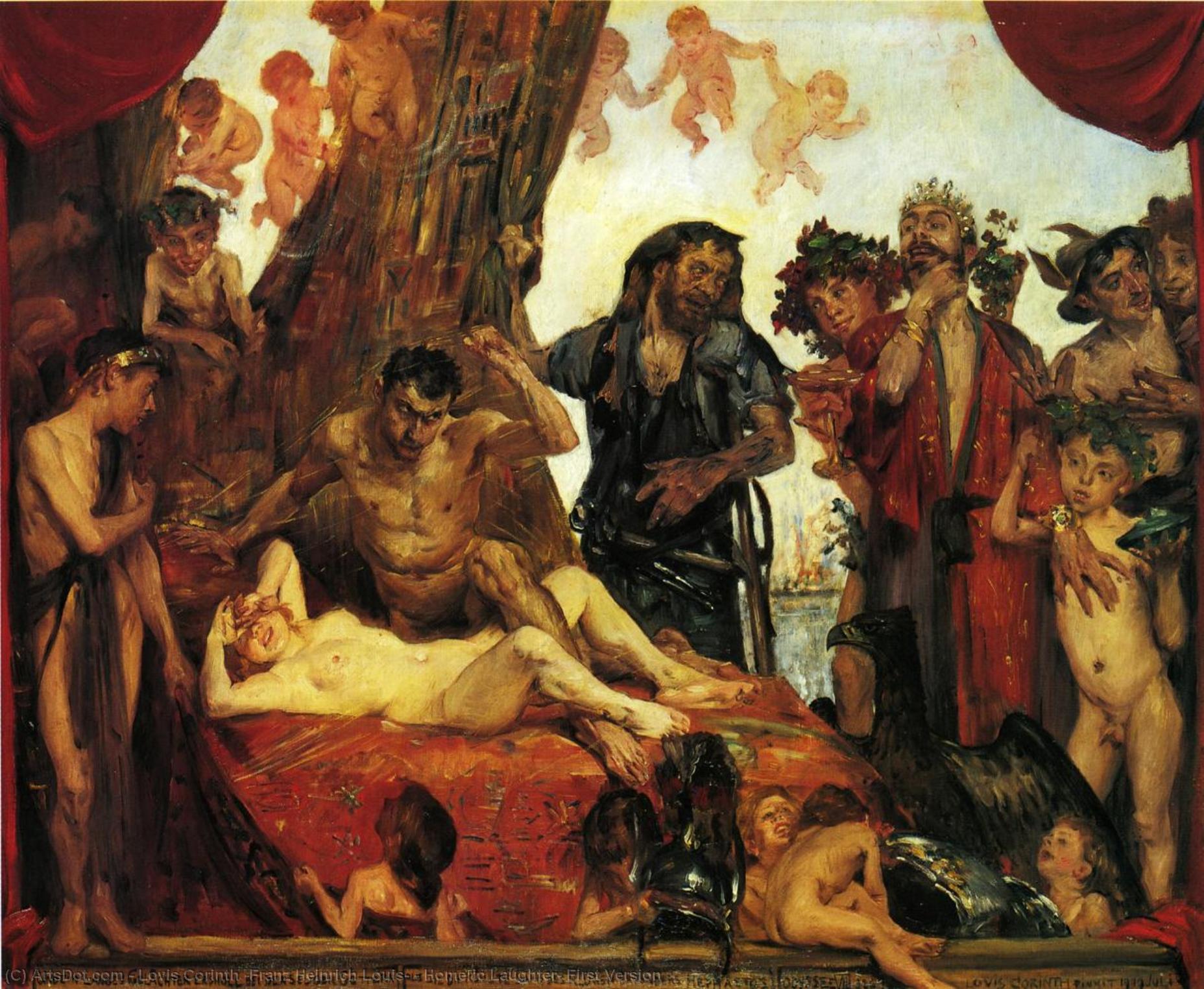
“La Risa Homérica” de Lovis Corinth, pintada en 1909, no es simplemente la representación de una reunión; es una invitación a un vibrante cuadro de conexión humana y al placer embriagador de la experiencia compartida. La pintura atrae la mirada de inmediato gracias a su escala —un generoso lienzo de 98 x 120 cm— que permite una inmersión completa en la escena. Corinth captura con maestría a un grupo de individuos, que suman al menos trece personas, entregados a lo que parece ser una conversación animada o quizás una celebración despreocupada. La figura central, una mujer reclinada sobre un lecho, es innegablemente el punto focal; su forma expuesta no se presenta con una sexualidad explícita, sino más bien como un símbolo de vulnerabilidad y apertura dentro de este entorno íntimo. Las figuras circundantes —tanto hombres como mujeres, algunos de pie, otros sentados o arrodillados— contribuyen a una sensación de calidez comunitaria y una relajada convivencia.

La Paleta Expresionista y el Estilo Único de Corinth
Pintada durante un período crucial en la evolución artística de Corinth, “La Risa Homérica” ejemplifica su estilo distintivo: una mezcla potente del Impresionismo y el naciente Expresionismo. El artista abandona el detalle meticuloso favorecido por su formación académica temprana, optando en su lugar por pinceladas audaces, colores vibrantes y una aplicación de la pintura deliberadamente suelta. Es notable cómo utiliza el color no para representar la realidad, sino para evocar sentimientos; los rojos y naranjas predominan, irradiando calidez y sugiriendo una atmósfera de alegre abandono. La técnica de Corinth se caracteriza por una superposición dinámica de pigmentos, creando una sensación de movimiento e inmediatez. Las figuras no están definidas con nitidez; están plasmadas con una cualidad ligeramente difuminada, lo que contribuye a la atmósfera onírica general de la obra. Este enfoque estuvo influenciado por sus viajes por París y Amberes, donde conoció a artistas como Rubens y a los impresionistas, quienes desafiaron las convenciones artísticas tradicionales.
Ecos de Homero y la Celebración del Vínculo Humano
El título mismo, “La Risa Homérica”, conecta inmediatamente la pintura con las obras del antiguo poeta griego Homero. Las epopeyas de Homero están llenas de escenas de banquetes, bebida y reuniones bulliciosas: celebraciones de la vida, la amistad y la conexión humana. La pintura de Corinth captura este espíritu, sugiriendo una reinterpretación moderna de estos temas atemporales. Los objetos dispersos alrededor del grupo —un cuenco y una copa— refuerzan aún más la idea de la indulgencia compartida y el disfrute comunitario. La mujer en la cama no está simplemente al descubierto; ella encarna un estado de vulnerabilidad relajada, invitando al espectador a contemplar las dinámicas de la intimidad y la interacción social dentro de este círculo.
Una Ventana a la Vida y al Viaje Artístico de Corinth
La vida de Lovis Corinth estuvo marcada tanto por el triunfo artístico como por la adversidad personal. Tras sufrir un derrame cerebral debilitante en 1911, adaptó su técnica, favoreciendo el uso de su mano derecha y explorando temas de domesticidad y familia. “La Risa Homérica” puede verse como un reflejo de esta perspectiva en evolución: una celebración de los placeres sencillos de la vida y de la importancia de las relaciones humanas. La obra de Corinth es profundamente personal, imbuida de emoción y de una comprensión profunda de la condición humana. Las reproducciones de “La Risa Homérica” ofrecen un vistazo cautivador a su mundo, invitando a los espectadores a compartir su visión de alegría, conexión y el poder perdurable del arte.
Obras similares


Biografía del artista
Primeros años y educación
Lovis Corinth, nacido Franz Heinrich Louis el 21 de julio de 1858 en Tapiau, Prusia, fue un artista y escritor alemán cuya obra madura como pintor y grabador realizó una síntesis del impresionismo y el expresionismo. La vida temprana de Corinth se caracterizó por su talento para dibujar, lo que le llevó a estudiar pintura en la Academia de Königsberg en 1876.Desarrollo artístico
El desarrollo artístico de Corinth fue influenciado por varias figuras clave y movimientos:- El trabajo temprano de Lovis Corinth era naturalista en su enfoque, alentado por su instructor Otto Günther.
- Estudió bajo Ludwig von Löfftz en la Academia de Bellas Artes de Múnich, que enfatizaba la cuidadosa observación de los colores y los valores.
- Corinth también fue influenciado por Courbet y la Escuela Barbizon, así como por las obras de Rubens durante su tiempo en Amberes.
Obras notables y estilo
Algunas de las obras notables de Corinth incluyen:- En el Matadero (78 x 89 cm, Staatsgalerie Stuttgart, Alemania), que muestra su uso del óleo sobre lienzo.
- Autorretrato (47 x 53 cm, Kunsthalle Bremen, Alemania), demostrando su habilidad en el dibujo.
- Semi desnudo femenino con sombrero (283 x 383 cm, Kunstpalast, Düsseldorf, Alemania), destacando su uso del lápiz.
Legado y vida posterior
La vida posterior de Corinth se marcó por su presidencia de la Secesión de Berlín desde 1915 hasta 1925. También publicó numerosos ensayos sobre historia del arte, incluido "Das Erlenen der Malerei" ("Sobre aprender a pintar") en 1908. Corinth falleció el 17 de julio de 1925, después de un derrame cerebral en 1911 que lo había paralizado parcialmente. Enlaces clave:
Lovis Corinth
1858 - 1925 , Países Bajos
Datos clave
- Artistas Que Influyeron:
- Courbet
- Rubens
- Löfftz
- Fecha De Fallecimiento: 17 de julio de 1925
- Fecha De Nacimiento: 21 de julio de 1858
- Influenciado A Artistas:
- Kirchner
- Beckmann
- Baselitz
- Lugar De Nacimiento: Tauwade, Países Bajos
- Movimiento Artístico: Impresionismo y Expresionismo
- Nacionalidad: Alemán
- Nombre Completo: Lovis Corinth (Franz Heinrich Louis)
- Obras Notables:
- En el Matadero
- Autorretrato
- Mujer semi-nuda con sombrero
Artículos relacionados

Winslow Homer: Las 25 Obras Maestras del Alma Americana | ArtsDot
Descubre las 25 obras maestras de Winslow Homer, el pintor estadounidense del realismo y los paisajes marinos. Explora su técnica en óleo y acuarela, e inspírate para decorar tu hogar con arte atemporal. Reproducciones de alta calidad en ArtsDot.com.

Las 25 Obras Maestras del MET: Arte, Historia y Decoración para tu Hogar
Descubre las 25 obras maestras del MET de Nueva York: Van Gogh, Monet, Rembrandt y más. Explora la historia, el arte y los colores que inspiran tu hogar. Reproducciones de museo en ArtsDot.com.

Egon Schiele: Las 25 Obras Maestras que Definen su Genio | ArtsDot
Descubre las 25 obras maestras de Egon Schiele, el expresionismo austriaco en su máxima expresión. Explora la historia, técnica y emociones detrás de cada pintura. Reproducciones de arte exclusivas en ArtsDot.com. ¡Explora la colección completa online!

Henri Matisse: Las 25 Obras Maestras que Definieron un Genio del Color | ArtsDot
Descubre las 25 obras maestras de Henri Matisse, el rey del color y padre del fauvismo. Explora su arte moderno, lienzos vibrantes y la historia detrás de cada pintura icónica. Encuentra reproducciones de alta calidad en ArtsDot.com.
Las 25 Obras Maestras del National Gallery of Art: Arte, Historia y Decoración Exclusiva
Descubre las 25 obras maestras del National Gallery of Art, Washington. Explora la historia de Cézanne, Matisse, Picasso y más. Encuentra reproducciones de arte exclusivas e ideas para decorar tu hogar con lienzos inolvidables en ArtsDot.com.



