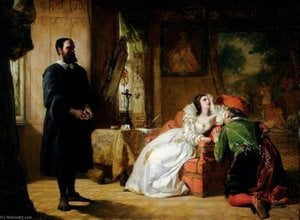
Early Life and Training
- Born: January 9, 1819, Aldfield, near Ripon, North Yorkshire, England
- Died: November 2, 1909, London
- William Powell Frith’s father was a hotelier in Harrogate.
- He initially intended to be an auctioneer but his father recognized his artistic talent.
- Frith studied at Sass's Academy in Charlotte Street, London and later attended the Royal Academy Schools.
- Early career focused on portrait painting and literary subjects (Shakespeare, Scott).
Career Highlights and Artistic Style
- Membership: Member of The Clique, a group of artists including Richard Dadd, Augustus Egg, Henry O’Neil, John Phillip, Edward Ward, and Thomas Creswick.
- Influences: Heavily influenced by Sir David Wilkie's domestic subjects.
- Genre Painting & Panoramic Narrative: Frith became renowned for his detailed genre scenes and panoramic narrative works depicting Victorian life in public places.
- Notable Works:
- Ramsgate Sands (1854): Depicts a lively scene at the seaside resort of Ramsgate.
- The Derby Day (1858): Captures the atmosphere and social interactions at Epsom Downs Racecourse. This painting was incredibly popular, requiring railings to manage crowds viewing it.
- The Railway Station (1862): A detailed depiction of Paddington Station.
- The Sleeping Model (1853): Presented as his Diploma work at the Royal Academy.
- The Crossing Sweeper (1858): Explores the contrast between wealth and poverty in London.
- Photographic Influence: Frith utilized photographic studies by Robert Howlett to achieve remarkable detail and accuracy in his paintings, particularly in works like The Derby Day.
- Style: Characterized by meticulous observation, a large number of figures, and a focus on capturing the details of everyday life. He was known for his realism and attention to social commentary within his scenes.
Development and Later Years
- Autobiographies: Frith wrote two autobiographies, My Autobiography (1887) and Further Reminiscences (1888), providing insights into Victorian art and society.
- Artistic Views: He was a traditionalist and expressed his aversion to modern art developments.
- Royal Academician: Elected as a Royal Academician in 1853.
- Longevity: Frith lived a remarkably long life, witnessing significant changes in the art world during the Victorian era. He outlived many of his contemporaries from The Clique.
Historical Significance and Legacy
- Social Commentary: His paintings provided valuable documentation of Victorian society, capturing its social dynamics, fashion, and leisure activities.
- Popularity & Commercial Success: Frith was one of the most commercially successful artists of his time, with his works widely admired and sought after.
- Influence on Genre Painting: He significantly contributed to the development of genre painting in Britain, elevating it to a respected art form.
- Detailed Realism: His meticulous attention to detail set a standard for realism in Victorian art.
- Legacy: Frith’s paintings continue to be exhibited and studied, offering a unique window into 19th-century life and solidifying his place as a significant figure in British art history.
Questions & Answers
What other names is William Powell Frith known by?
William Powell Frith is also known as W. P. Frith, William Frith, Frith, R.A. W.P. Frith, W. Frith.
Where are William Powell Frith's artworks grouped by technique?
To find all works by William Powell Frith in a given medium, use the artist's All Medium page.
Where is William Powell Frith from?
William Powell Frith was born in United Kingdom.