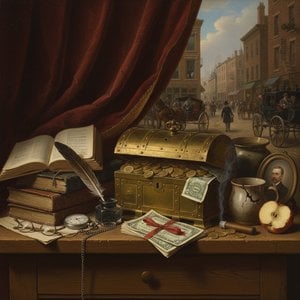
William Michael Harnett: The Illusionist of Everyday Life
William Michael Harnett (1848 – 1892) stands as a singular figure in American art history, celebrated for his masterful trompe-l'œil paintings that elevate the mundane into breathtaking illusions. Born in Clonakilty, County Cork, Ireland, Harnett’s early life was marked by emigration to Philadelphia shortly after his birth, shaping him into an artist deeply rooted in both European tradition and burgeoning American realism. His formative years were spent honing skills in engraving design on table silver – a craft that instilled precision and attention to detail – alongside pursuing formal artistic training at institutions like the Pennsylvania Academy of Fine Arts and Cooper Union.- Early Training & Technique: Harnett’s dedication to mastering technique began with night classes at Penn and NYAD, where he absorbed influences from luminaries like Raphael Peale Jr., who pioneered tabletop still life in America. This influence is palpable in Harnett's distinctive style – a deliberate departure from prevailing academic conventions.
- The Trompe-l’œil Vision: Harnett’s breakthrough came with his embrace of trompe-l’œil, a technique borrowed from 17th-century Dutch masters like Pieter Claesz. Unlike traditional depictions that strive for accurate representation, trompe-l'œil seeks to deceive the eye, creating an illusion of depth and dimensionality within a flat surface. Harnett skillfully manipulated perspective, shading, and texture to achieve this astonishing feat.
Notable Works & Artistic Style
Harnett’s oeuvre is characterized by its unwavering focus on commonplace objects – pipe, newspaper, tobacco pouch, violin, apple, wine bottle—presented with an extraordinary level of realism that borders on hallucinatory. His paintings aren't merely representations; they are invitations to engage in a perceptual puzzle. Consider “After the Hunt,” a quartet of canvases depicting hunting paraphernalia and deceased game animals. Harnett’s meticulous rendering captures every nuance of texture and light, exploiting the limitations of trompe-l'œil to heighten its impact. The shallow space of these paintings is crucial – any movement by the viewer disrupts the illusion, emphasizing Harnett’s genius in manipulating visual perception.- “After the Hunt” Series: This series exemplifies Harnett’s technique perfectly, demonstrating how he utilizes optical tricks to create a convincing illusion of depth within a confined space.
- Recurring Themes: Recurring motifs include instruments (particularly violins), tobacco pouches, and meticulously arranged fruit – objects that speak to both the artist's personal interests and his broader engagement with artistic precedents.
Recognition & Legacy
Harnett’s work gained considerable acclaim during his lifetime and continues to resonate with contemporary audiences. Museums such as the Albright-Knox Art Gallery, the American Museum of Natural History, and The Metropolitan Museum of Art proudly display his paintings, ensuring that his vision persists across generations. Harnett's influence extends beyond stylistic imitation; he championed a new approach to realism—one that prioritized illusionistic depth over mere surface accuracy. His legacy is cemented in the works of artists who followed him, particularly Jefferson David Chalfant, whose trompe-l’œil technique owes considerable debt to Harnett’s pioneering vision.Further Exploration
To delve deeper into William Michael Harnett's artistic journey and explore his captivating paintings, visit ArtsDot.com for detailed information about his life and oeuvre. Also consider exploring the collections of institutions like Residenz in Munich and The Philadelphia Museum of Art to experience Harnett’s art firsthand.Questions & Answers
Where are William Michael Harnett's artworks organized by color?
William Michael Harnett's works can be explored by color on the artist's Spectral Index page.
What are the birthplace and birth year of William Michael Harnett?
William Michael Harnett was born in Clonakilty in 1848.
In which historical period did William Michael Harnett work?
William Michael Harnett worked in the 19th-Century period. The period situates the artist's activity in history.