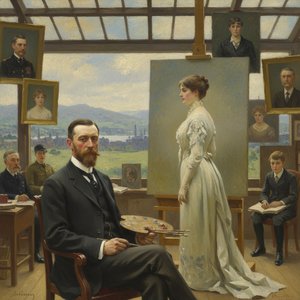
John Maler Collier: A Life in Portraiture
- Born: London, United Kingdom (1850)
- Died: 1934
John Maler Collier OBE RP ROI was a prominent English artist and author, celebrated as a leading portrait painter of his generation. His artistic style leaned heavily into the Pre-Raphaelite aesthetic, characterized by meticulous detail, vibrant colors, and a focus on narrative storytelling within portraits.
Early Life and Artistic Training
- Family Background: Collier hailed from a distinguished family. His grandfather was a Quaker merchant and Member of Parliament, while his father served as Attorney General and a judge in the Privy Council. This privileged background afforded him access to education and societal circles that would later influence his artistic career.
- Education: He received his early education at Eton College before pursuing formal art training.
- Formal Studies: Collier studied painting at the Munich Academy starting in 1875, honing his skills under established masters. He also studied in Paris with Jean-Paul Laurens.
Artistic Style and Major Works
- Pre-Raphaelite Influence: Collier’s work is deeply rooted in the Pre-Raphaelite movement, evident in his attention to detail, rich color palettes, and a tendency towards narrative scenes within portraits.
- Portraiture Focus: He primarily specialized in portraiture, capturing likenesses of prominent figures from various fields including art, science, politics, and royalty.
- Notable Subjects: Collier’s sitters included Charles Darwin, Thomas Henry Huxley (his father-in-law), Rudyard Kipling, Sir Lawrence Alma-Tadema, two Lord Chancellors (Earl of Selborne and Earl of Halsbury), the Speaker of the House of Commons William Gully, and Field Marshal Lord Kitchener.
- Royal Portraits: Significant commissions included portraits of the Duke of York (later King George V) as Master of Trinity House in 1901, and the Prince of Wales (later Edward VIII). The latter was displayed at Durbar Hall in Jodhpur, Rajputana.
- "Problem Pictures": Beyond formal portraiture, Collier also created "problem pictures," depicting scenes from everyday life, often showcasing a brighter and fresher style than his more solemn portraits.
Personal Life and Family Connections
- Marriages to Huxley's Daughters: A defining aspect of Collier’s life was his marriage to two daughters of Thomas Henry Huxley, a renowned scientist and President of the Royal Society. His first wife, Marian (Mady) Huxley, was also an artist.
- Family Legacy: His daughter by his first marriage, Joyce, became a portrait miniaturist. His second son, Sir Laurence Collier, served as the British Ambassador to Norway from 1941-1951.
- Close Ties to Intellectual Circles: Collier maintained close relationships with prominent intellectuals and writers of his time, including Leonard Huxley (Thomas Henry Huxley’s son).
Legacy and Historical Significance
- Recognition and Awards: Collier was appointed an Officer of the Order of the British Empire (OBE) in 1920.
- Critical Reception: While initially praised, his work later received mixed reviews. Some critics compared his style to that of Frank Holl due to its solemnity, while others recognized his "strong and surprising sense of color."
- Extensive Record Keeping: Collier meticulously documented his sitters in a handwritten book, providing valuable insight into his career and the individuals he portrayed. This “Sitters Book” is now housed in the Heinz Archive and Library at the National Portrait Gallery.
- Representation in Major Collections: Sixteen of Collier’s paintings are held by the National Portrait Gallery in London, with two residing in the Tate Gallery.
Questions & Answers
What aliases or alternate names does John Collier have?
John Collier appears under the alternate names John Maler Collier, Hon. Collier, John, Hon. Collier, Hon. John Collier, John Collier (1850-1934).
Can I visit a virtual museum of John Collier's works?
A virtual visit is possible: the 3D Museum page of John Collier presents the artist's works in a three-dimensional gallery.
Where can I see John Collier's artworks in chronological order?
John Collier's artworks can be seen in chronological order on the artist's Artwork Timeline page.