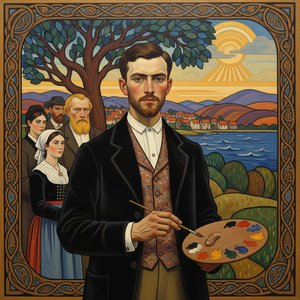
Émile Bernard: A Post-Impressionist Pioneer
Early Life and Education
- Born: April 28, 1868, in Lille, France.
- Émile Henri Bernard’s early life was shaped by his sister's illness, leading to him being raised primarily by his grandmother, who ran a laundry in Lille. This supportive environment fostered his artistic inclinations.
- In 1878, the family relocated to Paris, where Bernard attended the Collège Sainte-Barbe.
- He began formal art studies at the École des Arts Décoratifs and later joined the Atelier Cormon in 1884. Here, he experimented with Impressionism and Pointillism.
- His expressive tendencies led to a suspension from the École des Beaux-Arts, prompting a formative journey through Brittany on foot.
Artistic Development and Influences
- Bernard’s artistic development was significantly influenced by his travels in Brittany, where he encountered local traditions and landscapes that deeply resonated with him.
- Key Relationship: A pivotal moment came in August 1886 when he met Paul Gauguin in Pont-Aven. This encounter sparked a close artistic friendship and profoundly impacted both artists’ styles.
- Bernard's style played a crucial role in shaping Gauguin’s mature work, particularly his exploration of symbolism and flattened forms.
- He also associated with Vincent van Gogh, forming part of the “School of Petit-Boulevard” alongside Anquetin and Toulouse-Lautrec.
Key Artistic Movements
- Cloisonnism: Bernard is considered a pioneer of Cloisonnism, a style characterized by bold, flat shapes separated by dark contours – reminiscent of stained glass.
- Synthetism: He also played a key role in the development of Synthetism, which emphasized the creation of art based on subjective experience and symbolic meaning rather than direct observation of nature.
- These movements represented a departure from Impressionism, focusing instead on structure, symbolism, and emotional expression.
Notable Works
- La Grandmère (1887): A poignant portrait of his grandmother, showcasing the artist’s early mastery of expressive form and color. This work is considered one of his most iconic pieces.
- Numerous Breton landscapes capturing the essence of rural life in Brittany.
- Religious works such as “The Adoration of the Shepherds” demonstrating his exploration of symbolic themes.
Literary Contributions and Historical Significance
- Beyond painting, Bernard was a prolific writer, producing plays, poetry, and art criticism. His writings provide valuable first-hand insights into the development of modern art during his time.
- Legacy: Émile Bernard’s contributions to Post-Impressionism, particularly his role in shaping Cloisonnism and Synthetism, left a lasting impact on the course of modern art.
- His work paved the way for subsequent movements like Fauvism and Expressionism, influencing generations of artists to explore subjective expression and symbolic representation.
- He died in 1941, leaving behind a body of work that continues to be celebrated for its originality and artistic innovation.
Questions & Answers
Can I study Émile Bernard's use of color across all works?
Émile Bernard's use of color across the works listed on this website can be studied on the artist's Palette Genome page.
Where can I find statistics about Émile Bernard's works?
Statistics about Émile Bernard's works are available on the artist's Stats page.
Can I explore Émile Bernard's works by keyword?
To find works by Émile Bernard on a specific theme, use the artist's By Keywords page, which groups the artworks by keyword.