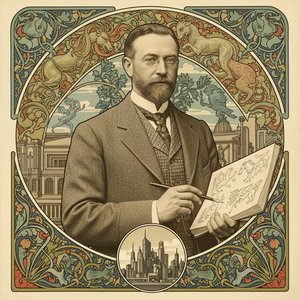
Early Life and Education
- Born: January 25, 1806, Cork, Ireland
- Died: April 25, 1870, London, England
- Parents: Alexander McLish (tanner/shoemaker) and Rebecca McLeish
- Early education in Cork; showed artistic talent from a young age.
- Studied at the Cork School of Art, focusing on drawing and anatomy.
- Self-funded move to London in 1827 to pursue art studies.
- Entered the Royal Academy Schools in 1828, excelling in life drawing and history painting.
Career and Major Works
- Rapidly gained recognition for his portrait skills, notably depicting Charles Kean and Niccolò Paganini.
- Contributed significantly to *Fraser's Magazine* under the pseudonym "Alfred Croquis," creating a series of character portraits that enhanced his reputation.
- Became an Associate of the Royal Academy in 1835 and a full member in 1840.
- Notable Works:
- The Meeting of Wellington and Blücher after the Battle of Waterloo (located at Westminster Palace)
- The Death of Nelson (located at Westminster Palace) – A monumental fresco considered one of his masterpieces.
- The Chivalric Vow of the Ladies and the Peacock
- Illustrations for Charles Dickens' Christmas books and other works.
Artistic Style and Influences
- Maclise’s style blended historical narrative with elements of realism and portraiture.
- Influenced by French and classical art, particularly after his visit to Paris in 1830.
- His work often depicted scenes from history, literature (Shakespeare), and mythology.
- Demonstrated a keen eye for detail and characterization in both portraits and historical compositions.
Later Life and Legacy
- Intense dedication to his art took a toll on his health.
- Declined the presidency of the Royal Academy in 1865 due to declining health.
- Died in Chelsea, London, in 1870.
- A memoir was published by William Justin O'Driscoll in 1871.
- Maclise’s murals at Westminster Palace remain significant contributions to British art and architecture.
- His illustrations for Dickens helped popularize the author's works.
- Considered a key figure in Victorian-era history painting, bridging the gap between Neoclassicism and Realism.
Historical Significance
- Maclise played a crucial role in documenting significant historical events and figures for a wider audience.
- His work reflects the cultural and artistic trends of the 19th century, particularly the Victorian era's fascination with history and literature.
- He helped establish the tradition of large-scale narrative painting within British art.
- His contributions to Westminster Palace’s decoration are integral to the building's aesthetic and symbolic importance.
Questions & Answers
What are the birthplace and birth year of Daniel Maclise?
Daniel Maclise was born in Cork in 1806.
What are the birth city and country of Daniel Maclise?
Daniel Maclise was born in Cork, in Ireland.
How is Daniel Maclise's career divided into periods?
A chronological account of Daniel Maclise's work is available on the artist's Chronicle page, where the artworks pass in order of creation, chapter by chapter.