The Mariner's Vision: The Life and Legacy of Adolphus Knell
In the grand tapestry of nineteenth-century British art, few threads are as salt-sprayed and tempestuous as those woven by William Adolphus Knell. Born in 1801 amidst the maritime rhythms of Carisbrooke on the Isle of Wight, Knell possessed a soul deeply attuned to the ebb and flow of the English Channel. His early years were steeped in the sights and sounds of shipbuilding and the rugged vitality of seafaring life, an immersion that would later manifest in his canvases as more than mere scenery; it was a profound understanding of the ocean's dual nature as both a provider and a predator. Before he became a celebrated figure in the London art scene, Knell’s journey began in the humble workshops of Bath, working as a furniture decorator. This foundational period, though far removed from the high seas, likely instilled in him the meticulous attention to detail and technical precision that would become the hallmark of his maritime masterpieces.
As his talent matured, Knell transitioned from the decorative arts to the prestigious halls of the Royal Academy, where he began exhibiting as early as 1825. His stylistic evolution was deeply influenced by the Dutch masters of the seventeenth century, whose ability to capture light reflecting off turbulent waters and the structural majesty of sailing vessels provided a blueprint for his own development. This reverence for tradition allowed him to bridge the gap between classical maritime portraiture and the burgeoning Romantic movement. His work began to move beyond simple documentation, embracing an atmospheric quality that sought to evoke the very spray of the sea and the heavy, salt-laden air of a gathering storm.
Mastery of the Naval Canvas
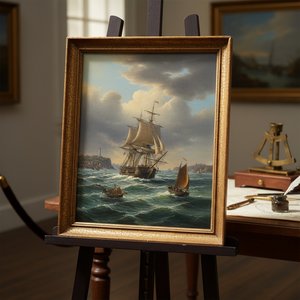
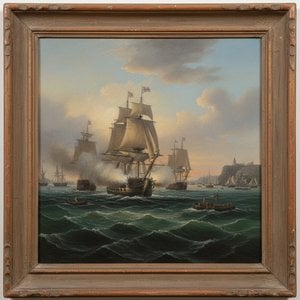
Knell’s ascent within the British art establishment was marked by his ability to capture the drama of naval history with unparalleled realism. He became a preferred chronicler of the Royal Navy's most significant moments, utilizing his brush to immortalize the tension and grandeur of maritime conflict. His technical prowess was perhaps most evident in his depictions of ship battles, where he balanced the intricate rigging and structural complexity of warships with the chaotic, swirling energy of the sea. A defining moment in his career arrived in 1847 with the exhibition of “The Battle off Cape St Vincent, 14 February 1797,” a monumental work that showcased his capacity for historical storytelling through the lens of naval combat.
Beyond the smoke and thunder of battle, Knell possessed a remarkable sensitivity to the quieter, more luminous aspects of maritime life. His repertoire extended into the realm of coastal landscapes and tranquil nautical scenes, where he explored the interplay of light and shadow during the golden hours of sunset. In works such as “Sunset With Boats,” one can observe a shift toward a more luminist approach, where the sky becomes a canvas for radiant, glowing hues that reflect upon the gentle movement of the tide. This versatility—the ability to pivot from the terrifying turbulence of “HMS Shannon Lying Off Dover” to the serene beauty of a coastal evening—is what truly distinguished him from his contemporaries.
Historical Significance and Artistic Impact
The enduring significance of Adolphus Knell lies in his role as a visual historian of the British maritime era. Through his paintings, the triumphs and perils of the nineteenth-century navy were preserved not just as facts in a ledger, but as visceral, emotional experiences. His contributions to prestigious institutions like the British Institution and the Society of British Artists helped solidify the maritime genre as a cornerstone of Victorian art. He did not merely paint ships; he painted the spirit of an age defined by naval supremacy and the relentless human drive to navigate the unknown.
Today, Knell’s legacy continues to resonate through his ability to evoke nostalgia and awe. His works serve as windows into a vanished world of sail and wind, reminding modern viewers of the raw power of the natural elements and the bravery of those who ventured upon them. His artistic achievements can be summarized by several key pillars:
- Technical Precision: An extraordinary ability to render the complex architecture of naval vessels and the fluid dynamics of water.
- Atmospheric Storytelling: The use of light, weather, and sea state to convey deep emotional narratives, from peace to peril.
- Historical Preservation: A dedicated focus on documenting pivotal naval engagements and the daily realities of maritime life.
- Stylistic Versatility: A seamless blend of Dutch-inspired realism with the emotive qualities of the Romantic and Luminist movements.
Questions & Answers
Can I sort Adolphus Knell's artworks by color?
Adolphus Knell's works can be explored by color on the artist's Spectral Index page.
How many artworks by Adolphus Knell are available to browse?
You can browse 77 artworks by Adolphus Knell on the All Artworks page.
Where are Adolphus Knell's artworks mapped by subject?
The Subject Atlas page maps Adolphus Knell's artworks by subject.
Where is Adolphus Knell from?
Adolphus Knell was born in United Kingdom.
Where can I see Adolphus Knell's artworks in chronological order?
A timeline of Adolphus Knell's works exists: the artist's Artwork Timeline page orders the artworks by creation date.
Where can I see Adolphus Knell's artworks arranged by atmosphere?
The Mood Room of Adolphus Knell is a page that arranges the artist's artworks by mood.
Where are Adolphus Knell's artworks grouped by keywords?
Adolphus Knell's works can be explored by keyword on the artist's By Keywords page. Each keyword groups the related artworks.
Where can I see Adolphus Knell's artworks in a 3D gallery?
Adolphus Knell's artworks can be seen in a 3D gallery on the artist's 3D Museum page.