


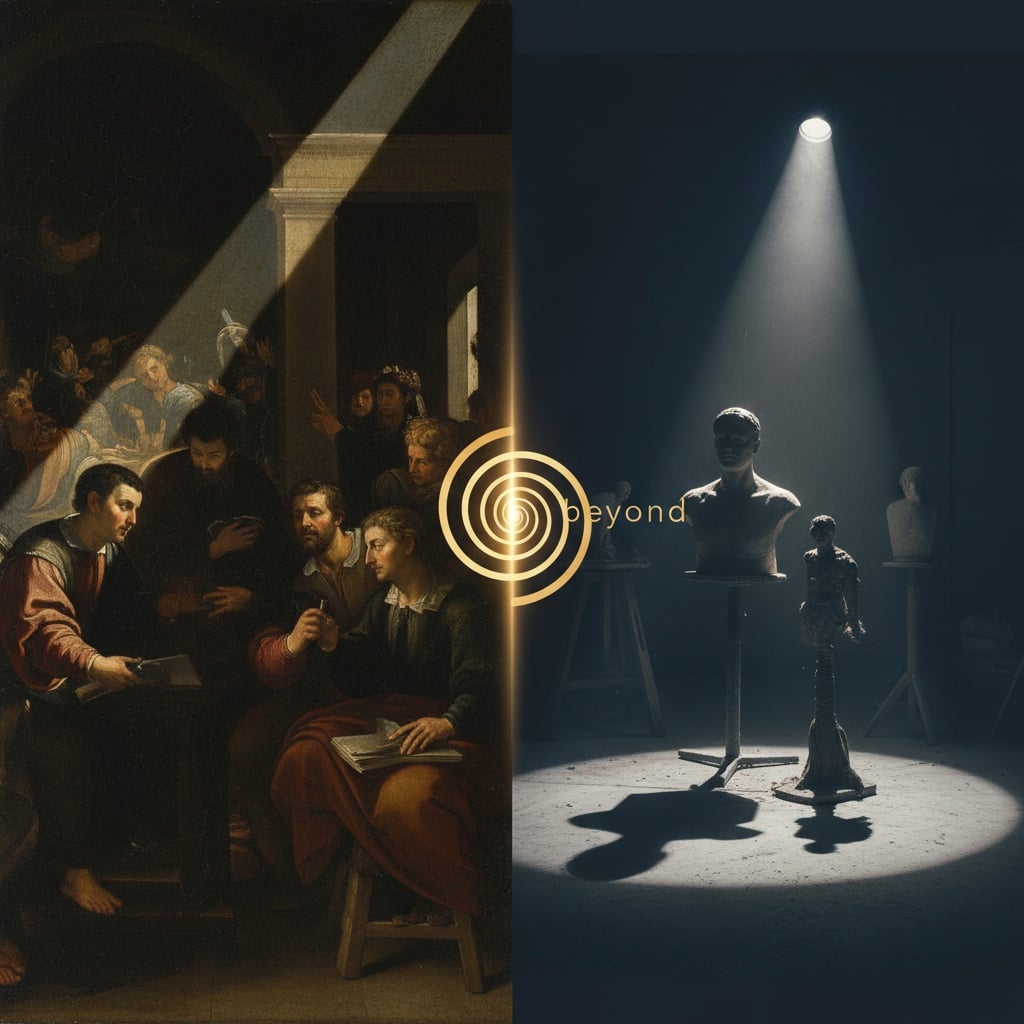
Introduction: The Power of Light and Shadow
From the flickering candlelight illuminating a Renaissance workshop to the stark contrasts defining a Caravaggio masterpiece, light has always been more than mere illumination for artists; it’s a narrative force, an emotional catalyst, and a tool for profound psychological revelation. The manipulation of light and shadow isn't simply about depicting what the eye sees, but rather about controlling *how* we see – guiding our gaze, shaping our understanding, and evoking powerful responses within us. This exploration delves into the captivating history of chiaroscuro and tenebrism, tracing their evolution from subtle modeling techniques to dramatic statements that redefined painting in the Baroque era and continue to resonate with audiences today.
Chiaroscuro Defined: Origins and Core Principles
In art, chiaroscuro (English: kee-AR-ə-SKOOR-oh, -SKURE-, Italian: [ˌkjaroˈskuːro]; lit. 'light-dark') is the use of strong contrasts between light and dark, usually bold contrasts affecting a whole composition. It is also a technical term used by ...
The term “chiaroscuro,” derived from the Italian *chiaro* (light) and *scuro* (dark), initially described a technique employed during the Renaissance as artists sought greater realism in their depictions. Early examples weren’t about stark contrasts, but rather a gradual blending of light and shadow to create volume and depth – a means of rendering three-dimensional forms on a two-dimensional surface. Think of Leonardo da Vinci's subtle gradations in *Mona Lisa*, where the sfumato technique—a softening of edges achieved through layers of translucent glazes—creates an almost ethereal quality, subtly modeling her face and hands. This wasn’t about spotlighting; it was about nuanced representation. However, this foundation laid the groundwork for a more radical approach that would emerge in the following century. The core principle remained: light defines form, but its application began to shift from gentle suggestion to forceful declaration.
Caravaggio & Tenebrism: A Revolution in Darkness
Tenebrism, from Italian tenebroso ('dark, gloomy, mysterious'), also occasionally called dramatic illumination, is a style of painting using especially pronounced chiaroscuro, where there are violent contrasts of light and dark, and where darkness be...
Michelangelo Merisi da Caravaggio is almost universally credited with transforming chiaroscuro into the dramatic style known as tenebrism – from the Italian *tenebroso*, meaning “dark, gloomy, mysterious.” While earlier artists used light to model forms, Caravaggio weaponized it. He plunged his canvases into profound darkness, illuminating only select elements with a harsh, almost theatrical spotlight. This wasn’t merely about realism; it was about psychological intensity and emotional impact. Works like *The Calling of Saint Matthew* exemplify this approach: a dimly lit tavern scene suddenly pierced by a beam of divine light, focusing our attention on the moment of revelation. Caravaggio's naturalistic subjects – often ordinary people depicted with raw emotion – further amplified the shock value. He rejected idealized forms in favor of gritty realism, and his use of tenebrism served to heighten this effect, creating scenes that felt both immediate and deeply unsettling. This revolutionary approach broke sharply from the conventions of Renaissance painting, prioritizing drama over decorum.
Beyond Caravaggio: Exploring Chiaroscuro in Baroque Painting
Caravaggio’s influence spread rapidly throughout Europe, inspiring a generation of artists to embrace tenebrism and dramatic lighting. In Spain, painters like José de Ribera adopted the technique, infusing their religious scenes with a similar intensity and realism. Francisco Goya, later in his career, also employed tenebrism to convey the darkness and brutality of war. In Northern Europe, Dutch masters developed a related style known as “candlelight painting,” where scenes were illuminated solely by the glow of a single candle or lamp. Rembrandt van Rijn, perhaps the most celebrated exponent of this technique, used subtle gradations of light and shadow to create intimate portraits and biblical narratives filled with psychological depth. While sharing Caravaggio’s interest in dramatic lighting, these artists often employed a softer touch, focusing on mood and atmosphere rather than stark contrast. Peter Paul Rubens also incorporated chiaroscuro into his dynamic compositions, though typically with a greater emphasis on color and movement.
Georges de La Tour: The Candlelight Master
Few artists captured the quiet intimacy of candlelight as effectively as Georges de La Tour. Working in France during the 17th century, De La Tour specialized in nocturnal scenes – often depicting religious subjects or fortune tellers illuminated by a single flickering flame. His paintings are characterized by their profound stillness and emotional resonance. Unlike Caravaggio’s dramatic spotlighting, De La Tour's light is softer, more diffused, creating an atmosphere of contemplative mystery. *St. Simeon with a Child*, for example, showcases his mastery of tenebrism: the saint bathed in the warm glow of candlelight, his face etched with devotion as he gazes upon the infant Christ. The darkness surrounding him isn’t oppressive but rather serves to heighten the sense of spiritual intimacy and focus our attention on the central figures. De La Tour's work demonstrates a unique sensitivity to the nuances of light and shadow, creating scenes that are both visually stunning and deeply moving.
The Enduring Legacy of Dramatic Lighting Techniques
The techniques pioneered by Caravaggio, De La Tour, and their contemporaries continue to influence artists today. Beyond painting, chiaroscuro and tenebrism have found applications in photography, film noir, and even digital art. The fundamental principles – the power of light to define form, evoke emotion, and guide the viewer’s eye – remain as relevant now as they were centuries ago. At ArtsDot, we celebrate this rich artistic heritage by offering meticulously crafted reproductions of masterpieces from the Baroque era and beyond. Whether you're captivated by Caravaggio’s dramatic intensity or De La Tour’s quiet intimacy, exploring these works allows us to appreciate the enduring power of light and shadow in shaping our visual experience. Discover a world of museum-quality art and bring the brilliance of these masters into your home with a hand-painted reproduction from ArtsDot.com.



