


 Preview
 Send
Send Share
Share
 Details
 Guide
Guide

 Download
 Similars
 X-Ray
X-Ray Diaporama
 Stats
StatsStudy for Dance


 Read More
Giclée / Art Print
Museum-quality giclée or canvas print with fast production and flexible finish options. ( Buy Hand Made Painting Switch to Digital Image)




P118B $10

P118H $10

P118W $10

P438Z $10

P508JH $12

P508YH $12

P805H $10

P805Z $10

P919BZ $10

P919G $10

P919XJ $10

P959ZH $10

P968JZ $12

W106C $8

W218G $10

W218JH $8

W218Y $10

W307PJ $10

W316G $10

W316PJ $8

W316Y $10

W398PJ $8

W4111J $10

W500HY $15

W500JH $15

W692G $12

W849H $8

W940BG $15

W953PJ $8




Pick from our preset sizes that match the artwork's original proportions.

Type the width and the height you need, to fit your frame or your wall. A print can only be cut, never made bigger than the picture, so a size with a different shape loses a part of the image. We send you a digital mockup to approve before we print anything. The picture shown on this page does not show the real cut — only the mockup does.
Worldwide Delivery () in 2 weeks instead of standard 4/5 weeks. (20 October)

Free Worldwide Express Shipping

High-Quality Linen Canvas

Full Shipping Insurance

Customs Tax Refund Guarantee

True Color Matching Guarantee

100-Day Return Policy (Defects Only)

100% Money-Back Guarantee

Bulk Discount Offer
 Glass option is only available in size under 110 CM

Study for Dance
Giclée / Art Print
Reproduction Size
-


Total Price
$ 63
A Study in Fluidity: Alphonse Mucha’s ‘Study for Dance’
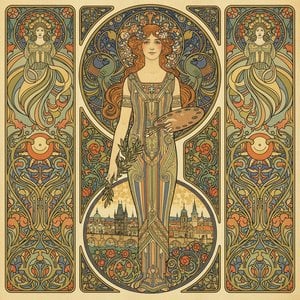
Alphonse Maria Mucha's “Study for Dance,” a pastel drawing of remarkable delicacy and dynamism, offers a captivating glimpse into the heart of Art Nouveau. Dating from around 1900, this piece transcends mere representation; it is an embodiment of movement, beauty, and the spirit of a burgeoning artistic era. The artwork’s immediate impact lies in its depiction of a nude woman – a recurring motif in Mucha's oeuvre – caught in a swirling, almost ecstatic pose, reminiscent of a dancer lost within her own rhythm. This isn’t a study for a grand salon painting; rather, it feels intensely personal, a concentrated exploration of form and emotion.
Style & Technique: The Essence of Art Nouveau
Mucha's distinctive style is immediately recognizable. “Study for Dance” exemplifies the flowing lines, organic forms, and decorative elements that defined Art Nouveau. The composition prioritizes graceful curves over rigid realism, creating a dreamlike atmosphere where perspective is subtly flattened to emphasize the figure’s movement. The pastel technique itself is crucial – layers of color are meticulously built up to achieve a velvety texture and luminous quality. Notice how loose brushstrokes contribute to the ethereal effect, while delicate linework defines the contours of the woman's body and the intricate details of the circular frame. The use of hatching and cross-hatching adds depth and dimension, particularly in rendering the folds of her dress, which appears to ripple with movement.
Symbolism & Composition
Beyond its aesthetic beauty, “Study for Dance” is rich in symbolic meaning. The swirling lines that dominate the composition represent fluidity – not just physical movement but also ideas and emotions. The ornate circular frame, a frequent element in Mucha’s work, suggests eternity or a celestial realm, elevating the figure to something almost divine. The warm color palette—dominated by reds, golds, and muted greens—evokes feelings of sensuality and warmth. Considering Mucha's influences – particularly his admiration for Gustave Moreau – we can see echoes of classical mythology and allegorical themes within this intimate study. The pose itself, with the woman’s arms outstretched, speaks to a yearning for freedom and expression, aligning perfectly with the core values of Art Nouveau.
Historical Context & Mucha's Legacy
Created during a period of immense artistic innovation, “Study for Dance” reflects the broader cultural shift towards embracing beauty, nature, and decorative arts. Mucha’s work was instrumental in establishing Art Nouveau as a dominant style, influencing designers, architects, and artists across Europe. His commissions for Parisian department stores and exhibitions helped to popularize his distinctive aesthetic. As a precursor to Cubism and other modern movements, Mucha's emphasis on flattened perspective and stylized forms paved the way for new approaches to representation. Studying “Study for Dance” allows us to appreciate not only Mucha’s individual genius but also his pivotal role in shaping the course of 20th-century art.
Questions & Answers
How do the colors of "Study for Dance" by Alphonse Mucha relate to its emotion?
In "Study for Dance", pastels colors accompany an ethereal feeling.
What is the color identity of "Study for Dance" by Alphonse Mucha?
The color identity of "Study for Dance" by Alphonse Mucha: a pastels palette, dominated by khaki (#dcd17e).
Does "Study for Dance" show strong light-dark contrasts?
The light-dark contrast of "Study for Dance" is recorded as serene. Contrast describes how strongly light and dark areas differ.


Artist Biography
Early Life and Education
- Born: July 15, 1860, in Ivanačice, Moravia (now part of the Czech Republic)
- Showed artistic talent from a young age.
- Studied at the Academy of Fine Arts in Prague but became disillusioned with traditional approaches.
- Moved to Paris in 1887 to pursue his own style.
Artistic Style and Notable Works
- Known for distinctive Art Nouveau style characterized by flowing lines, organic forms, and a sense of movement.
- Influenced by artists like Pierre-Auguste Renoir and Gustave Moreau.
- Notable Works:
- The Slavonic Uprising - Showcases blending traditional Czech motifs with modern Art Nouveau elements.
- Salon des Cent
- Paintings inspired by works like The Daughters of Tespio by Gustave Moreau, and La Ribambelle des Gobelins by Piero Dorazio.
- Illustrations based on Young Farmers Breaking Flax by Sir Hubert von Herkomer.
- Frequently featured idealized women in flowing robes surrounded by lush flowers.
Career Highlights and Major Commissions
- Sarah Bernhardt Collaboration: Created posters and designs for the actress Sarah Bernhardt, starting with the poster for Gismonda (1894), which launched his career.
- Universal Exhibition in Paris (1900): His Art Nouveau style gained international recognition at this exhibition. He decorated the Bosnia and Herzegovina Pavilion and collaborated on the Austrian Pavilion.
- Charles Richard Crane Patronage: Received support from Charles Richard Crane, which enabled him to create the monumental series The Slav Epic (1912-30).
- Post-Independence Czechoslovakia: Designed postage stamps, banknotes, and government documents for newly independent Czechoslovakia.
Influences and Legacy
- Influenced by Czech artistic traditions and modern European art movements.
- His unique style paved the way for future generations of artists in Art Nouveau and Secessionism.
- Inspired other artists like Eva Prokopcová.
- Legacy extends beyond his artwork to influence design and aesthetics.
Later Life and Death
- Married Maruska (Marie/Maria) Chytilová in 1906.
- Visited the United States from 1906-1910, where their daughter Jaroslava was born.
- Died on July 14, 1939, in Prague, Czechoslovakia.

Alphonse Mucha
1860 - 1939 , Czech Republic
Quick Facts
- Full Name: Alphonse Maria Mucha
- Nationality: Czech
- Date Of Birth: 1860
- Date Of Death: 1939
- Place Of Birth: Brno, Czech Republic
- Notable Artworks:
- Slavic Uprising
- Salon des Cent
- The Daughters of Tespio
- La Ribambelle des Gobelins
- Young Farmers Breaking Flax
- Artistic Movement Or Style: Art Nouveau
- Artists Who Influenced This Artist:
- Pierre-Auguste Renoir
- Gustave Moreau
- Dante Gabriel Rossetti
- Artists Or Movements Influenced By This Artist: ['Eva Prokopcová']
Related Articles
Alphonse Mucha: A Comprehensive Exploration of Art Nouveau's Master of Decorative Symbolism
Explore the life & art of Alphonse Mucha, master of Art Nouveau! Discover his iconic posters, stunning illustrations, and the monumental Slav Epic. A comprehensive guide for collectors & enthusiasts.

The Enduring Allure of the Nude: A Historical & Artistic Exploration of the Human Form
Explore the captivating history of nude art! Discover iconic paintings & artists from classical to modern eras. Uncover symbolism, techniques & find museum-quality reproductions at ArtsDot.

The Subtleties of Pastel: A Comprehensive Exploration of Technique, History & Emotional Resonance
Explore the captivating world of pastel art! Discover its rich history, Impressionistic masters like Degas, emotional power & unique techniques. Find museum-quality reproductions at ArtsDot.

The Eloquent Form: A Historical & Aesthetic Exploration of the Nude in Art
Explore the captivating history of the nude in art! From ancient Greece to modern masters, discover its evolving symbolism, techniques & enduring beauty. Expert insights for collectors and enthusiasts.

The Subdued Radiance of Pastel: Exploring Nuance & Emotion in Art
Explore the nuanced world of pastel art! Discover its history, techniques & emotional power with expert insights from ArtsDot.com. Find museum-quality reproductions and learn about collecting this delicate medium.


