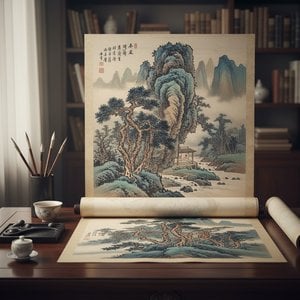
Wu Guxiang (1848–1903): The Poet Painter of Tranquility
Wu Guxiang (吳穀祥), born in Jiangsu Province, China, was a pivotal figure in the late Qing Dynasty’s artistic landscape. He emerged as a prominent Shanshui painter—a genre emphasizing idealized depictions of mountainous landscapes—whose work embodies both meticulous technique and profound philosophical contemplation. His art reflects the spirit of Neo-Confucianism, prioritizing harmony with nature and inner reflection alongside masterful brushwork.
Early Life & Education: Guxiang’s formative years were marked by a rigorous Confucian upbringing, instilled in him by his father, who recognized his artistic talent early on. He studied calligraphy and painting under renowned masters, honing his skills and absorbing the aesthetic principles of traditional Chinese art.
Influences: His artistic vision was deeply impacted by Tang Dynasty landscape painters like Wang Wei and Guo Xi, whose serene depictions of mountains and rivers served as models for Guxiang’s compositions. Furthermore, he embraced Zen Buddhism's emphasis on simplicity and mindfulness, translating into a restrained palette and understated brushstrokes.
The Art of Shanshui: Technique & Symbolism
Guxiang’s Shanshui paintings are characterized by exceptional mastery of ink wash technique—known as Guan hua qi shi. He skillfully employed layering, hatching, and blending to create textures that capture the misty grandeur of mountainous terrains. Beyond mere representation, his works convey deeper meanings rooted in Confucian cosmology. Pine trees, often depicted prominently, symbolize longevity and resilience – enduring symbols of virtue and spiritual fortitude. Waterfalls represent purity and transformation, mirroring the Buddhist concept of overcoming obstacles on the path to enlightenment.
Critical Reception: Contemporary critics lauded Guxiang's work for its aesthetic beauty and intellectual depth. He was recognized as one of the foremost Shanshui painters of his era, securing a place among the giants of Chinese art history.
Legacy & Historical Significance
Wu Guxiang’s influence extended far beyond his lifetime. His paintings continue to inspire artists and scholars alike, serving as benchmarks for Shanshui aesthetics. He championed a contemplative approach to artistic creation—emphasizing inner harmony and spiritual awareness alongside technical virtuosity. As a symbol of Neo-Confucian ideals embodied in visual art, Guxiang’s oeuvre remains an enduring testament to China's cultural heritage and its profound engagement with the natural world.
Continuing Influence: His stylistic innovations—particularly his use of subtle color gradations—influenced subsequent generations of painters. He solidified Shanshui painting as a genre dedicated to conveying moral and spiritual truths alongside visual splendor.
Explore the captivating world of Pu Xinyu (Puru), the last great literati painter. Discover his imperial heritage, masterful ink wash techniques & enduring legacy – a valuable addition to any discerning art collection.
Ανακαλύψτε τους 10 κορυφαίους πίνακες του 19ου αιώνα! Μονέ, Ρενουάρ & άλλοι μεγάλοι ζωγράφοι. Ιμπρεσιονισμός, ρομαντισμός και η ιστορία της τέχνης ζωντανεύουν. Βρείτε την ιδανική αναπαραγωγή πίνακα για τον χώρο σας στο ArtsDot.com.
Bada Shanren, born into the imperial House of Zhu, sought refuge in Buddhist monasteries after the Ming Dynasty fell. How did political upheaval shape his art?
Πού μπορώ να δω το χρωματικό προφίλ των έργων του Wu Guxiang;
Το χρωματικό προφίλ των έργων του/της Wu Guxiang εμφανίζεται στη σελίδα Γενετικό Σύστατο Παλέτας του καλλιτέχνη/της.
Πώς μπορώ να βρω έργα του/της Wu Guxiang με ένα συγκεκριμένο θέμα;
Ανακαλύψτε τα έργα του/της Wu Guxiang ανά λέξη-κλειδί στη σελίδα των λέξεων-κλειδιών του/της Με Λέξεις-Κλειδιά. Κάθε λέξη-κλειδί ομαδοποιεί τα σχετικά έργα.
Με τι άλλα ονόματα ή ψευδώνυμα είναι γνωστός/η Wu Guxiang;
Ο/Η Wu Guxiang είναι γνωστός/η επίσης ως 吳穀祥.
Πώς μπορώ να βρω έργα του/της Wu Guxiang σε μια συγκεκριμένη παλέτα χρωμάτων;
Μπορείτε να περιηγηθείτε στα έργα του/της Wu Guxiang ανά χρωματική παλέτα στη σελίδα των χρωμάτων του/της Wu Guxiang, στην ενότητα Κατά Παλέτα Χρωμάτων.
Πού μπορώ να δω όλα τα έργα του/της Wu Guxiang;
Μπορείτε να περιηγηθείτε σε όλα τα έργα του/της Wu Guxiang στο αυτή η ιστοσελίδα μέσω της σελίδας με την πλήρη συλλογή τους (Όλα τα έργα).
Πόσο δημοφιλή είναι τα έργα του/της Wu Guxiang;
Μπορείτε να επισκεφθείτε τη σελίδα Στατιστικά επισκεψιμότητας για τον/την Wu Guxiang, η οποία παρουσιάζει στατιστικά στοιχεία σχετικά με τα έργα του/της καλλιτέχνη/στη στο αυτή η ιστοσελίδα.
Μπορώ να επισκεφτώ ένα εικονικό μουσείο με τα έργα του Wu Guxiang;
Η 3D Μουσείο του Wu Guxiang σας προσφέρει μια εικονική τρισδιάστατη γκαλερί, όπου μπορείτε να θαυμάσετε τα έργα του καλλιτέχνη.
Πώς μπορώ να παρακολουθήσω το έργο του/της Wu Guxiang χρονολογικά;
Μπορείτε να δείτε τη χρονολογία των έργων του/της Wu Guxiang στη σελίδα Χρονολόγιο Έργων, όπου τα έργα είναι ταξινομημένα ανά ημερομηνία δημιουργίας.
Πού μπορώ να βρω τα έργα του καλλιτέχνη Wu Guxiang ομαδοποιημένα ανά καλλιτεχνικό ρεύμα;
Τα καλλιτεχνικά κινήματα στα οποία συμμετείχε ο/η Wu Guxiang μπορείτε να τα δείτε στη σελίδα των καμπανών του/της Όλα τα Ρευmatά, η οποία ομαδοποιεί τα έργα ανά καλλιτεχνικό κίνημα.
Γεια σας! Μπορώ να σας βοηθήσω στην επιλογή ενός έργου τέχνης, στην παρακολούθηση μιας παραγγελίας ή στην απάντηση ερωτήσεων σχετικά με την εγγύηση. Πώς μπορώ να σας φανώ χρήσιμος;