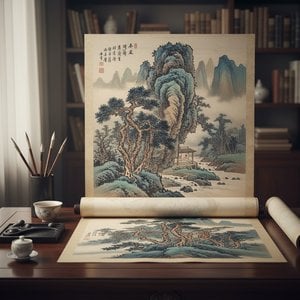
Wang Shimin: A Master of Ming-Qing Landscape Painting
Early Life and Background
Born: Approximately 1592 in Taichung, China.
Died: 1680.
Wang Shimin grew up in a highly cultured and scholarly environment. His grandfather was a prime minister during the late Ming dynasty, and his father served as an editor at the Hanlin Academy.
This upbringing instilled in him a deep appreciation for art and literature from a young age.
Artistic Development and Influences
Wang Shimin received early training in both painting and calligraphy. His father, having studied with Tung Ch'i-ch'ang, passed on valuable artistic knowledge.
Key Influence: He was profoundly influenced by the landscape paintings of Wang Wei, particularly “Snow over Rivers and Mountains,” which he later emulated in his own work.
He also drew inspiration from earlier masters like Huang Gongwang, often creating variations on their established styles.
Career as an Official and Artistic Pursuit
Initially, Wang Shimin pursued a career as a government official. However, illness contracted during a trip to Nanking in 1630 forced him to return home.
Turning Point: This period of convalescence marked a turning point in his life, leading him to dedicate himself fully to the pursuit of art.
He immersed himself in painting and created numerous landscapes, establishing his reputation as a skilled artist.
Artistic Style and Major Works
Style: Wang Shimin’s landscape paintings are characterized by their serene atmosphere, meticulous brushwork, and atmospheric depth. He often employed a restrained palette and focused on capturing the essence of nature.
His works exemplify the literati painting tradition, emphasizing intellectual and emotional expression alongside technical skill.
The Four Wangs: Wang Shimin is considered one of the “Four Wangs” – a group of influential landscape painters who dominated the art scene during the late Ming and early Qing dynasties.
Along with his grandson, Wang Yuanqi (also a member of the Six Masters), they played a crucial role in shaping the development of Chinese landscape painting.
Their emphasis on tradition and refinement helped to preserve and promote classical styles during a period of significant social and political upheaval.
Legacy: Wang Shimin’s work continues to be admired for its beauty, technical skill, and profound connection to the natural world. He remains an important figure in the history of Chinese art.
Από την επιβλεπόμενη ομάδα της ArtsDot.com
Γρήγορο κвиζ
Για κάθε ερώτηση υπάρχει μόνο μία σωστή απάντηση.
Ερώτηση 1:
Ο Wáng Shímín είναι γνωστός κυρίως ως δάσκαλος σε ποιο είδος ζωγραφικής;
Ερώτηση 2:
Κατά τις οποίες δύο δυναστείες δημιούργησε ο Wáng Shímín την τέχνη του;
Ερώτηση 3:
Ο Wáng Shímín σχετίζεται με μια ομάδα καλλιτεχνών γνωστή ως «Οι Τέσσερις Wang». Ποια ήταν η σημασία τους;
Ερώτηση 4:
Ποιος προγενέστερος καλλιτέχνης επηρέασε σημαντικά το στυλ τοπίου του Wáng Shímín, όπως αναφέρεται στη βιογραφία;
Ερώτηση 5:
Εκτός από το ότι ήταν καλλιτέχνης, τι άλλο ρόλο κατείχε ο Wáng Shímín νωρίτερα στη ζωή του;
Ανακαλύψτε τους 10 κορυφαίους πίνακες του 19ου αιώνα! Μονέ, Ρενουάρ & άλλοι μεγάλοι ζωγράφοι. Ιμπρεσιονισμός, ρομαντισμός και η ιστορία της τέχνης ζωντανεύουν. Βρείτε την ιδανική αναπαραγωγή πίνακα για τον χώρο σας στο ArtsDot.com.
Explore the life & art of Simon Vouet, a pivotal French Baroque painter who introduced Italian styles to France. Discover his masterpieces and lasting influence on 17th-century art.
Explore the captivating world of Pu Xinyu (Puru), the last great literati painter. Discover his imperial heritage, masterful ink wash techniques & enduring legacy – a valuable addition to any discerning art collection.
Γεια σας! Μπορώ να σας βοηθήσω στην επιλογή ενός έργου τέχνης, στην παρακολούθηση μιας παραγγελίας ή στην απάντηση ερωτήσεων σχετικά με την εγγύηση. Πώς μπορώ να σας φανώ χρήσιμος;