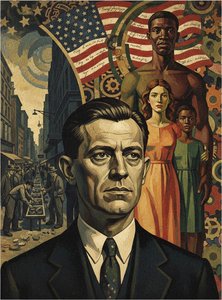
Ustad Allah Bakhsh: Weaver of Punjab’s Tales and Landscapes

Ustad Allah Bakhsh, born around 1895 in Wazirabad, Pakistan – a small town nestled within the fertile plains of Punjab – stands as one of the most beloved and enduring figures in Pakistani art. His life was inextricably linked to the rich cultural tapestry of his homeland, and his artistic output served as both a mirror reflecting its traditions and a window offering glimpses into timeless narratives. More than simply a painter, Allah Bakhsh was a storyteller, meticulously capturing the essence of Punjabi rural life alongside the dramatic sweep of Persian mythology and Hindu legends. His legacy continues to resonate through the National Art Gallery’s collection and in the hearts of those who connect with the poignant beauty of his work.

Early Life and Artistic Training

Allah Bakhsh's early years were marked by a grounding in traditional Islamic education, spending time at a Madrasa studying Urdu and Arabic. However, it was a chance encounter with Master Abdullah, a renowned miniature artist, that truly ignited his artistic passion. At the tender age of five, he began his apprenticeship, initially mastering the basics of calligraphy before transitioning to painting. This early training instilled in him a deep respect for technique and detail, while simultaneously exposing him to the vibrant colors and expressive brushwork characteristic of traditional Pakistani art. Later, he further honed his skills under Master Meeran Bakhsh Naqash, a respected teacher and Vice Principal of the Mayo School of Arts (now the National College of Arts) in Lahore – an institution that played a crucial role in shaping the artistic landscape of British India. This diverse mentorship provided him with a broad foundation, blending classical influences with local sensibilities.

Themes and Artistic Style

Allah Bakhsh’s oeuvre is remarkably diverse, encompassing a wide range of subjects that reflect his deep connection to Pakistani culture. He is perhaps most renowned for his depictions of tragic love stories – the heart-wrenching tales of Sohni Mahiwal, Heer Ranjha, and Tilism-e-Hoshruba. These narratives, deeply rooted in Punjabi folklore, explore themes of devotion, sacrifice, and unrequited longing with a profound emotional intensity. Beyond these romantic dramas, Allah Bakhsh also skillfully portrayed the everyday life of rural Punjab, capturing the dignity and resilience of its people. His paintings are filled with vibrant colors, dynamic compositions, and meticulously rendered details – from the intricate patterns of traditional clothing to the lush landscapes of the region. He was particularly adept at portraying faces, imbuing each figure with a unique personality and emotional depth. Interestingly, Allah Bakhsh’s style evolved over time, incorporating elements of Western classical painting while retaining his distinctly Pakistani aesthetic. This fusion is evident in his use of perspective, lighting, and composition, demonstrating a willingness to experiment and push the boundaries of traditional art forms.

Major Works and Recognition

Several works by Ustad Allah Bakhsh have become iconic representations of Pakistani art. His paintings of Sohni Mahiwal, for example, are instantly recognizable and continue to be reproduced widely. The epic tale of Amir Hamza, depicted in *Tilism-e-Hoshruba*, showcases his ability to weave complex narratives into visually stunning compositions. His depictions of traditional Punjabi festivals – Holi, Eid, and harvest celebrations – offer a glimpse into the vibrant cultural traditions of the region. Following Pakistan’s independence, Allah Bakhsh's work gained further recognition, with several pieces being acquired by the National Art Gallery. In 1963, he was awarded the Pride of Performance, a national honor recognizing his significant contributions to Pakistani culture. Furthermore, in 1991, Pakistan Post issued a commemorative postage stamp honoring his legacy, solidifying his place as a national treasure.

Legacy and Influence

Ustad Allah Bakhsh’s impact on Pakistani art extends far beyond the canvases he adorned. He established “Allah Bux Academy,” a school dedicated to preserving and transmitting his artistic style – a testament to his belief in the importance of nurturing future generations of artists. His studio, now transformed into an academy, continues to serve as a hub for aspiring painters, ensuring that his legacy lives on through those who learn at his feet. Allah Bakhsh’s work remains deeply cherished by Pakistanis, embodying the spirit and soul of their nation. He is remembered not only for his artistic talent but also for his dedication to preserving and celebrating Punjabi culture and mythology – a true testament to the power of art to connect us to our past and inspire us towards the future.

Γρήγορη κουίζ

Για κάθε ερώτηση υπάρχει μόνο μία σωστή απάντηση.

Ερώτηση 1:
Ustad Allah Bakhsh is primarily known for his depictions of which subjects?
Ερώτηση 2:
In what region was Ustad Allah Bakhsh born?
Ερώτηση 3:
Which of the following tales is Ustad Allah Bakhsh most famous for portraying?
Ερώτηση 4:
What honor did Ustad Allah Bakhsh receive in 1963?
Ερώτηση 5:
Where is Ustad Allah Bakhsh's studio now?

Ερωτήσεις και Απαντήσεις

Υπάρχει μια πλήρης λίστα με τα έργα του/της Ustad Allah Bakhsh;

Μπορείτε να περιηγηθείτε σε όλα τα έργα του/της Ustad Allah Bakhsh στο αυτή η ιστοσελίδα μέσω της σελίδας με την πλήρη συλλογή τους (Όλα τα έργα).

Μπορώ να εξερευνήσω τα έργα του/της Ustad Allah Bakhsh ανά φάσμα χρωμάτων;

Στη σελίδα Δείκτης Χρώματος του Ustad Allah Bakhsh, τα έργα του καλλιτέχνη είναι οργανωμένα ανά χρώμα.

Πού μπορώ να δω τα έργα του/της Ustad Allah Bakhsh σε χρονολογική σειρά;

Τα έργα του καλλιτέχνη Ustad Allah Bakhsh μπορούν να περιηγηθούν χρονολογικά στη σελίδα Χρονολόγιο Έργων.

Μπορώ να εξερευνήσω τα έργα του/της Ustad Allah Bakhsh μέσω λέξεων-κλειδιών;

Στη σελίδα Με Λέξεις-Κλειδιά του Ustad Allah Bakhsh, τα έργα του καλλιτέχνη ομαδοποιούνται ανά λέξεις-κλειδιά.

Υπάρχει μια χρονολογική αναδρομή για τον/την Ustad Allah Bakhsh;

Η καριέρα του/της Ustad Allah Bakhsh αναπτύσσεται περίοδο προς περίοδο στη σελίδα Χρονικό έργο: μια χρονοσειρά των έργων, τα οποία είναι ομαδοποιημένα σε ενότητες ανά περίοδο της καριέρας του/της.

Μπορώ να περιηγηθώ στα έργα του/της Ustad Allah Bakhsh ανά τεχνική;

Η σελίδα Κατά Τεχνική ομαδοποιεί τα έργα του/της Ustad Allah Bakhsh ανά τεχνική.

Ποιες διαθέσεις εκφράζουν τα έργα του/της Ustad Allah Bakhsh;

Μπορείτε να περιηγηθείτε στα έργα του Ustad Allah Bakhsh ανάλογα με τη διάθεση στη σελίδα Κόρνερ Αίσθησης, η οποία ταξινομεί τα έργα τέχνης σύμφωνα με τη διάθεση που αποπνέουν.

Πόσο δημοφιλή είναι τα έργα του/της Ustad Allah Bakhsh;

Μπορείτε να επισκεφθείτε τη σελίδα Στατιστικά επισκεψιμότητας για τον/την Ustad Allah Bakhsh, η οποία παρουσιάζει στατιστικά στοιχεία σχετικά με τα έργα του/της καλλιτέχνη/στη στο αυτή η ιστοσελίδα.

Σε ποια πόλη και χώρα γεννήθηκε ο/η Ustad Allah Bakhsh;

Ο/Η Ustad Allah Bakhsh γεννήθηκε στην/στη Faisalabad, στο/στη Pakistan.