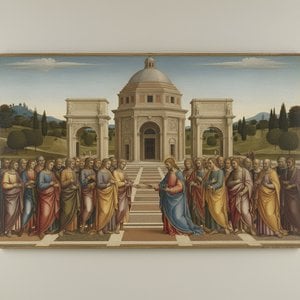
The Divine Brush of the Umbrian Renaissance
In the golden twilight of the Italian Renaissance, a painter emerged from the spiritual heart of Umbria to leave an indelible mark on the sacred landscapes of Italy. Tiberio d'Assisi, born Tiberio Ranieri di Diotallevi around 1470, was more than just a craftsman; he was a chronicler of the divine. Operating during the early 16th century, his life and work were deeply intertwined with the religious fervor of his era. While historical records suggest he was first documented in Assisi in 1486 as a member of the Confraternita di San Vitale, his artistic soul likely found its formative rhythm under the influence of masters like Pintoricchio and the graceful, harmonious style of Pietro Perugino. This lineage of grace allowed him to infuse his compositions with a serene, celestial light that seemed to bridge the gap between the earthly and the eternal.
The trajectory of Tiberio's career was marked by both local devotion and prestigious papal connections. It is believed that he may have accompanied Pintoricchio to Rome, contributing to the magnificent decorations within Santa Maria del Popolo and the Borgia apartments in the Vatican Palace. Such exposure to the highest echelons of Roman art undoubtedly refined his technique, blending the soft, atmospheric qualities of the Umbrian school with the monumental grandeur required by the Papacy. His reputation was so profound that in 1504, the Commune of Assisi commissioned him to paint the arms of Pope Julius II, describing him in contemporary contracts as a “sublimis et quasi divinus pictor”—a sublime and almost divine painter. This rare accolade speaks to the emotional resonance his work held for those who gazed upon it.
A Legacy Carved in Fresco and Wood
Tiberio's oeuvre is a tapestry of sacred narratives, much of which remains preserved in the very churches where they were originally breathed into life. His mastery was particularly evident in his fresco work, where he transformed cold plaster into vibrant, living histories. From the Basilica of Santa Maria degli Angeli to the churches of Montefalco and Assisi, his hands traced the lives of saints with a delicate yet powerful touch. His ability to navigate complex theological themes through visual storytelling is perhaps best seen in his depictions of the life of St. Francis, where he captured the humility and miraculous nature of the saint's journey.
Beyond the expansive walls of frescoes, Tiberio excelled in more intimate formats, such as tempera on wood panels. Some of his most significant surviving achievements include:
- The Altarpiece in Pinacoteca Vaticana (1502): A breathtaking depiction of the Madonna and Child enthroned between Saint Jerome and Saint Francis, showcasing his ability to balance complex iconography with profound tenderness.
- Saint Clare of Assisi: A poignant fresco fragment, now held by the Barber Institute of Fine Arts, which captures the youthful sanctity of the founder of the Order of Poor Clares, holding a lily as a symbol of purity.
- St. Sebastian and Saint Ansanus: Works that demonstrate his command over the human form and the dramatic tension inherent in the lives of the martyrs.
As the 16th century progressed, Tiberio's influence continued to ripple through the Umbrian landscape. Even as styles began to shift toward the more complex Mannerist movement, the foundational grace he established remained a cornerstone of regional devotion. Though much of his work was subject to the ravages of time—with many frescoes being detached from walls and transferred to canvas for preservation—the essence of his vision remains. He stands today not merely as a follower of Perugino, but as a master who captured the very breath of the Renaissance, turning the history of Assisi into a visual prayer that continues to inspire awe centuries later.