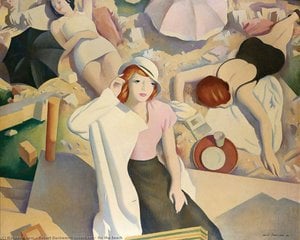
The Artistry of Robert Duckworth Greenham
Born in the vibrant atmosphere of Streatham, Surrey, on September 6, 1906, Robert Duckworth Greenham emerged as a distinguished figure in the mid-twentieth-century British art scene. His journey into the heart of classical training began at the Byam Shaw and Vicat Cole School of Art in London, but it was his tenure at the prestigious Royal Academy Schools between 1926 and 1929 that truly forged his technical mastery. During these formative years, Greenham proved himself an exceptional talent, earning accolades such as the Landseer Scholarship, the British Institute Scholarship, and the Cresswick Prize, alongside silver and bronze medals that signaled the arrival of a formidable new voice in painting, etching, and engraving.
Greenham’s artistic evolution was marked by a profound dedication to the nuances of form and light. As a professional artist, he became a mainstay of the London art world, exhibiting with remarkable consistency at the Royal Academy from 1931 until 1969. His presence was felt across the most esteemed galleries of his era, including the New English Art Club, the London Group, and the Redfern Gallery. Whether capturing the quiet intimacy of a still life or the sweeping atmosphere of a seaside landscape, his work resonated with a refined sensibility that bridged the gap between traditional academic rigor and a more evocative, modern perception of subject matter.
A Legacy of Portraiture and Precision
Beyond his landscapes, Greenham is celebrated for his evocative portraits and meticulous costume studies. His ability to breathe life into historical figures and capture the essence of his subjects through delicate textures and thoughtful compositions has left a lasting impression on collectors and historians alike. Much of his legacy is intertwined with significant cultural collections, notably through works linked to Martita Hunt and the Fox Costume Collection, where his eye for detail in period attire and character study truly shines.
The breadth of his technical skill allowed him to move seamlessly between various mediums, leaving behind a diverse body of work that includes:
- Portraiture: Capturing the psychological depth of individuals, from notable figures like Alice Bruce to intimate studies of women in period dress.
- Still Life: Exploring the interplay of light and shadow through arrangements involving organic elements, such as animal skulls and potted plants.
- Landscape and Seascape: Evocative depictions of the British coastline that capture the ephemeral qualities of weather and tide.
- Printmaking: Masterful etchings and engravings that demonstrate his command over line and tonal contrast.
Throughout his life, which saw him move from London to the tranquil surroundings of Gillingham, Dorset, Greenham remained a respected member of the Royal Society of British Artists (RBA) and the Royal Society of Oil Painters. His passing in Southampton in 1976 marked the end of a prolific career, yet his contributions to British art—characterized by an unwavering commitment to craftsmanship and a poetic approach to the visible world—continue to endure in the halls of prestigious collections like the Ingram Collection and Art UK.