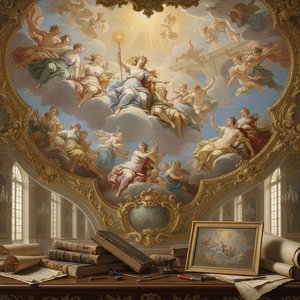
A Master of Light and Illusion: The Life and Art of Narciso Tomé
Narciso Tomé, born in Toro, Spain, around 1690 and passing away in Toledo in 1742, stands as a pivotal figure bridging the late Baroque and burgeoning Rococo periods. While biographical details remain somewhat elusive, his artistic legacy is powerfully etched into the Spanish landscape, most notably through his breathtaking masterpiece, the *Transparente* at Toledo Cathedral. Tomé emerged from a family deeply rooted in architectural and sculptural traditions; his father, Antonio Tomé, and brothers, Andrés and Diego, all contributed to the artistic fervor of early 18th-century Castile. This familial foundation undoubtedly shaped his initial training and instilled within him a profound understanding of form and craftsmanship. The earliest documented work involving the Tomé family is the portal of the Universidad de Valladolid in 1715, where a monumental order crowned with statues dominates the façade—a testament to their collaborative skill and emerging style.
The Cathedral of Toledo: A Defining Commission
In 1721, Narciso Tomé’s career reached a defining moment with his appointment as Master of Works at Toledo Cathedral. Replacing Teodoro Ardemans, he was entrusted with the ambitious project of designing and constructing the retro-choir, a space intended to elevate the spiritual experience through dramatic visual impact. Within months, Tomé presented designs that were met with unanimous approval, most significantly for what would become his signature work: the *Transparente*. This wasn’t merely an addition to the cathedral; it was a radical intervention—a deliberate breaking of the wall in the apse to allow natural light to flood the space and illuminate the tabernacle. The concept itself was revolutionary, conceived as a two-story altarpiece teeming with movement, exquisitely sculpted marbles and jaspers, and gilded bronzes depicting narrative reliefs. It’s an apotheosis of form, a dynamic composition that draws the eye upwards, creating a sense of awe and transcendence.
The *Transparente*: A Symphony in Stone and Light
The *Transparente* is more than just a sculptural ensemble; it's a carefully orchestrated symphony of stone, light, and symbolism. Several stories high, the structure explodes with fantastical figures rendered in stucco, painting, and bronze castings. The interplay of these materials creates a rich tapestry of textures and colors, drawing the viewer into a world of religious iconography and Baroque exuberance. However, what truly sets the *Transparente* apart is its masterful manipulation of light. Tomé ingeniously designed an oculus positioned to capture the daily passage of sunlight. For a fleeting few minutes each day, a shaft of radiant light pierces through the opening, striking the altar and giving the impression that the entire structure is ascending towards heaven—a powerful visual metaphor for divine grace. The effect is not merely decorative; it’s deeply spiritual, transforming the altar into a beacon of celestial illumination.
Beyond Toledo: A Legacy of Unfinished Visions
While the *Transparente* remains Tomé's most celebrated achievement, his career extended beyond the walls of Toledo Cathedral. He was commissioned for other significant projects, including the retable of the chapel of the Baronesa convent of Discalced Carmelites in Madrid (1736), though sadly this work is now untraced. Similarly, his design for the high altar of León Cathedral (1738) met an unfortunate fate—dismantled during 19th-century restorations, with only fragments surviving in the Capuchin monastery. These lost works hint at a broader artistic vision and underscore the fragility of historical legacies. Despite these incomplete projects, Tomé’s influence resonated throughout Spanish art. His innovative use of materials, dramatic compositions, and masterful manipulation of light set a new standard for Baroque sculpture and paved the way for the Rococo aesthetic that would flourish in Spain during the latter half of the 18th century. He remains an enigmatic yet profoundly important figure—a master craftsman who transformed spaces into vessels of spiritual wonder.
Historical Significance and Enduring Influence
Narciso Tomé’s work embodies the culmination of Spanish Baroque traditions while simultaneously foreshadowing the elegance and dynamism of Rococo art. His ability to seamlessly blend sculpture, painting, architecture, and light created a holistic artistic experience that captivated audiences then and continues to inspire today. The *Transparente* is not simply a religious monument; it’s a testament to human ingenuity and the power of art to evoke emotion and spiritual contemplation.His influence can be seen in subsequent Spanish church architecture, where dramatic altarpieces and elaborate ornamentation became hallmarks of the period. Though details about his life remain scarce, Narciso Tomé’s artistic legacy is secure—a shining example of Baroque brilliance that continues to illuminate the cultural landscape of Spain.
Από την επιβλεπόμενη ομάδα της ArtsDot.com
Γρήγορη κουίζ
Για κάθε ερώτηση υπάρχει μόνο μία σωστή απάντηση.
Ερώτηση 1:
In which city was Narciso Tomé born?
Ερώτηση 2:
What major work is Narciso Tomé most famous for creating at Toledo Cathedral?
Ερώτηση 3:
Around what year was Narciso Tomé appointed Head of Works at Toledo cathedral?
Ερώτηση 4:
What artistic period is Narciso Tomé associated with?
Ερώτηση 5:
With whom did Narciso Tomé sculpt the facade of the University of Valladolid in 1715?
Spanish Baroque masters like Diego Velázquez, Bartolomé Esteban Murillo, and Jusepe de Ribera defined 17th-century art. View the collection at ArtsDot.com.
Explore the captivating world of Giambattista Tiepolo, master of Rococo art. Discover his innovative techniques, iconic frescoes, and lasting influence on Italian painting. A guide for discerning collectors.
Εξερευνήστε την εκθαμβωτική τέχνη του Μπαρόκ! Ιστορία, χαρακτηριστικά και η διαρκής επιρροή του σε αρχιτεκτονική, ζωγραφική, μουσική & λογοτεχνία. Ανακαλύψτε τα μυστικά της εποχής!
Ο/Η Narciso Tomé γεννήθηκε στην/στη Toreo, στο/στη Spain.
Μπορώ να επισκεφτώ ένα εικονικό μουσείο με τα έργα του Narciso Tomé;
Μια εικονική επίσκεψη είναι εφικτή: η σελίδα 3D Μουσείο του Narciso Tomé παρουσιάζει τα έργα του καλλιτέχνη σε μια τρισδιάστατη γκαλερί.
Ποιες διαθέσεις εκφράζουν τα έργα του/της Narciso Tomé;
Στη σελίδα Κόρνερ Αίσθησης του Narciso Tomé, τα έργα του καλλιτέχνη είναι διατεταγμένα ανάλογα με τη διάθεση.
Πόσα έργα του/της Narciso Tomé είναι διαθέσιμα για περιήγηση;
Μπορείτε να περιηγηθείτε σε 1 έργα τέχνης έργα του Narciso Tomé στη σελίδα Όλα τα έργα.
Μπορώ να εξερευνήσω τα έργα του/της Narciso Tomé ανά θέμα;
Το Ατλάς Θεμάτων του Narciso Tomé είναι μια σελίδα που ομαδοποιεί τα έργα του καλλιτέχνη ανάλογα με τα θέματά τους.
Πώς εξελίχθηκε η τέχνη του/της Narciso Tomé με την πάροδο του χρόνου;
Μια χρονολογική καταγραφή του έργου του/της Narciso Tomé είναι διαθέσιμη στη σελίδα Χρονικό έργο, όπου τα έργα παρουσιάζονται με σειρά δημιουργίας, χωρισμένα σε περιόδους της καριέρας του/της.
Πού και πότε γεννήθηκε ο/η Narciso Tomé;
Ο/Η Narciso Tomé γεννήθηκε στην/στη Toreo το 1690.
Υπάρχει χρονολόγιο με τα έργα του/της Narciso Tomé;
Μπορείτε να δείτε τη χρονολογία των έργων του/της Narciso Tomé στη σελίδα Χρονολόγιο Έργων, όπου τα έργα είναι ταξινομημένα ανά ημερομηνία δημιουργίας.
Με τι άλλα ονόματα είναι γνωστός/η ο/η Narciso Tomé;
Ο/Η Narciso Tomé αναγνωρίζεται και με τα εναλλακτικά ονόματα Narciso Tome.
Γεια σας! Μπορώ να σας βοηθήσω στην επιλογή ενός έργου τέχνης, στην παρακολούθηση μιας παραγγελίας ή στην απάντηση ερωτήσεων σχετικά με την εγγύηση. Πώς μπορώ να σας φανώ χρήσιμος;