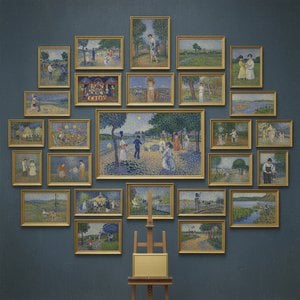
George Pontin: A Painter of English Light and Life
George Pontin (1872 – 1949) remains a quietly significant figure in early 20th-centuryBritish art, an artist whose evocative landscapes and architectural scenes offer a poignant glimpse into the evolving rhythms of rural England. Often overshadowed by his more flamboyant contemporaries, Pontin’s work possesses a subtle beauty and remarkable sensitivity to light and atmosphere that rewards patient observation. His paintings aren't grand pronouncements; they are intimate studies of everyday life, imbued with a deep appreciation for the changing seasons and the enduring character of the English countryside.
Pontin’s early life was marked by relative isolation. Born in Highams Park, near London, he developed a solitary disposition, finding solace primarily in books and intellectual pursuits rather than social interaction. This introspective nature profoundly shaped his artistic vision – he wasn't driven by a desire for fame or dramatic spectacle but by a genuine fascination with the world around him, meticulously rendered on canvas. He initially pursued a career in the City, working in the stock exchange, before dedicating himself fully to art in his early thirties. This shift reflects a yearning for a more meaningful connection with the natural world and a desire to capture its essence through visual representation.
Pontin’s artistic development can be traced through a series of distinct phases. Initially influenced by the Impressionists – particularly Monet and Pissarro – he adopted their techniques of broken brushwork and emphasis on capturing fleeting moments of light. However, Pontin quickly moved beyond mere imitation, developing his own unique style characterized by a restrained palette, meticulous detail, and an almost photographic realism. He was a master of depicting atmospheric effects, skillfully conveying the subtle shifts in light and shadow that define the English landscape. His paintings of Millbrook Church, for example, are renowned for their ability to evoke the solemn beauty of the ancient structure bathed in the golden light of late afternoon. His work also demonstrates an acute awareness of architectural detail, evident in his depictions of Southampton Town Quay and other urban settings.
A key element of Pontin’s artistic practice was his meticulous approach to observation. He spent countless hours sketching outdoors, studying the nuances of color, form, and texture. This dedication to direct observation is reflected in the remarkable accuracy with which he renders details – from the weathered stonework of a farmhouse to the delicate petals of a wildflower. His paintings are not simply representations of reality; they are carefully constructed interpretations, imbued with his personal sensibility. He frequently worked en plein air, directly on location, allowing him to capture the immediacy and spontaneity of the scene. This commitment to direct observation is particularly evident in works like “In Regent’s Park,” where the dappled sunlight filtering through the trees creates a sense of vibrant movement and atmosphere.
Pontin's subject matter largely focused on rural England – landscapes, villages, and scenes of everyday life. He was particularly drawn to depictions of the seasons, capturing the beauty of spring blossoms, summer meadows, autumn foliage, and winter snowscapes. His paintings of Millbrook Church, for instance, are inextricably linked to the changing seasons, with each depiction reflecting the unique character of a particular time of year. He also produced notable architectural studies, showcasing his ability to capture the dignity and charm of historic buildings. The “Gateway, Back of the Walls” exemplifies this skill, presenting a muted yet compelling view of an old gatehouse, capturing both its weathered appearance and the surrounding landscape with quiet precision.
Despite his considerable talent, Pontin’s work received relatively little recognition during his lifetime. He primarily sold his paintings through art dealers and private commissions, avoiding the spotlight of major exhibitions. However, in recent decades, there has been a growing appreciation for his quietly compelling style. His paintings are now exhibited in public collections across England and have gained increasing attention from art historians and collectors. George Pontin’s legacy lies not in grand pronouncements or sensational displays but in the enduring beauty and quiet dignity of his paintings – a testament to the power of observation, sensitivity, and a deep love for the English countryside.
Gateway, Back of the Walls (1900): A muted architectural study capturing the weathered beauty of an old gatehouse and its surrounding landscape.
Town Quay, Southampton (circa 1905-1910): An evocative portrayal of Southampton’s harbor, demonstrating Pontin's ability to capture the energy and character of a bustling port town.
Millbrook Church (various dates): A series of paintings depicting Millbrook Church at different times of year, showcasing Pontin’s skill in capturing the church’s architectural details and its relationship to the surrounding landscape.
Historical Context
Pontin's work emerged during a period of significant social and artistic change in Britain. The late 19th and early 20th centuries witnessed the rise of Impressionism, which profoundly influenced British artists like Pontin. Simultaneously, there was a growing interest in documenting and celebrating English landscapes and rural life – a trend reflected in the works of J.M.W. Turner and Constable. Pontin’s paintings can be understood within this broader context as an attempt to capture the essence of England's changing identity during a period of rapid industrialization and urbanization. His focus on the countryside represents a deliberate counterpoint to the increasingly dominant forces of modernity.
Ανακαλύψτε τα 25 κορυφαία έργα τέχνης του Georges Seurat! Ιμπρεσιονισμός, pointillism & χρωμολουμινισμός ζωντανεύουν. Βρείτε αναπαραγωγές ζωγραφιών υψηλής ποιότητας για διακόσμηση με στυλ στο ArtsDot.com.
Explore the life & art of John Constable, the Romantic painter who revolutionized landscape with emotive scenes of rural England. Discover his techniques, legacy, and key works – perfect for collectors & enthusiasts.
Πόσα έργα του/της George Pontin είναι διαθέσιμα για περιήγηση;
Μπορείτε να περιηγηθείτε σε 21 έργα τέχνης έργα του George Pontin στη σελίδα Όλα τα έργα.
Υπάρχει χρονολόγιο με τα έργα του/της George Pontin;
Η σελίδα Χρονολόγιο Έργων του καλλιτέχνη παρουσιάζει τα έργα του George Pontin ταξινομημένα ανά ημερομηνία, έτος προς έτος.
Υπάρχει 3D εικονική περιήγηση στα έργα του George Pontin;
Μια εικονική επίσκεψη είναι εφικτή: η σελίδα 3D Μουσείο του George Pontin παρουσιάζει τα έργα του καλλιτέχνη σε μια τρισδιάστατη γκαλερί.
Πού μπορώ να βρω τα έργα του George Pontin ομαδοποιημένα ανά παλέτα χρωμάτων;
Για να βρείτε έργα του George Pontin σε μια συγκεκριμένη παλέτα χρωμάτων, επισκεφθείτε τη σελίδα Κατά Παλέτα Χρωμάτων του καλλιτέχνη.
Με τι άλλα ονόματα ή ψευδώνυμα είναι γνωστός/η George Pontin;
Ο/Η George Pontin αναγνωρίζεται και με τα εναλλακτικά ονόματα David George Ritchie, Fred Pontin.
Σε ποια ιστορική περίοδο δραστηριοποιήθηκε ο/η George Pontin;
Ο/Η George Pontin δραστηριοποιήθηκε κατά την περίοδο του/της Modern. Η συγκεκριμένη εποχή τοποθετεί τη δραστηριότητα του/της καλλιτέχνη/στη στην ιστορία.
Πώς εξελίχθηκε η τέχνη του/της George Pontin με την πάροδο του χρόνου;
Η σελίδα Χρονικό έργο του/της George Pontin αποτελεί μια χρονολογική διαδρομή με δυνατότητα ακολούθησης κατά το scroll, η οποία παρουσιάζει τα έργα του/της καλλιτέχνη σε χρονολογική σειρά, ομαδοποιημένα σε κεφάλαια ανά περίοδο της καριέρας του/της.
Ποια χρώματα χρησιμοποίησε πιο συχνά ο/η George Pontin;
Η Γενετικό Σύστατο Παλέτας του George Pontin παρουσιάζει το χρωματικό προφίλ του συνολικού έργου του καλλιτέχνη.
Ποιο είναι το κορυφαίο έργο του George Pontin στο ArtsDot.com;
Γεια σας! Μπορώ να σας βοηθήσω στην επιλογή ενός έργου τέχνης, στην παρακολούθηση μιας παραγγελίας ή στην απάντηση ερωτήσεων σχετικά με την εγγύηση. Πώς μπορώ να σας φανώ χρήσιμος;