Introduction: The Power of Atmosphere in Painting
From the earliest cave paintings to the masterpieces of the Renaissance and beyond, artists have sought not merely to depict reality but to capture its essence – a quality often found less in precise form than in the subtle interplay of light, shadow, and atmosphere. Atmosphere, in painting, is more than just the air between objects; it’s a potent tool for conveying mood, depth, and emotional resonance. It's the veil through which we perceive the world, and its skillful rendering can transform a simple landscape into a profoundly moving experience. This exploration delves into the history of atmospheric techniques, tracing their evolution from early innovations to the evocative power of Tonalism, revealing how artists have harnessed the intangible qualities of air and light to create enduring works of art.
The Renaissance Roots of Atmospheric Perspective
 Veiled Distances: Exploring Atmospheric Perspective in Painting – Techniques, History & Emotional Resonance
Explore the art of atmospheric perspective! Discover historical techniques, scientific principles & practical tips for creating depth & mood in your paintings. Learn from masters like da Vinci and elevate your artwork.
While rudimentary attempts at suggesting depth existed prior, it was during the Renaissance that a systematic understanding of atmospheric perspective began to emerge. Artists like Leonardo da Vinci weren’t simply observing how distant objects appeared fainter; they were analyzing why. Da Vinci meticulously documented the effects of aerial perspective – the way colors desaturate and cool as they recede into the distance, the softening of edges, and the diminishing contrast between foreground and background. His “Mona Lisa,” for example, isn’t just a portrait; it's a masterclass in sfumato, a technique employing subtle gradations of light and shadow to create an atmospheric haze that lends the subject an ethereal quality. This wasn’t merely about realism; it was about mimicking the way the human eye perceives depth, creating a more believable and immersive experience for the viewer. Prior to this, paintings often lacked spatial coherence, appearing flat and two-dimensional. The introduction of aerial perspective revolutionized painting, paving the way for more naturalistic and emotionally engaging compositions.
Romanticism's Embrace of Sublime Atmospheres
 Mountain Landscape with Rainbow
Experience the sublime beauty of Caspar David Friedrich's 'Mountain Landscape with Rainbow.' This iconic painting captures a solitary figure contemplating nature’s grandeur, embodying Romantic ideals and evoking feelings of awe.
The Romantic era witnessed a shift in focus from scientific precision to emotional expression, and artists eagerly embraced atmospheric effects as a means of conveying powerful feelings. Caspar David Friedrich, a leading figure of the German Romantic movement, exemplified this trend. His landscapes aren’t simply depictions of nature; they are meditations on the sublime – the awe-inspiring grandeur that evokes both wonder and terror. In paintings like “Mountain Landscape with Rainbow,” Friedrich uses atmospheric haze to create a sense of vastness and mystery, dwarfing the solitary figure within the scene and emphasizing humanity's smallness in the face of nature’s power. The soft, diffused light and muted colors contribute to an overall feeling of melancholy and spiritual longing. J.M.W. Turner, another Romantic master, pushed atmospheric effects even further, often dissolving forms entirely into swirling mists and vibrant washes of color. His works weren't about accurately representing a specific location but about capturing the feeling of being immersed in nature’s raw energy – storms, sunsets, and the ever-changing play of light on water.
Tonalism: A Study in Mood and Light
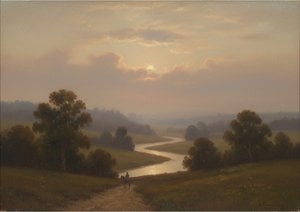
Tonalism was an artistic style that emerged in the 1880s when American artists began to paint landscape forms with an overall tone of colored atmosphere or mist. Between 1880 and 1915, dark, neutral hues such as gray, brown or blue, often dominated c...
Emerging in the late 19th century, Tonalism represented a deliberate reaction against the increasing industrialization and materialism of modern life. American artists associated with this movement sought to create paintings that were less about depicting specific scenes and more about evoking mood and atmosphere. George Inness, often considered the father of American Tonalism, believed in painting not what he saw, but what he felt. His landscapes are characterized by soft, muted tones, delicate gradations of color, and a sense of quiet contemplation. James Abbott McNeill Whistler, though not exclusively a Tonalist, profoundly influenced the movement with his “Nocturnes” – paintings that prioritized tonal harmony over precise representation. “Variations in Flesh Colour and Green: The Balcony,” for instance, is less about depicting a balcony scene than it is about exploring the subtle interplay of light and shadow, creating an almost musical composition of color and tone. Tonalist painters often used limited palettes and avoided harsh contrasts, aiming to create paintings that were immersive and emotionally resonant.
Whistler and the Pursuit of ‘Art for Art’s Sake’
Whistler's philosophy of “art for art’s sake” was central to the Tonalist aesthetic. He believed that a painting should be judged solely on its artistic merits – its composition, color harmony, and tonal balance – rather than its narrative content or moral message. This radical idea challenged traditional notions of what constituted ‘good’ art and paved the way for greater experimentation and abstraction. His “Nocturnes” were often criticized for their lack of detail, but Whistler defended them as explorations of pure aesthetic form. He saw himself as a composer arranging colors in much the same way a musician arranges notes, creating a visual symphony that appealed to the senses rather than the intellect. This emphasis on subjective experience and emotional resonance continues to resonate with artists and viewers today. The influence of Whistler’s work can be seen in the broader development of modern art, particularly in movements like Abstract Expressionism.
Conclusion: Capturing Emotion Through Spatial Representation
From the scientific investigations of da Vinci to the emotional landscapes of Friedrich and the subtle harmonies of Whistler, artists have consistently sought to harness the power of atmosphere to create works that transcend mere representation. Atmospheric perspective isn’t simply a technical skill; it's a means of conveying mood, depth, and emotional resonance. It allows us to step into the painting, to experience the scene as if we were truly there, enveloped by the air and light. At ArtsDot.com, we celebrate this legacy by offering high-quality reproductions of masterpieces that capture the beauty and emotional depth of these iconic works, allowing you to bring the power of atmosphere into your own home. Explore our collection today and discover the transformative potential of art.