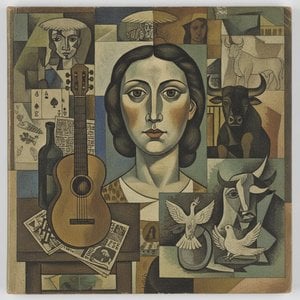
las meninas picasso vs velasquez
The primary distinction lies in their artistic movements and execution. Diego Velázquez created a Baroque masterpiece in 1656 using realistic detail and light. Pablo Picasso reinterpreted this scene in 1957 through Cubism and Primitivism, replacing photographic depth with fragmented shapes, simplified forms, and a vibrant, modern palette.
Velázquez's original work depicts the Spanish court of King Philip IV. It features Infanta Margaret Theresa, her entourage, and the artist himself within a meticulously ordered, three-dimensional space. The 1656 painting is a cornerstone of Western art, celebrated for its complex use of shadow and perspective.
Picasso’s 1957 version, part of his massive "Las Meninas Suite" of 58 paintings, approaches the subject with a different intent. Rather than replicating the courtly realism of the 17th century, Picasso uses the subject as a springboard for modern experimentation. His work is held in collections such as the Museu Picasso in Barcelona.
How did Picasso use Cubism to reinterpret the original?
 Las Meninas (Velazquez)
Las Meninas (Velazquez), Pablo Picasso
Picasso utilized Cubist techniques to deconstruct Velázquez's composition into geometric planes. He broke down recognizable figures from the Spanish court into constituent parts, replacing the original's continuous, realistic forms with fragmented shapes and a flattened perspective that allows for multiple simultaneous viewpoints within a single frame.
This method of reconstruction fundamentally changes how the viewer perceives the scene. While Velázquez used light and shadow to create an illusion of depth, Picasso’s Cubist approach emphasizes the raw materials of artistic construction. He strips away the literal historical context to focus on the structural essence of the figures.
The transformation involves several key technical shifts:
- Fragmentation: Breaking faces and bodies into interlocking geometric components.
- Abstraction: Moving away from precise representation toward simplified, symbolic forms.
- Reconstruction: Reassembling the original elements in a new, non-traditional arrangement.
What are the main differences in color and perspective?
The most striking difference is the shift from muted earth tones to a vibrant palette. Velázquez employed a somber, realistic range of colors to achieve depth. Picasso injected energy into his 1957 reinterpretation using bright hues, specifically moving through a spectrum of amber to saffron.
Perspective also undergoes a radical change. The 1656 masterpiece relies on a meticulously ordered, three-dimensional space that draws the viewer into the room. Picasso rejects this traditional depth in favor of a flattened perspective characteristic of modernism and Primitivism, which emphasizes the surface of the canvas.
These visual differences create two distinct moods:
- Velázquez: Muted tones, realistic light, and an immersive, illusionistic space.
- Picasso: Vibrant amber and saffron hues with a flattened, energetic composition.
Did Picasso maintain any symbols from Velázquez's work?
Yes, Picasso maintained the fundamental structural dialogue of the original while changing its meaning. He preserved the presence of the artist and the central figures, but reinterpreted them through a modern lens. He kept the essence of the "gaze" and the interaction between the subjects and the viewer.
While Velázquez used symbols like the mirror to explore the relationship between art and reality, Picasso utilized these elements to engage in a conversation across centuries. He maintained the presence of the artist at work, mirroring Velázquez's self-portrait, but imbued it with a sense of modern irony and introspection.
Picasso’s reinterpretation also draws on Primitivism, using simplified forms to honor the legacy of the master. By keeping the core arrangement of the Spanish court figures, he ensures the connection to the 1656 original remains recognizable even as the style becomes entirely abstract and modern.
Frequently asked questions
How many paintings are in the Las Meninas Suite?
Picasso created a series of 58 paintings known as the Las Meninas Suite.
When was the original Las Meninas painted?
Velázquez completed his original masterpiece in 1656.
Where is the Las Meninas Suite located?
The Las Meninas Suite is housed at the Museu Picasso in Barcelona.
What colors are used in Picasso's version of Las Meninas?
Picasso's version features a vibrant palette ranging from amber to saffron.
Learn more
- 1599 – 1660Diego VelázquezExplore the masterful techniques of the Spanish Golden Age legend.
- 1881 – 1973Pablo PicassoDiscover how this icon reimagined classical themes through modern eyes.
- Pablo Picasso · 1957Las Meninas (Velazquez)See how this stunning rendition serves as a conversation with the past.