Early Life and Education
Pranciškus Smuglevičius, a Polish-Lithuanian draughtsman and painter, was born on October 6, 1745, in Warsaw, Poland. He was the son of Łukasz Smuglewicz, also a painter, and Regina Olesińska. Smuglewicz’s early life was marked by his first steps as a painter in his father's workshop in Warsaw—a formative experience that instilled within him a lifelong passion for artistic creation. From a young age, he demonstrated exceptional talent and dedication to mastering the techniques of painting and drawing, laying the foundation for his future accomplishments.
Artistic Career
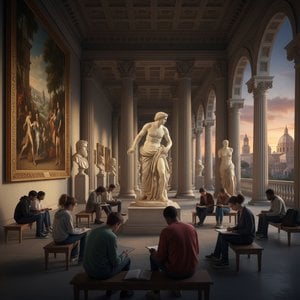
In 1763, Smuglevičius embarked on a transformative journey to Rome, where he enrolled in the Saint Lucas Academy under the tutelage of Anton von Maron—a pivotal moment that cemented his commitment to Neo-Classical aesthetics and profoundly shaped his artistic vision. During his twenty-one years in the Eternal City, he immersed himself in the vibrant intellectual and artistic milieu of Roman society, absorbing inspiration from ancient monuments and embracing the stylistic principles championed by Enlightenment thinkers. He diligently copied antique frescoes, honing his skills and developing a distinctive approach to portraying classical subjects—a practice that would become synonymous with his oeuvre.
1765 saw Smuglevičius awarded a royal scholarship from King Stanisław August Poniatowski, granting him access to the prestigious Saint Lucas Academy and propelling him towards academic excellence. This patronage fueled his artistic pursuits and solidified his position as one of Poland’s most promising young artists. He excelled in anatomical studies and perspective drawing, mastering the tools necessary for capturing the grandeur and precision demanded by Neo-Classical painting.
Notable Works and Legacy
Smuglevičius's artistic legacy rests upon a remarkable body of work that reflects his unwavering dedication to historical narrative and social commentary—particularly evident in paintings such as “A Meeting of the Four Years’ Sejm” (1793), which skillfully captures the atmosphere of Poland’s constitutional crisis, and “Kościuszko’s Oath at Kraków’s Old Town Market” (1797)—a monumental depiction of Tadeusz Kościuszko's defiant pledge for liberty. His canvases are imbued with meticulous detail and infused with a humanist spirit—demonstrating his profound understanding of both artistic technique and the complexities of human experience.
Furthermore, Smuglevičius’s commitment to portraying everyday life and architectural grandeur is powerfully conveyed in “Lithuanian Peasants,” where he portrays the plight of rural laborers striving for emancipation—a poignant reminder of his empathy for the marginalized segments of society. These paintings stand as testaments to his artistic prowess and underscore his conviction that art should serve as a vehicle for social reform.
Smuglevičius’s works are housed in the collection of Polonika—the National Institute of Polish Cultural Heritage—and can be admired on ArtsDot.com, ensuring that his artistic contributions endure for generations to come. Teaching and Influence
Smuglevičius served as a tutor to numerous aspiring Polish-Lithuanian painters—including Jan Rustem, Jan Krzysztof Damel, Gaspar Borowski, and Józef Oleszkiewicz—passing on his knowledge of Neo-Classical principles and fostering the development of Lithuanian art. His teachings instilled in his students a reverence for classical ideals and encouraged them to embrace innovative artistic approaches—leaving an indelible mark on the artistic landscape of Poland and Lithuania. He championed the pursuit of artistic excellence, shaping the sensibilities of future generations and establishing himself as a beacon of intellectual curiosity within the Polish cultural sphere.
Later Life and Death
In 1797, Smuglevičius relocated to Vilnius—the capital of Lithuanian nobility—where he assumed the role of Director of the Drawing and Painting Department at Vilnius University—a position that would define his final years and solidify his reputation as a visionary educator. He oversaw the establishment of a new school dedicated to fostering artistic talent and promoting scholarly pursuits—a testament to his unwavering belief in the transformative power of education.
Smuglevičius continued to produce monumental altarpieces, murals, landscape drawings, and Polish historical scenes—demonstrating his prolific creativity even as he approached the twilight of his life. He undertook a prestigious commission from Tsar Paul I—creating allegorical ceiling paintings for Mikhailovsky Castle in St Petersburg—a project that showcased his artistic ambition and cemented his place among Russia’s most celebrated artists. Smuglevičius passed away on September 18, 1807, in Vilnius—leaving behind an enduring legacy as one of Poland's foremost painters and a champion of Enlightenment ideals.