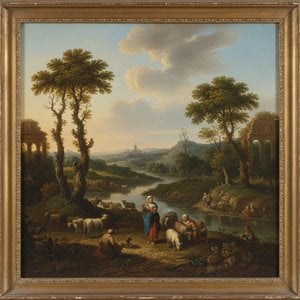
Johannes van Haensbergen (1642 – 1705): A Master of Serene Landscapes and Elegant Portraits
Johannes van Haensbergen, born in Gorinchem around 1642, stands as a pivotal figure within the Dutch Golden Age—a period characterized by unparalleled artistic innovation and cultural flourishing. His career unfolded amidst the vibrant intellectual currents of his time, leaving an indelible mark on landscape painting and portraiture alike.Early Life and Artistic Training
Details surrounding van Haensbergen’s formative years remain somewhat elusive, yet records indicate he enrolled in the Utrecht Guild of St. Luke in 1668 and joined the confrerie pictura in The Hague shortly thereafter, marrying johanna van heusden. This union provided him with a stable domestic life while simultaneously fostering his artistic ambitions. Crucially, he received instruction from Cornelius van Poelenburgh, whose distinctive landscape style profoundly shaped his own approach to painting—a stylistic influence that would permeate his subsequent works. Van Poelenburgh’s emphasis on atmospheric perspective and tonal modulation served as a cornerstone for Haensbergen's artistic development.Shift Towards Portraiture: Style and Technique
Despite acknowledging Poelenburgh’s influence, van Haensbergen decisively pivoted towards portrait painting—a decision that proved remarkably astute from both an artistic and commercial standpoint. Unlike many of his contemporaries who favored dramatic compositions or theatrical gestures, Haensbergen cultivated a refined aesthetic focused on capturing the subtle nuances of human expression. His technique involved meticulous attention to skin tone—a skill honed through careful observation and masterful blending—resulting in portraits that radiated warmth and luminosity. He skillfully accentuated the subject’s complexion, creating images that were not merely representations but embodiments of character and dignity.Notable Works: Landscapes and Portraits
Van Haensbergen's artistic legacy is cemented by two distinct yet equally impressive genres: landscapes and portraits. His depictions of serene vistas—such as “Nymphs Bathing”—demonstrate the enduring impact of Poelenburgh’s style, characterized by hazy skies and muted colors designed to evoke tranquility. These canvases exemplify his ability to convey mood and atmosphere with remarkable precision. Simultaneously, his portraiture—exemplified by “Portrait of Maria duyst van Voorhout”—established him as a leading practitioner of his craft. This portrait showcases Haensbergen’s mastery in capturing the likeness of his subject while simultaneously conveying an aura of sophistication and refinement.Commercial Ventures and Artistic Collaboration
Beyond his artistic pursuits, van Haensbergen engaged in significant commercial activities—serving as headman of the confrerie pictura alongside jan both. This partnership facilitated access to lucrative commissions and bolstered his reputation within the art world. Houbraken’s biographical sketches corroborate this account, highlighting the importance of social connections in shaping an artist's career trajectory.Legacy and Influence
Johannes van Haensbergen’s influence extends beyond his own output—his son, Willem Johan van Haensbergen (1680-1755), served as his pupil, ensuring that his artistic principles continued to resonate through subsequent generations. His work stands alongside the luminaries of Dutch Baroque art—particularly Rembrandt van Rijn and Johannes Vermeer—within the canon of the Golden Age, securing his place as a master of both landscape and portraiture—artists whose enduring beauty continues to captivate audiences worldwide.Fragen & Antworten
Kann ich die Farbwahl von Johannes Van Haensbergen über das gesamte Werk hinweg studieren?
Das Farbprofil der Werke von Johannes Van Haensbergen finden Sie auf der Farbpalette des Künstlers-Seite des Künstlers.
Wie hat sich die Kunst von Johannes Van Haensbergen im Laufe der Zeit entwickelt?
Die Werdegang von Johannes Van Haensbergen ist eine scrollbare Zeitachse, die die Werke des Künstlers in chronologischer Reihenfolge präsentiert, unterteilt in Kapitel nach Schaffensperioden.
In welcher Stadt und in welchem Land wurde Johannes Van Haensbergen geboren?
Johannes Van Haensbergen wurde in Gorinchem, Niederlande, geboren.