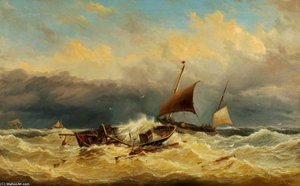
George Gregory: Bridging the Seas and Soul
George Gregory (1849 – 1938) wasn’t merely a marine painter; he was an interpreter of the soul through the lens of the sea. Born in Wahoo, Nebraska—a location that would profoundly shape his artistic vision—Gregory’s life unfolded as a fascinating confluence of frontier experience, Native American influences, and a deep, abiding connection to the natural world. His work, characterized by its dramatic lighting, rich textures, and evocative sense of atmosphere, stands as a testament to this unique blend of experiences.
Gregory's early years were steeped in the rugged realities of the American West. His father, a veteran of the Civil War, instilled in him a strong work ethic and an appreciation for the land. Crucially, Gregory spent his formative years among the Omaha tribe, learning their customs, language, and reverence for nature – elements that would become integral to his artistic philosophy. This immersion wasn’t simply observational; he actively sought to understand the Native American worldview, recognizing its profound connection to the cycles of life, death, and rebirth mirrored in the rhythms of the ocean.
His artistic journey began modestly, initially producing illustrations for local newspapers and magazines. However, it was his encounter with the work of Albert Bierstadt and Thomas Moran – masters of capturing the grandeur of the American West – that truly ignited his passion for landscape painting. These artists’ ability to convey both the scale and the emotional resonance of nature profoundly influenced Gregory's approach. He quickly moved beyond mere representation, striving instead to capture the *feeling* of a place—the wind-swept dunes, the crashing waves, the brooding skies.
The Language of Light and Texture
Gregory’s technique is immediately recognizable for its dramatic use of light and shadow. He was particularly adept at rendering the effects of sunlight on water – capturing the shimmering reflections, the turbulent foam, and the ethereal quality of twilight. His paintings are rarely flat or static; instead, they pulsate with movement and energy. This dynamism is achieved through a meticulous layering of paint, often applied thickly to create a tactile surface that invites the viewer to reach out and touch it.
Consider his “Sail And Steam By Moonlight,” a piece that exemplifies this approach. The dark, brooding sky contrasts sharply with the luminous glow of the moonlit water and the silhouetted ships. Thick impasto – a technique involving applying paint in heavy layers – creates a sense of texture and depth, while the chiaroscuro (the strong contrast between light and dark) intensifies the drama. It’s not simply a depiction of a seascape; it's an evocation of mystery, solitude, and the power of nature.
Furthermore, Gregory’s use of color is remarkably restrained, relying primarily on shades of blue, gray, and brown to convey the mood and atmosphere. He understood that less was often more, allowing the interplay of light and shadow to do most of the talking. His palette reflects his deep connection to the natural world – a world where subtle shifts in tone can reveal an astonishing amount of information.
Influences and Legacy
While influenced by the Hudson River School painters, Gregory’s work possesses a distinctly American character—rooted in the frontier experience and informed by Native American perspectives. He wasn't simply replicating scenes from nature; he was engaging with it on a deeply personal level, imbuing his paintings with a sense of reverence and respect.
The impact of George Gregory’s work is often overlooked, overshadowed by more commercially successful artists of the era. However, his evocative depictions of the American West—particularly his seascapes—continue to resonate with viewers today. His ability to capture both the grandeur and the vulnerability of nature speaks to a timeless truth: that we are all inextricably linked to the natural world.
His paintings, now housed in collections across North America, offer a unique window into the 19th century—a time when the American West was still being forged, and artists were grappling with questions of identity, place, and the relationship between humanity and nature. George Gregory’s legacy lies not just in his beautiful paintings but also in his profound understanding of the spirit of the land.
Notable Works
- Marine Painting (1897): A romantic coastal scene, capturing maritime life and a bygone era. (Image: /media/artworks/images/thumbnails/9bfede50e05b46dfa36b4b79526a2258.jpg)
- Sail And Steam By Moonlight (1903): A dramatic, moody seascape in an impressionistic style. (Image: /media/artworks/images/thumbnails/85ad7fd8cf6c4cc5be47f8807bc8d4a4.jpg)
A Life Beyond the Canvas
Beyond his artistic pursuits, George Gregory was a dedicated advocate for Native American rights and education. He actively sought to bridge cultural divides and promote understanding between European Americans and indigenous peoples. His commitment to social justice reflects a deep sense of empathy and a belief in the inherent dignity of all human beings. His later years were spent involved with the Baháʼí Faith, demonstrating his lifelong pursuit of spiritual truth and service to humanity.