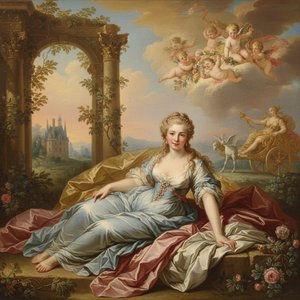
Gabriel François Doyen: The Venetian Echoes of Dramatic History
Gabriel François Doyen (1726-1806) stands as a pivotal figure in French Baroque painting, remembered for his monumental canvases depicting biblical narratives and mythological scenes imbued with theatrical grandeur. Born in Paris amidst the burgeoning artistic fervor of the Enlightenment, Doyen’s path to renown was marked by defiance against familial expectations – he pursued art despite his father's disapproval, embarking on formal training at the tender age of twelve under the tutelage of Charles-André van Loo, a leading sculptor and painter of the royal court. This early exposure instilled in him a disciplined approach that swiftly yielded impressive results; by twenty, he secured the prestigious Grand Prix de Rome, propelling him to Florence where he immersed himself in the artistic legacy of Caravaggio and Bernini.- Early Influences: Doyen’s formative years witnessed a profound engagement with the Baroque masters, particularly Caravaggio's dramatic chiaroscuro technique – a masterful manipulation of light and shadow that aimed to heighten emotional impact – and Bernini’s sculptural dynamism. These influences would permeate his subsequent oeuvre, shaping his artistic vision and informing his compositional choices.
- The Grand Prix de Rome & Florentine Studies: Winning the Grand Prix de Rome afforded him unparalleled access to artistic scholarship and provided invaluable experience in tackling ambitious projects. His time in Florence solidified his understanding of classical ideals and honed his observational skills; he meticulously studied Michelangelo’s sculptures, analyzing how he achieved monumental grandeur through masterful anatomical precision and expressive gesture.
Venetian Colorism and Artistic Transformation
A decisive turning point arrived during Doyen’s journey to Venice between 1752 and 1755 – a city renowned for its vibrant color palette and masterful pigmentists. This visit irrevocably altered his artistic sensibilities, exposing him to the revolutionary approach championed by Titian and Tintoretto. Unlike the prevailing monochrome tendencies of Parisian painting at the time—a stylistic preference that prioritized intellectual contemplation over visceral emotion—Venetian artists prioritized luminous hues and textural richness, prioritizing emotional impact over strict adherence to academic conventions. Doyen absorbed these techniques with fervor, recognizing their potential to elevate his compositions beyond mere representation into vehicles for conveying profound spiritual truths. This newfound appreciation for color would become a hallmark of his distinctive style—a stylistic decision that foreshadowed the burgeoning Romantic movement in France. He particularly admired Titian’s ability to capture fleeting moments of beauty and emotion through subtle gradations of color, mirroring the expressive aims of Venetian painters.- Titian's Influence: Doyen meticulously studied Titian's paintings, analyzing how he achieved unparalleled luminosity and depth through masterful layering of pigments—a technique that would become central to his artistic practice.
- The Venetian Style: The Venetian influence is particularly evident in “Le Miracle des Ardents,” commissioned for Saint Genevieve Church in St Roch; Doyen skillfully employs color to heighten the drama and evoke a palpable sense of emotion—a technique that anticipates the expressive fervor characteristic of Romantic painters like Théodore Géricault.
Rubensian Influence & Dramatic Composition
Further enriching Doyen's artistic vocabulary was his admiration for Peter Paul Rubens, whom he encountered during a visit to Antwerp. Rubens’ dynamic compositions—characterized by swirling figures and theatrical gestures—served as an inspiration for Doyen, influencing his stylistic choices and elevating the expressive power of his paintings. Notably, “Le Miracle des Ardents,” exemplifies this Rubensian influence; its dramatic staging and masterful use of color resonate with the aesthetic sensibilities of Romantic painters like Théodore Géricault—a connection that art historian Michael Levey has termed "the high point" of Doyen’s career. He sought to emulate Rubens' ability to convey grandeur and emotion through monumental scale and dynamic movement, mirroring the stylistic ambitions of his contemporaries.- Rubensian Inspiration: Doyen meticulously studied Rubens’ paintings, analyzing how he achieved monumental grandeur through masterful anatomical precision and expressive gesture—a technique that would become a cornerstone of his artistic style.
Legacy & Historical Significance
Doyen's artistic legacy extends beyond his individual masterpieces; he stands as a crucial conduit between Baroque grandeur and Romantic fervor. His Venetian style foreshadowed the stylistic innovations of the Romantic movement, demonstrating how artists could harness color and dramatic composition to convey profound emotional truths—a contribution that continues to inspire artists today. As Levey eloquently observes, Doyen’s work anticipates “the drama of the piece may be a precursor to that which characterises the french romantic painting of the 19th century.” His enduring influence testifies to his ability to capture the spirit of an era and to elevate artistic expression beyond mere formal convention—a testament to his place within the annals of French art history.Fragen & Antworten
Wo sind die Kunstwerke von Gabriel François Doyen nach Farbpaletten gruppiert zu finden?
Die Seite Nach Farbpaletten gruppiert die Kunstwerke von Gabriel François Doyen nach ihren Farbpaletten.
In welcher historischen Epoche war Gabriel François Doyen tätig?
Gabriel François Doyen war in der Epoche der – Frühe Neuzeit tätig. Diese Periode ordnet das künstlerische Schaffen historisch ein.
Gibt es eine virtuelle 3D-Tour durch die Werke von Gabriel François Doyen?
Die Kunstwerke von Gabriel François Doyen können in einer 3D-Galerie auf der Seite 3D-Museum des Künstlers besichtigt werden.