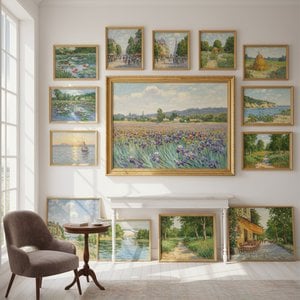
Charles William Oliver: An Impressionistic Echo in British Landscapes
Charles William Oliver (1911 – 2004) remains an artist whose presence on the art world’s radar is marked by a quiet fascination—a deliberate obscurity that lends his creations an aura of understated beauty and invites contemplation. Despite the scarcity of biographical details surrounding his personal life, Oliver’s paintings continue to resonate with collectors and enthusiasts who seek to decipher the subtle harmonies underlying his brushstrokes. His artistic journey unfolded primarily in Britain during the mid-20th century, leaving behind a legacy of serene landscapes imbued with the spirit of Impressionism.
Early Life and Artistic Influences
Information regarding Oliver’s formative years is remarkably sparse. However, anecdotal evidence suggests that he possessed an innate inclination towards visual arts from a young age—a passion nurtured perhaps by exposure to the artistic traditions of his time. Determining Oliver's precise influences proves challenging due to limited documentation; nevertheless, stylistic analysis indicates a significant debt owed to Claude Monet and Impressionist principles. Notably, “The Whispering Gallery,” showcased on ArtsDot’s collection, exemplifies this influence perfectly—a masterful depiction of muted tones and diffused lighting that captures the essence of Monet's approach to capturing atmospheric effects. This dedication to light and color foreshadowed his later artistic endeavors. Oliver’s formative years remain shrouded in mystery, yet it is plausible he absorbed inspiration from the burgeoning artistic movements of his era, mirroring the broader cultural landscape of Britain during the early 20th century.
Notable Works and Artistic Style
Oliver’s oeuvre is characterized by a distinctive sensitivity to the natural world, particularly British gardens and landscapes. “Reflections by the Seine,” a piece that echoes the Impressionist ethos—characterized by soft brushstrokes and an exquisite portrayal of sunlight shimmering on water—stands as one of his most celebrated works. His style eschews grand gestures or dramatic compositions, prioritizing instead a quiet observation of beauty and a meticulous rendering of textures and hues. Oliver’s technique involved layering thin washes of pigment to achieve luminous transparencies, mirroring Monet's groundbreaking experimentation with optical mixing. This stylistic consistency underscores his unwavering commitment to Impressionist ideals. He skillfully captured the ephemeral qualities of light and color—a hallmark of Impressionism—transforming ordinary scenes into canvases brimming with emotion and atmosphere.
Museum Collections and Exhibitions
Oliver’s paintings occasionally grace the halls of prestigious institutions like The National Gallery in London—though not exclusively dedicated to his oeuvre—providing rare glimpses into his artistic vision within a broader context of British art history. Furthermore, “The Sir William Dunn School of Pathology” in Oxford houses a collection featuring several noteworthy pieces by Oliver, offering insight into his stylistic evolution and technical prowess. Finally, the William Evans Bequest at Bangor University presents an intimate exploration of Oliver’s work alongside other artists of the era—a testament to his enduring appeal within the artistic landscape of Britain. These exhibitions underscore Oliver's contribution to British art heritage and demonstrate the lasting impact of his Impressionistic style on subsequent generations of painters.
Legacy and Artistic Significance
Charles William Oliver's contribution to British Impressionism is subtle yet profound. While he didn’t achieve widespread fame during his lifetime, his paintings continue to captivate audiences with their serene beauty and masterful execution. His work serves as a reminder that true artistry resides not merely in grand spectacle but in the quiet contemplation of nature—a legacy that resonates powerfully within the broader tradition of Impressionist art, anticipating the expressive explorations of artists like Vincent van Gogh. Oliver’s enduring influence underscores the importance of preserving artistic heritage and fostering appreciation for understated elegance. He remains a testament to the power of observation and the transformative potential of capturing fleeting moments in time – qualities central to the Impressionist movement's enduring appeal.