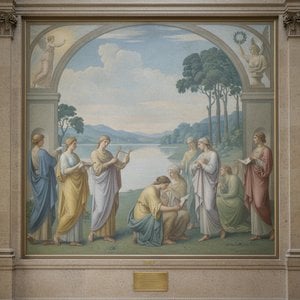
Early Life and Artistic Foundations
Charles Meynier, a name inextricably linked to the grandeur of Neoclassicism in France, was born on November 24th, 1768, in the heart of Paris. His early life, however, wasn’t destined for the artistic heights he would eventually achieve. Initially, his family envisioned a future for him as a tailor – a practical profession rooted in their modest circumstances. Yet, from a young age, Charles displayed an undeniable passion for drawing and painting, a talent that stubbornly resisted conventional expectations. Recognizing this innate inclination, his elder brother, Etienne Meynier, a successful actor at the Comédie-Française, secured him a place within the atelier of François-André Vincent, a renowned painter and teacher. This pivotal apprenticeship provided Charles with a foundational education in artistic techniques, laying the groundwork for his future success. It was here that he began to hone his skills, absorbing the principles of classical composition and mastering the tools of his trade.Rise to Prominence: Prix de Rome and Academic Recognition
Meynier’s career truly took flight in 1789 when he secured second place at the prestigious Prix de Rome competition. This remarkable achievement not only validated his artistic talent but also opened doors to membership within the Académie de France in Rome – a highly coveted honor that cemented his position as a rising star in the Parisian art world. The Prix de Rome, a contest designed to identify and nurture promising young artists, provided Meynier with invaluable experience and exposure. He spent several years immersed in the artistic traditions of Italy, studying ancient sculpture and architecture, which profoundly influenced his subsequent work. His time in Rome was marked by intense study and experimentation, culminating in a series of masterful paintings that showcased his evolving style. Returning to Paris in 1793, he navigated the tumultuous period of the French Revolution, continuing to produce significant works reflecting both the era’s spirit and his own artistic sensibilities.Notable Works and Commissions: Celebrating Napoleon
Charles Meynier's artistic output during the Napoleonic era is particularly noteworthy. He was commissioned to create numerous paintings that glorified Napoleon Bonaparte and celebrated the triumphs of the French Empire. One of his most iconic works, “Marshal Ney and the Soldiers of the 76th Regiment Retrieving their Flags from the Arsenal of Inspruck” (1808), exemplifies this period. This dramatic scene, depicting a pivotal moment during the Napoleonic campaigns in Germany, is characterized by its dynamic composition, meticulous detail, and powerful sense of movement. Beyond individual paintings, Meynier also contributed significantly to the decoration of public spaces, designing bas-reliefs and sculptures for the Arc de Triomphe du Carrousel in Paris – a monumental structure intended to commemorate Napoleon’s victories. His work on this grand project demonstrated his versatility as an artist and his ability to translate complex historical narratives into visually compelling forms. Other notable commissions included illustrations for decorative elements within the Château de Versailles, further solidifying his reputation as a court painter of considerable skill and influence.Legacy and Artistic Influence
Charles Meynier’s impact on the art world extends far beyond his individual achievements. He served as a mentor to numerous younger artists, including James Pradier, who went on to become a prominent figure in Neoclassical sculpture. Meynier's emphasis on classical ideals, meticulous technique, and dramatic storytelling profoundly influenced subsequent generations of painters. His work continues to be studied and admired for its elegance, clarity, and emotional resonance. Though his life ended on September 6th, 1832, in Paris, Charles Meynier’s artistic legacy endures, a testament to the enduring power of Neoclassicism and the brilliance of one of France's most celebrated painters. His paintings remain treasured possessions within museums and private collections worldwide, offering a glimpse into a pivotal era in French art history.Fragen & Antworten
Kann ich die Werke von Charles Meynier nach Farben sortiert entdecken?
Die Werke von Charles Meynier können auf der Farbindex-Seite des Künstlers nach Farben sortiert erkundet werden.
Kann ich die Werke von Charles Meynier nach Stimmung durchsuchen?
Auf der Stimmungswelten-Seite des Künstlers finden Sie die Kunstwerke von Charles Meynier, sortiert nach ihrer Atmosphäre.
In welche Zeitperioden lässt sich die Karriere von Charles Meynier unterteilen?
Eine chronologische Übersicht des Werks von Charles Meynier ist auf der Werdegang-Seite des Künstlers verfügbar, wo die Kunstwerke kapitelweise in ihrer Entstehungsreihenfolge präsentiert werden.