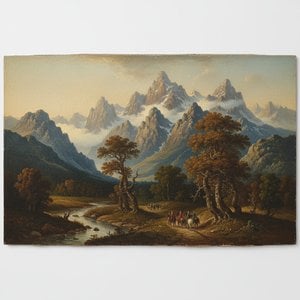
The Philosophy of the Sublime: Mountains as Mirrors of the Human Soul Peak Inspiration: 10 Breathtaking Artworks That Capture the Majesty of Mountains Introduction There is a profound, almost spiritual silence that resides within the peaks of our wor...
To stand before a mountain is to encounter a scale that defies easy measurement. In the lexicon of art history, this encounter is often described through the concept of the sublime—that specific, unsettling intersection where immense beauty meets an overwhelming sense of grandeur. It is not merely a visual experience but a psychological one, occurring when the human spirit confronts the infinite and recognizes its own fragility against the weight of geological time. This tension between terror and admiration forms the foundation of much of the landscape tradition, particularly as artists moved away from purely decorative scenery toward works that demand contemplation.
The nineteenth-century Romantic movement found its most profound expression in this very struggle. Artists sought to capture the feeling of being small beneath a vast, indifferent sky. In the works of painters like Joseph Anton Koch, we see a transition from the structured, classical landscapes of the past toward a more visceral, heroic aesthetic. His compositions often utilized dramatic lighting and rugged terrains to organize space in a way that felt both monumental and intensely personal. By blending the clarity of Neoclassim with the burgeoning fervor of Romanticism, Koch helped establish the mountain as a stage for the soul's most profound reflections.
From Sacred Backgrounds to Natural Protagonists: The Evolution of the Horizon
Alpine Landscape is an oil-on-canvas painting by Flemish painter Tobias Verhaecht. The painting was completed between 1600 and 1615, and is now in the Museum of Prado in Madrid. == Painting == The painting was painted in Antwerp between 1600 and 1615...
In the earliest stages of European painting, mountains were rarely the primary subject. During the fifteenth and sixteenth centuries, landscapes often served as mere backdrops for religious narratives, appearing as stylized, almost secondary elements in devotional works. However, a shift began to occur as the concept of the landscape as an independent genre emerged. The horizon line, once elevated and compressed to allow for more narrative detail, began to recede, granting the earth and sky a new, commanding presence.
This evolution is visible in the transition from the Weltlandschaft style to more focused naturalism. Consider the work of Tobias Verhaecht, whose Alpine Landscape, completed between 1600 and 1615, utilizes three parallel color bands of yellow, green, and blue to structure a vast, imaginary valley. While his work retains elements of the older tradition—including a castle perched on a cliff and figures engaged in hunting—the sheer scale of the terrain suggests an increasing fascination with the landscape as a protagonist. This movement toward the natural world paved the way for later masters to treat the mountain not just as a setting, but as the very essence of the painting itself.
Light, Mist, and Memory: Capturing the Ephemeral Alpine Atmosphere
A Vision of Myth and Majesty – Carl Rottmann’s Corinth with Akrocorinth Carl Anton Joseph Rottmann's “Corinth with Akrocorinth,” completed in 1847, stands as a cornerstone of Bavarian Romanticism. More than just a depiction of a mountainous landscape...
The true challenge for any landscape artist lies in the depiction of the intangible: the way light dissolves a ridge or how mist clings to a valley. Capturing these fleeting moments requires more than mere topographical accuracy; it requires an understanding of atmosphere. The mastery of light is what allows a canvas to breathe, transforming static stone into a living, changing entity.
This atmospheric precision is perhaps most evident in the works of J.M. Martin Turner, whose depictions of the Alps demonstrate a dissolution of form. In his 1842 watercolor of The Foot of Mount St. Gotthard, the boundaries between solid matter and ephemeral light begin to blur, creating a sense of movement and energy. Similarly, the use of encaustic wax by Carl Rottmann in Corinth with Akrocorinth (1847) allowed for a luminous surface that captured subtle tonal variations and a hazy, atmospheric sky. Through these techniques, the artist does not just show us a mountain; they allow us to feel the temperature of the air and the weight of the clouds.
The Human Presence in the Wild: Narratives of Solitude and Strength
James Henry Crossland: A Yorkshire Painter of Mountain Majesty James Henry Crossland (1852-1939) emerges from the heart of Victorian England as a quietly significant landscape artist, a master of capturing the rugged beauty and atmospheric drama of t...
While the mountains represent the eternal, the presence of the human figure provides the necessary scale for our empathy. Throughout art history, the placement of a lone traveler or a group of hunters serves to anchor the viewer within the vastness. These figures are often depicted in states of quiet labor or solitary contemplation, reflecting the tension between human industry and the untamed wilderness.
In the snowy landscapes of Pieter Bruegel the Elder, such as The Hunters in the Snow (1565), we see the integration of village life with a harsh, wintry environment. The hunters, trudging through the snow with their dogs, are dwarfed by the frozen ponds and distant, snow-covered peaks. This tradition continued into the nineteenth century with artists like James Henry Crossland, whose work in the Yorkshire Dales and the Welsh mountains captured the rugged beauty of rural life. His paintings often convey a palpable sense of solitude, where the weather—swirling mists or golden sunsets—becomes a character as much as the people inhabiting the land.
Geological Permanence in a Changing World: The Enduring Mountain Motif
--- title: Albert Bierstadt - Mountain Scene - American - The Metropolitan Museum of Art url: https://www.metmuseum.org/art/collection/search/10151 hostname: metmuseum.org description: Mountain Scene Albert Bierstadt (American, Solingen 1830–1902 New...
There is a profound stability in the silhouette of a mountain peak that contrasts sharply with the rapid changes of human civilization. As the Industrial Revolution transformed the European landscape, the mountain remained a symbol of the unchangeable and the absolute. This permanence has made the mountain motif a constant in art, providing a sense of continuity even as artistic styles shifted from the Renaissance to Impressionism and beyond.
Even as modern technology allows us to document every ridge with photographic precision, the painted landscape retains a unique power. The works of Albert Bierstadt, such as his Mountain Scene (1880–90), utilize oil on paper to create a sense of geological grandeur that feels both real and idealized. These works remind us that while our methods of seeing may change, the fundamental awe inspired by the earth's most ambitious reaches remains constant. The mountain serves as a bridge between the terrestrial and the celestial, a permanent fixture in an ever-shifting cultural landscape.
The Summit as Sanctuary: Integrating Grandeur into the Modern Home
Caspar David Friedrich (1774-1840): German Romantic painter of evocative landscapes & symbolic art exploring nature, spirituality & the sublime. Pioneer of the movement.
The impulse to bring the stillness of high altitudes into domestic spaces remains a constant in the history of interior curation. A landscape functions as more than an ornament; it provides a window into a different tempo of life. To hang a mountain vista is to introduce a sense of scale that contradicts the enclosure of four walls.
Caspar David Friedrich often placed his solitary figures before vast, unyielding ranges, using the landscape to anchor the viewer's internal state. This practice finds a parallel in the way we select works for our own environments today. A hand-painted oil reproduction, with its visible brushstrokes and physical depth, mirrors the ruggedness of the subject itself. The texture of the paint captures light much like the snow on a granite peak. By integrating these monumental vistas into a room, one invites the enduring strength of the peaks to become a quiet part of the daily environment.
Joseph Anton Koch (1768-1839) war ein wegweisender österreichischer Maler zwischen Klassizismus & Romantik. Bekannt für seine „heldenhaften“ Landschaften und seinen Einfluss auf die deutsche Landschaftsmalerei. Entdecken Sie sein …
Entdecken Sie die bewegenden Landschaften von Carl Rottmann – Meister der deutschen Romantik! Erforschen Sie seine mythologischen Szenen & bayerischen Ausblicke. Eine Schlüsselfigur der Kunst des 19. Jahrhunderts.
Entdecken Sie 10 ikonische Meisterwerke der romantischen Landschaftsmalerei. Von Caspar David Friedrich bis John Constable – erleben Sie die emotionale Kraft des Erhabenen. Finden Sie museale Kunstreproduktionen für Ihr Zuhause auf ArtsDot.com. Jetzt Kollektion entdecken!
Explore the history of mountain painting! Discover Romantic masterpieces & key artists like Dahl & Calame. Learn about the Sublime & Picturesque aesthetics and find your perfect artwork at ArtsDot.
AStudio-AssistentOnline · antwortet innerhalb einer Minute
Hallo! Ich kann Ihnen dabei helfen, ein Kunstwerk auszuwählen, eine Bestellung zu verfolgen oder Fragen zur Garantie zu beantworten. Wie kann ich Ihnen heute behilflich sein?



 Majestic Peaks: A Definitive Guide to the Sublime Alpine Landscapes of Art History
 Alpine Landscape
 Corinth with Akrocorinth
 James Henry Crossland
 Caspar David Friedrich